


Gospel in Art: This is the heir. Come, let us kill him
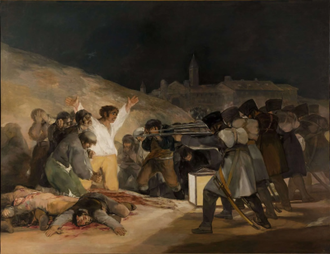
The Third of May 1808 by Francisco José de Goya y Lucientes, 1814 © Museo del Prado, Madrid
Source: Christian Art
Gospel of 6 March 2026
Matthew 21:33-43, 45-46
At that time: Jesus said to the chief priests and the elders of the people, 'Hear another parable. There was a master of a house who planted a vineyard and put a fence round it and dug a wine press in it and built a tower and leased it to tenants, and went into another country. When the season for fruit drew near, he sent his servants to the tenants to get his fruit. And the tenants took his servants and beat one, killed another, and stoned another. Again he sent other servants, more than at first. And they did the same to them. Finally he sent his son to them, saying, "They will respect my son." But when the tenants saw the son, they said to themselves, "This is the heir. Come, let us kill him and have his inheritance." And they took him and threw him out of the vineyard and killed him. When therefore the owner of the vineyard comes, what will he do to those tenants?'
They said to him, 'He will put those wretches to a miserable death and let out the vineyard to other tenants who will give him the fruits in their seasons.'
Jesus said to them, 'Have you never read in the Scriptures: "The stone that the builders rejected has become the cornerstone; this was the Lord's doing, and it is marvellous in our eyes"? Therefore I tell you, the kingdom of God will be taken away from you and given to a people producing its fruits.'
When the chief priests and the Pharisees heard his parables, they perceived that he was speaking about them. And although they were seeking to arrest him, they feared the crowds, because they held him to be a prophet.
Reflection on the painting
In the parable Jesus tells, we encounter a lot of violence. The servants of a landowner are sent to collect the harvest from his vineyard, but the tenants turn on them and kill them. Then, in an even more shocking act, they kill the landowner's own son, imagining that by doing so they can seize the vineyard for themselves. At the root of their violence lies greed, a desire to possess what is not theirs. We recognise something of this in our own world. Look at all the wars raging in the world today. Violence today is often driven by the same forces: jealousy, anger, and the hunger for control. Scripture, in this way, holds up a mirror to every age, including our own.
Yet the parable also points beyond itself. Jesus is speaking, in part, about his own rejection: how he, the Son, will be cast aside and put to death. And still, violence does not have the final word. And then Jesus quotes the psalms, which he was of course very family with: "the stone rejected by the builders has become the cornerstone" (Psalm 118:22). God transforms rejection into new life! These readings remind us that even when darkness seems to prevail, God is still quietly at work, bringing life out of loss.
According to global conflict data from the UN, there are over 50 active armed conflicts taking place across the world, the highest number recorded since the Second World War. Tens of thousands of people are killed each year as a direct result of warfare, and millions more are displaced, forced to flee their homes in search of safety. Today we pray for all the victims.
Probably one of the most famous painting depicting the horrors of war, is our painting by Goya. The Third of May 1808 by Francisco Goya captures the brutal aftermath of a failed Spanish uprising against Napoleon's occupying forces. In the painting, a group of Spanish civilians are being executed by a firing squad of faceless French soldiers, their backs turned to us, forming a cold, mechanical wall of violence. At the centre stands a man in a white shirt, arms outstretched in a pose that recalls Christ on the Cross, illuminated by a big lantern in font of the soldiers. His expression is one of terror and surrender, while others around him cower or lie already dead. The painting has become famous because it does not glorify war, but exposes its horror. The painting strips away heroism and shows instead the raw suffering of innocent people.
LINKS
Christian Art: https://christian.art/
Today's reading: https://christian.art/daily-gospel-reading/matthew-21-33-43-45-46-2026/
 Facebook
 Twitter
 LinkedIn
 Print
Print Email
Email













 Facebook
 Twitter
 YouTube
 LinkedIn
 Pinterest