


Gospel in Art: Commemoration of Saint Polycarp, Bishop and Martyr
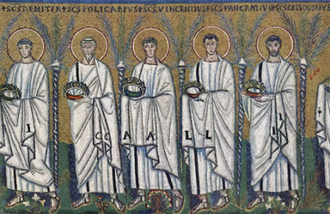
Five Early Saints. St Polycarp (second from left). Basilica of Sant'Apollinare Nuovo, Ravenna, Italy (AD 493-526), with later Byzantine modifications. ©Christian Art
Source: Christian Art
Gospel of 23 February 2026
Matthew 25:31-46
At that time: Jesus said to his disciples, 'When the Son of Man comes in his glory, and all the angels with him, then he will sit on his glorious throne. Before him will be gathered all the nations, and he will separate people one from another as a shepherd separates the sheep from the goats. And he will place the sheep on his right, but the goats on the left. Then the King will say to those on his right, "Come, you who are blessed by my Father, inherit the kingdom prepared for you from the foundation of the world. For I was hungry and you gave me food, I was thirsty and you gave me drink, I was a stranger and you welcomed me, I was naked and you clothed me, I was sick and you visited me, I was in prison and you came to me." Then the righteous will answer him, saying, "Lord, when did we see you hungry and feed you, or thirsty and give you drink? And when did we see you a stranger and welcome you, or naked and clothe you? And when did we see you sick or in prison and visit you?" And the King will answer them, "Truly, I say to you, as you did it to one of the least of these my brothers and sisters, you did it to me."
'Then he will say to those on his left, "Depart from me, you cursed, into the eternal fire prepared for the devil and his angels. For I was hungry and you gave me no food, I was thirsty and you gave me no drink, I was a stranger and you did not welcome me, naked and you did not clothe me, sick and in prison and you did not visit me." Then they also will answer, saying, "Lord, when did we see you hungry or thirsty or a stranger or naked or sick or in prison, and did not minister to you?" Then he will answer them, saying, "Truly, I say to you, as you did not do it to one of the least of these, you did not do it to me." And these will go away into eternal punishment, but the righteous into eternal life.'
Reflection on the Early Mosaics
Today we celebrate Saint Polycarp. In our radiant early Christian mosaic from the Basilica of Sant'Apollinare Nuovo, Ravenna, a solemn procession of martyrs (from left to right: Saint Demetrius of Thessaloniki, Saint Polycarp, Saint Vincent of Saragossa, Saint Pancras of Rome, and Saint Chrysogonus) moves rhythmically across a shimmering gold background. Each saint carries a crown, the symbol of martyrdom understood not as defeat but as victory. Their white garments against the gold ground create an atmosphere that is almost outside of time: these are not portraits of earthly individuals but images of the heavenly Church. The palm trees placed between them evoke Paradise, while the repetition of figures expresses unity: a reminder that sanctity is never solitary but always communal.
Ravenna itself is crucial to the history of Christianity because it stood at the crossroads between East and West during the collapse of the Western Roman Empire. In the 5th and 6th centuries it became a political and spiritual capital, first under the Ostrogothic kings and later under Byzantine rule. This unique position allowed early Christian art here to fuse Roman naturalism with Byzantine symbolism, giving birth to mosaics that glow with theological meaning. The gold backgrounds are not merely decorative; they signify divine light, eternity breaking into history. These mosaics are among the earliest large-scale visual catechisms of the Church. Ravenna's churches and their magnificent mosaics therefore mark a turning point in Christian art: from storytelling rooted in earthly space toward imagery that lifts the faithful's gaze toward the eternal kingdom.
Saint Polycarp, Bishop of Smyrna in the 2nd century, stands as one of the most important bridges between the Apostles and the later Church. According to early tradition, he was a disciple of John the Apostle, which means that in Polycarp we almost touch the generation that knew Christ personally. At a time when Christian teaching was still being formed and defended, he became a guardian of apostolic faith, helping the Church hold fast to what had been handed down rather than drifting into new interpretations.
A lovely anecdote from his martyrdom shows why he became such a beloved witness. When arrested and brought before the Roman authorities, he was urged simply to curse and deny Christ in order to save his life. Polycarp replied with calm courage: "Eighty-six years have I served him, and he has done me no wrong. How can I blaspheme my King who saved me?" Rather than dramatic defiance, it was the quiet loyalty of a lifetime that marked him. His death around AD 155 became one of the earliest recorded martyrdom accounts, strengthening Christians across the Roman world. In Polycarp we see not only heroic courage at the end, but steady faithfulness over many years; a reminder that holiness is often forged in daily perseverance long before it is revealed in moments of trial.
LINKS
Christian Art: https://christian.art/
Today's reading: https://christian.art/daily-gospel-reading/matthew-25-31-46-2026/
 Facebook
 Twitter
 LinkedIn
 Print
Print Email
Email











 Facebook
 Twitter
 YouTube
 LinkedIn
 Pinterest