


Gospel in Art: Why do you eat and drink with tax collectors and sinners?
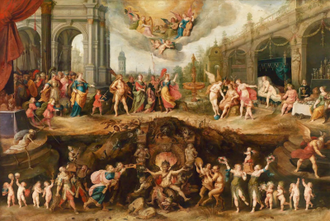
Mankind's Eternal Dilemma - The Choice Between Virtue and Sin, by Frans Francken the Younger, 1633, oil on panel © Dorotheum Vienna
Source: Christian Art
Gospel of 21 February 2026
Luke 5:27-32
At that time: Jesus saw a tax collector named Levi, sitting at the tax booth. And he said to him, 'Follow me.' And leaving everything, he rose and followed him.
And Levi made him a great feast in his house, and there was a large company of tax collectors and others reclining at table with them. And the Pharisees and their scribes grumbled at his disciples, saying, 'Why do you eat and drink with tax collectors and sinners?' And Jesus answered them, 'Those who are well have no need of a physician, but those who are sick. I have not come to call the righteous but sinners to repentance.'
Reflection on the painting
Questions run all through the Gospels, such as the 'why' question we looked at yesterday. Jesus asks questions, his followers ask questions, and so do those who struggle to understand him. In today's Gospel, the scribes and Pharisees challenge Jesus' disciples: "Why do you eat with tax collectors and sinners?" To their way of thinking, sharing a table with such people risked moral compromise. They believed holiness required distance, even separation - and it is telling that the very name "Pharisee" carries the idea of being set apart ( the word "Pharisee" comes from a Hebrew word meaning "to separate" or "to set apart."). Yet Jesus sees things differently. He knew that rather than the sin of others infecting him, his goodness would transform others. He is not afraid of being diminished by those he meets; rather, his presence has the power to restore.
This is still true in our own lives. Christ is never weakened by our failures or our brokenness. Instead, whenever we draw near to him, it is we who are lifted up and transformed by his goodness. That is why he never withdraws from us, even when shame or fear might tempt us to keep our distance. His holiness does not push us away; it continually reaches out, inviting us back into communion with him.
Our perception of what sin is, is at the centre of our reading. The choice we face each day between sin and virtue is dramatically depicted in our painting from 1633 by Franz Francken. The artist paints a dramatic allegorical vision of the human soul standing at a crossroads. At the centre of this vast and crowded composition, a lone figure must decide between two paths: one leading upward toward divine light and heavenly joy, the other descending into confusion, pleasure, and eventual ruin. Around him swirl mythological figures, personifications of virtue, seductive symbols of wealth and power, and darker images of death and judgement. Francken weaves together classical mythology and Christian theology so seamlessly that the scene feels like a visual meditation on the turmoil that sometimes goes on in our souls. Every gesture, every object every figure in our painting is quietly asking the viewer, Which way will you go?
What makes the painting so compelling is that it does not feel distant or abstract. The struggle between virtue and vice is not only the drama of this painted figure; it is our own daily interior battle. The artist reminds us that the path to holiness is rarely obvious or effortless. Temptations glitter, distractions multiply, and the noise of the world can drown out the gentle call of grace. Yet, amid the complexity, rays of divine light still break through, implying that God's invitation is always present.
LINKS
Christian Art: https://christian.art/
Today's reading: https://christian.art/daily-gospel-reading/luke-5-27-32-2026/
 Facebook
 Twitter
 LinkedIn
 Print
Print Email
Email






 Facebook
 Twitter
 YouTube
 LinkedIn
 Pinterest