


Gospel in Art: Do you not yet understand?
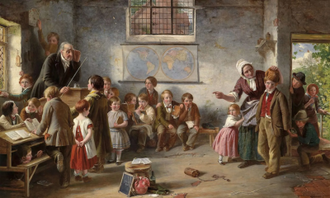
The New Pupil, by Thomas Brooks, 1854 © Dorotheum Auctions, Vienna
Source: Christian Art
Gospel of 17 February 2026
Mark 8:14-21
At that time: The disciples had forgotten to bring bread, and they had only one loaf with them in the boat. And he cautioned them, saying, 'Watch out; beware of the leaven of the Pharisees and the leaven of Herod.' And they began discussing with one another the fact that they had no bread. And Jesus, aware of this, said to them, 'Why are you discussing the fact that you have no bread? Do you not yet perceive or understand? Are your hearts hardened? Having eyes do you not see, and having ears do you not hear? And do you not remember? When I broke the five loaves for the five thousand, how many baskets full of broken pieces did you take up?' They said to him, 'Twelve.' 'And the seven for the four thousand, how many baskets full of broken pieces did you take up?' And they said to him, 'Seven.' And he said to them, 'Do you not yet understand?'
Reflection on the painting
Just before the Gospel scene we have heard, Jesus has fed a crowd of four thousand with seven loaves and a few small fish. And yet, as the disciples cross the Sea of Galilee, they are anxious because they have only one loaf with them in the boat. They completely miss the point of Jesus' warning about the leaven of the Pharisees and of Herod, taking his words in a painfully literal way. Leaven, in the Scriptures, always refers to 'a hidden influence at work beneath the surface', slowly shaping hearts and minds. Thuis leaven can be for the good or the bad. Mark presents Jesus here as deeply exasperated, frustrated (just like in yesterday's Gospel reading) firing off a series of questions like a teacher struggling to get through to a class that simply isn't listening. The disciples have seen miracles with their own eyes, and still they fail to understand.
And yet, what shines through this passage is not the disciples' blindness, but Jesus' extraordinary faithfulness. He does not abandon them, even though they will later desert him at the moment of his Passion. Instead, he seeks them out again after the Resurrection, renewing their calling and restoring their trust. Mark's brutally honest portrayal of the disciples can be a great comfort to us. Their slowness to hear and their failure to see, reveals the steadfast love of Jesus for them, always sticking with his disciples and encouraging them, despite getting very frustrated at times. The same Jesus who remained faithful to them remains faithful to us still. He keeps coming towards us, inviting us to begin again, and promising that if we try to follow him, he will give us all the spiritual nourishment we need for the journey.
A charming and gently humorous depiction of a teacher struggling to get through to his class is found in this canvas by Thomas Brooks, painted in 1854. The scene captures the arrival of a new boy in the classroom, already showing signs of mischief rather than eagerness to learn. He hides a bird's nest behind his back, discreetly passing it to another pupil (an act likely to win him popularity). Around him, the classroom is alive with small rebellions: one boy eats from an apple; a wine bottle lurks in the middle of the floor; and another child, hiding under a bench, busies himself painting onto a classmate's trousers. The room feels unruly and chaotic, yet irresistibly engaging. There is a sense that the lesson is being lost amid the distractions, and that the teacher, however patient, is failing to command the full attention of his pupils. In much the same way, the disciples often appear distracted and unfocused, losing sight of the task before them. And yet, it is precisely this human vulnerability, this tendency to be pulled in different directions, that makes them so engaging and so easy for us to recognise ourselves in them.
LINKS
Christian Art: https://christian.art/
Today's reading: https://christian.art/daily-gospel-reading/mark-8-14-21-2026/
 Facebook
 Twitter
 LinkedIn
 Print
Print Email
Email

















 Facebook
 Twitter
 YouTube
 LinkedIn
 Pinterest