


Gospel in Art: A woman whose little daughter had an unclean spirit
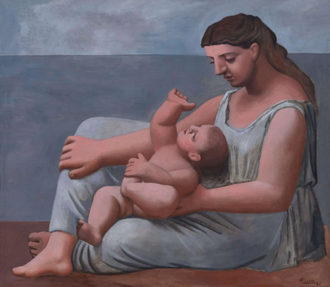
Mother and Child, by Pablo Picasso, 1921, oil on canvas © Alamy / Art Institute of Chicago
Source: Christian Art
Gospel of 12 February 2026
Mark 7:24-30
At that time: Jesus arose and went away to the region of Tyre and Sidon. And he entered a house and did not want anyone to know, yet he could not be hidden. But immediately a woman whose little daughter had an unclean spirit heard of him and came and fell down at his feet. Now the woman was a Gentile, a Syrophoenician by birth. And she begged him to cast the demon out of her daughter. And he said to her, 'Let the children be fed first, for it is not right to take the children's bread and throw it to the dogs.' But she answered him, 'Yes, Lord; yet even the dogs under the table eat the children's crumbs.' And he said to her, 'For this statement you may go your way; the demon has left your daughter.' And she went home and found the child lying in bed and the demon gone.
Reflection on the painting
In today's Gospel reading, we hear about a mother burdened with worry. Her 'little daughter' was possessed by an unclean spirit. The term 'little daughter,' used by Mark the Evangelist, conveys tenderness and emphasises the girl's youth. How heartbreaking it must have been for someone so young, an age meant for playing and carefree joy, to be oppressed by such a terrible affliction. It is no wonder her mother was desperate, determined to do whatever it took to set her child free. For a mother, nothing compares to the joy of watching her children flourish, grow, and blossom into the fullness of their humanity. Yet this mother's joy was robbed by the presence of something evil, and in her desperation, she took the bold step of approaching Jesus. Her resolve and her faith shine through in her determined act of approaching Jesus. She believed He could heal.
Her faith is remarkable for its simplicity. She had a problem, and she turned to Jesus. That was all. She came with nothing to offer, no claims to make. She can with only a complete dependence on his mercy. Jesus, recognising her profound humility and unwavering faith, responded to her plea and healed her daughter.
This encounter reminds us of the power of a mother's love. Motherhood, in all its tenderness, is beautifully captured in Picasso's Mother and Child (1921). In 1917 Picasso travelled to Rome to design sets and costumes for Sergei Diaghilev's Ballets Russes, and there he was deeply struck by the art of antiquity. Out of this encounter emerged his so-called "classical period," marked by monumental figures, calm compositions, and a renewed sense of classical order. At the same time, Picasso's own life was changing: he had married the Russian dancer Olga Khokhlova, and in 1921 they welcomed their son, Paolo. Mother and child became a recurring subject, and between 1921 and 1923 Picasso returned to it again and again.
Unlike the fragile, sorrowful figures of his Blue Period, these mother-and-child images are solid, sculptural, and serene. Here, the infant sits confidently on his mother's lap, reaching up to touch her, while she gazes at him with quiet intensity. Clothed in a Roman gown, the mother recalls classical sculpture, rooted and timeless, set against a simplified landscape of sand, sea, and sky. The scene is not sentimental, yet it radiates tenderness. Picasso presents motherhood not as anguish, but as strength and continuity.
LINKS
Christian Art: https://christian.art/
Today's reading: https://christian.art/daily-gospel-reading/mark-7-24-30-2026/
 Facebook
 Twitter
 LinkedIn
 Print
Print Email
Email















 Facebook
 Twitter
 YouTube
 LinkedIn
 Pinterest