


Gospel in Art: The people ran and began to bring the sick people to Jesus
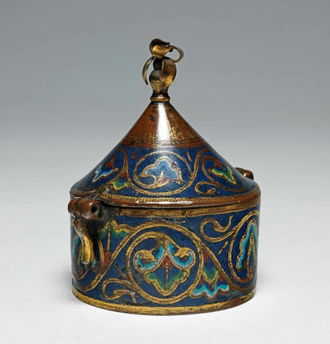
Copper, champlevé pyx, 1200 -1300 © The Fitzwilliam Museum, Cambridge
Source: Christian Art
Gospel of 9 February 2026
Mark 6:53-56
At that time: When they had crossed over, Jesus and his disciples came to land at Gennesaret and moored to the shore. And when they got out of the boat, the people immediately recognised him and ran about the whole region and began to bring the sick people on their beds to wherever they heard he was. And wherever he came, in villages, cities, or countryside, they laid the sick in the market-places and implored him that they might touch even the fringe of his garment. And as many as touched it were made well.
Reflection on the Medieval Pyx
This morning's Gospel paints a vivid scene of people streaming towards Jesus and his disciples in great numbers. They hurry across the countryside to reach him, but they do not come alone. They carry the sick on stretchers, bringing them to wherever Jesus happens to be, laying them in open spaces along his path. Those who are unable to move for themselves are carried by others, and once there, they beg only to touch the fringe of his cloak, trusting that even this will be enough to be healed.
That image speaks powerfully to us today: the healthy, those strong enough to run, bringing the sick to Jesus. There are many moments in life when we can do for others what they cannot do for themselves. This happens quietly every day in our parishes and homes: when a spouse cares for her husband who has grown frail; when children look after ageing parents; when neighbours visit the housebound; or when parishioners bring Holy Communion to those who cannot come to church. In all these simple yet profound acts, today's Gospel is lived again. Just as the people once carried the sick to Jesus, we now bring Jesus to the sick. So today is maybe a nice day to pray for all eucharistic ministers active in our parishes and for all they do.
The eucharistic ministers use a pyx to bring Holy Communion to the sick and housebound. A pyx is a small, portable vessel (usually made of silver or gilt metal). Designed to be both secure and reverent, it has a tight-fitting lid. The older models were meant to be worn on a cord around the neck (the older pyxes often have a loop opening for this purpose), keeping the Eucharist close to the heart of the minister. Its use reaches back to the early centuries of the Church, when Christians would take the consecrated Host from the community's celebration of the Eucharist to those unable to be present, especially the sick and those the imprisoned. The pyx became a quiet but powerful reminder that Christ is not confined to the sanctuary but is carried into homes, hospital rooms, and places of suffering, bringing his real presence to those most in need.
Our enamelled champlevé pyx (circa 1200-1300) is a beautiful medieval vessel used to carry the consecrated Host. Made of copper with richly coloured enamels it features a conical lid and elegant scrolling foliage decoration typical of Gothic Limoges enamel work. What makes this piece especially striking is the set of small loops cast into the body and lid of the pyx: these would have allowed it to be worn around the neck on a cord.
LINKS
Christian Art: https://christian.art/
Today's reading: https://christian.art/daily-gospel-reading/mark-6-53-56-2026/
 Facebook
 Twitter
 LinkedIn
 Print
Print Email
Email















 Facebook
 Twitter
 YouTube
 LinkedIn
 Pinterest