


Gospel in Art: You are the salt of the earth
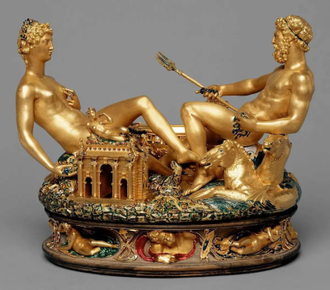
The Cellini Salt Cellar, made by Benvenuto Cellini, 1540-1543 © Kunsthistorisches Museum Vienna
Source: Christian Art
Gospel of 8 February 2026
Matthew 5:13-16
At that time: Jesus said to his disciples, 'You are the salt of the earth, but if salt has lost its taste, how shall its saltiness be restored? It is no longer good for anything except to be thrown out and trampled under people's feet.
'You are the light of the world. A city set on a hill cannot be hidden. Nor do people light a lamp and put it under a basket, but on a stand, and it gives light to all in the house. In the same way, let your light shine before others, so that they may see your good works and give glory to your Father who is in heaven.'
Reflection on the Salt Cellar
To describe someone as "the salt of the earth" is one of the highest compliments we can offer. We mean a person who is dependable, generous, kind and brings steadiness and goodness into the lives of others. Today, salt is often spoken of negatively, something to be limited or avoided for health reasons. But in the time of Jesus, salt was highly valued. It preserved food, prevented decay, and brought flavour where there would otherwise be none. That positive, life-giving role lies behind the expression Jesus uses in our Gospel reading today.
When Jesus says to his disciples, "You are the salt of the earth," he is not setting a distant goal but naming a present reality. Note how Jesus doesn't say 'you are to become the salt of the earth', but 'you ARE the salt of the earth'. It means each of us ARE already someone special, even before we become who God wants us to be. Jesus is, in effect, reminding us of our identity and our dignity: do not underestimate yourselves, do not forget what you have received, and who you are: you are special. And if this is who we are, then our calling is clear: to live in a way that preserves what is good and add the quiet flavour of Christ to the world around us.
On the tables of the wealthy, salt was presented not in an ordinary bowl but in a silver 'salt cellar'. In medieval Europe, these objects were far more than just practical utensils. Salt was expensive and precious, and the salt cellar became a marker of status. On grand tables, a large and often richly decorated standing salt was placed near the host, while lesser guests sat "below the salt," receiving their portion from smaller, simpler vessels. Crafted by skilled silversmiths, these salt cellars were designed to be seen: ornate and proudly displayed as signs of wealth.
A particularly striking museum example is the Cellini Salt Cellar (1543), now in the Kunsthistorisches Museum in Vienna. Made of gold rather than silver, it represents the pinnacle of 16th century silver-and goldsmith-making, transforming a functional object into a masterpiece of Renaissance art. Designed for King Francis I of France by Benvenuto Cellini, it features allegorical figures of Earth (the woman on the left holding grass in one hand) and Sea (the male figure on the right holding a trident), uniting salt and gold as symbols of power and abundance. While living at the French King's court (and before he moved to Florence to work for the Medici family), Cellini made the salt cellar, along with the assistance of five other artists (two from Italy, two from France, and one artist from Germany). Unfortunately many Renaissance gold-smithery works, including several made by Cellini (known to us solely because of his descriptions in his autobiography), were melted down. This piece was almost melted down and destroyed in 1562, but thankfully has survived.
LINKS
Christian Art: https://christian.art/
Today's reading: https://christian.art/daily-gospel-reading/matthew-5-13-16-2026/
 Facebook
 Twitter
 LinkedIn
 Print
Print Email
Email


















 Facebook
 Twitter
 YouTube
 LinkedIn
 Pinterest