

Gospel in Art: Baptise them in the name of the Father, the Son and Holy Spirit
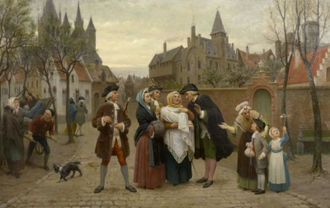
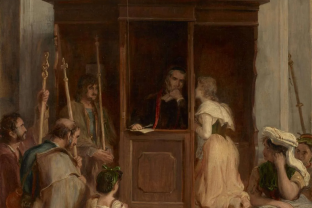
A Baptism in Flanders in the 18th Century, Félix De Vigne © Museum of Fine Arts Ghent, Belgium
Source: Christian Art
Gospel of 6 February 2026
Matthew 28:16-20
At that time: The eleven disciples went to Galilee, to the mountain to which Jesus had directed them. And when they saw him they worshipped him, but some doubted. And Jesus came and said to them, 'All authority in heaven and on earth has been given to me. Go, therefore, and make disciples of all nations, baptising them in the name of the Father and of the Son and of the Holy Spirit, teaching them to observe all that I have commanded you. And behold, I am with you always, to the end of the age.'
Reflection on the painting
Our short reading today is read at the Feast of the Most Holy Trinity. This is also the reading for the Ascension of Our Lord. Plus thsi reading is the main scriptural basis for the Sacrament of Baptism. It is also the primary scriptural foundation for the sacrament of baptism in Christian theology. In this passage, Jesus commands his disciples to make disciples of all nations, explicitly instructing them to baptise new believers in the name of the Father, the Son and the Holy Spirit. So it is quite the passage!
The command to "make disciples of all nations, baptising them in the name of the Father, and of the Son, and of the Holy Spirit"marks a seismic moment. The baptism offered by John the Baptist was only a baptism of repentance: a powerful sign of conversion and readiness, but ultimately only 'preparatory'. John himself was clear that his baptism could not give what only Christ could bestow. What Jesus institutes in our reading here is something entirely new: baptism not merely into repentance, but into God himself, into the life of the Trinity... it makes us entirely new!
Theologically, Christian Baptism is not just the forgiveness of sins (as per the baptisms Saint John was administering), though that is central; it is a radical transformation of the person. Through baptism, we are united to Christ's death and resurrection, clothed in a new identity, and reborn as children of God. The Church has always understood this as a true re-creation: the old self is washed away, and a new life is given, like being wrapped in an entirely new garment. For this reason, Baptism is the gateway to all the other sacraments. It configures us to Christ, incorporates us into his Body, the Church, and opens the way for the Eucharist, Confirmation, and the full sacramental life. In baptism, we are not simply cleansed, we are changed!
Our painting is by Flemish artist Félix De Vigne. Alongside his work as a painter, he was also a respected historian. He even authored and illustrated a guide to medieval costume. In our painting 'A Baptism in Flanders in the 18th Century', De Vigne consciously looks back in time. The figures are dressed in authentic eighteenth-century fashion, and the newly baptised child's family is presented as part of the prosperous middle class. This affluence is deliberately contrasted with a group of homeless figures on the left of the composition, a visual opposition that reflects a broader nineteenth-century concern with the divide between rich and poor.
LINKS
Christian Art: https://christian.art/
Today's reading: https://christian.art/daily-gospel-reading/matthew-28-16-20-2026/
 Facebook
 Twitter
 LinkedIn
 Print
Print Email
Email




 Facebook
 Twitter
 YouTube
 LinkedIn
 Pinterest