


Gospel in Art: How are such mighty works done by his hands?
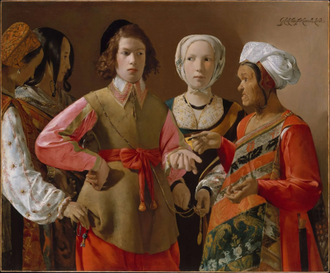
The Fortune Teller, by Georges de La Tour, 1630 © Metropolitan Museum of Art, New York
Source: Christian Art
Gospel of 4 February 2026
Mark 6:1-6
At that time: Jesus came to his home town, and his disciples followed him. And on the Sabbath he began to teach in the synagogue, and many who heard him were astonished, saying, 'Where did this man get these things? What is the wisdom given to him? How are such mighty works done by his hands? Is not this the carpenter, the son of Mary and brother of James and Joses and Judas and Simon? And are not his sisters here with us?' And they took offence at him. And Jesus said to them, 'A prophet is not without honour, except in his home town and among his relatives and in his own household.' And he could do no mighty work there, except that he laid his hands on a few sick people and healed them. And he marvelled because of their unbelief. And he went about among the villages teaching.
Reflection on the painting
For nearly thirty years, Jesus lived an ordinary life in Nazareth. He was known simply as the carpenter, the son of Mary, someone familiar and unremarkable in the eyes of his neighbours. But when he left Nazareth, his life took a decisive turn. He devoted himself fully to the work the Father had entrusted to him. He departed as a craftsman; he returned as a teacher and a healer. There was far more to Jesus than those who had grown up with him had ever imagined.
The Gospel suggests that this was precisely the problem. When Jesus came back, the people of Nazareth struggled to accept this deeper reality. They clung to the old version of him they thought they knew and could not make room for anything more. Their fixed image of Jesus became an obstacle to faith. Yet this is true not only of him, but of every human being. There is always more to a person than we can see or understand, even those closest to us. Made in the image of God, each life carries a mystery that can never be fully grasped. There is much more to every person we meet. Hence we should be careful jumping too quickly to any conclusions about anyone we meet.
Georges de La Tour's The Fortune Teller, circa 1630, is a masterclass in warning us against judging too quickly. At first glance, the scene appears straightforward: a young man has his palm read by a fortune teller. Yet as we look more closely, the painting unravels much more. While the youth is distracted, others quietly steal from him, and the fortune teller herself seems less a bearer of wisdom than being part of a deception. The woman is stealing the coin purse from his pocket, while her companion in profile has a pair of scissors and cuts a gold coin from his belt. De La Tour draws the viewer into the same trap as the young man: we think we understand what is happening, only to discover that there is far more beneath the surface. Notice how all the hands are aligned along a single horizontal band... each hand telling part of the story, and not a very flattering one.
LINKS
Christian Art: https://christian.art/
Today's reading: https://christian.art/daily-gospel-reading/mark-6-1-6-2026/
 Facebook
 Twitter
 LinkedIn
 Print
Print Email
Email

















 Facebook
 Twitter
 YouTube
 LinkedIn
 Pinterest