


Ian Linden: Turning ploughshares into swords
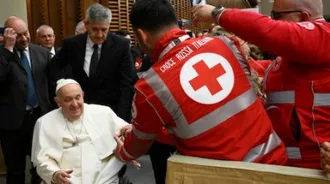
Pope Francis meets Italian Red Cross volunteers. Image: Vatican Media Divisione Foto
At a rough estimate, the Church runs 3,100 hospitals and 15,000 clinics in the Least Developed Countries (LDCs). From Pope John XXII's Mater et Magistra in 1961 to Pope Leo's Fratelli Tutti in 2020, the Church has consistently called the rich nations to action: supporting the poorest, engaging their citizens in development, reducing indebtedness, extending the outreach and effectiveness of the Catholic agencies under the CARITAS INTERNATIONALIS umbrella (founded in 1951), and seeking integral human development for all.
If you were called to sum up in just three words what Catholic Social Teaching was about, you'd do no better than 'Solidarity', 'Justice' and 'Compassion'. And if you were to find four words most used to oppose NGO international development agencies and Official Development Assistance (ODA) it would be "Charity Begins at Home". The natural commitment to family, friends and community has been set up against helping the poorest overseas, either-or instead of and-and. Who wants to join J.D. Vance in his justification for cutting aid? Sadly increasing numbers.
Last year, Elon Musk froze some $58 billion in US ODA allocated for 2025: in other words for poverty alleviation, emergency humanitarian interventions, conflict prevention, peacebuilding, global public goods such as health care and vaccination, or climate action. Out of a total payroll of 10,000, 1,200 USAID staff were fired and 4,200 put on 'administrative leave'. Meanwhile substantial buildings occupied by USAID were handed over to Customs and Border Patrol.
The US Government's only compliment to virtue was certain temporary waivers to cuts. Parts of infrastructure were left standing amongst the wreckage of Federal foreign aid. The priorities were telling. Most of the temporary exemptions related to the spending of the Bureau of International Narcotics and Law Enforcement Affairs and the State Department's Bureau of Political-Military Affairs. After 13 February 2025, the latter received exemption for $5.3 billion expenditure of which $4.1 billion went to Israel and Egypt, plus more moderate sums to Taiwan and the Philippines' military. The announced USAID exemptions for - non-food - aid to Gaza, were $78 million and $156 million for the Red Cross's work.
PEPFAR, the President's Emergency Plan For AIDS, launched by President G.W. Bush in 2003, is estimated to have saved 26 million lives around the world. It was operating in 2025 on 8% of its 2024 budget of $6.5 billion with consequences that hardly need spelling out. The waiver covered - in theory - all aspects of provision: antiretrovirals, testing, treatment and supply-chains. But the disruption caused by a 90 day freeze, let alone long term consequences, cost lives. Money to pay local NGO staff suddenly disappeared globally with an immediate halt to their work amongst some of the world's poorest people.
Global aid flows, currently between $170-180 billion, rose between 2019-2023 then dropped by 9% in 2024 and are currently falling at somewhere between 9-17%. The UN Coordination of Humanitarian Affairs (UNOCHA) calculate 239 million people currently require humanitarian aid. Between 2016-2019, UNOCHA reached some 130 million people but now has to adopt a prioritization programme for the very poorest, serving only 87 million, though hoping to return to 130 million in the future. OXFAM's statistics have a more powerful impact ; due to the US aid cuts "a child under five could die every forty seconds by 2030".
The justification for US aid cuts is allegedly to reduce national debt. Trump's acolytes complained about what they called 'woke' projects funded by USAID. Would funding a feminist theatre company who, amongst their performances role play preventative health care, be 'woke' and suspect? Women, of course, play an important educational role in health. Even giving 'woke' the widest interpretation, projects that might be eligible for this description amount to an infinitesimal percentage of overall expenditure on aid. And when a tiny fraction of a State institution's activities are ill-judged, most people living in the real world would say such institutions were doing well.
Aid is used to strengthen health systems. HIV, Ebola (funding for prevention frozen then re-instated), Marburg, West Nile and new lethal viruses do not respect borders. Can't aid-detractors recognise even self-interest?
There is the recurrent claim that development aid doesn't work because it hasn't jump-started the economies of poor countries. If that is the criterion, one reply is that it rarely has been given a chance to work. War, bad governance, and endemic corruption blight economic development. If you need to bribe your way through several roadblocks to get to and into a port, export growth will be stunted. Dealing with a wide range of problems, development aid, which encompasses many different and vital interventions, makes a major contribution to human well-being.
It does contribute to economies. Timely peace-building can avert war and subsequent collapse of the economy. If half the workforce is infected with malaria - thousands of their children dying from it - this harms productivity. As the CEO of an international aid NGO working in three continents, I've stood admiring trained senior women in West African villages, some of them illiterate, chatting to mothers as the sun went down, cleverly passing on health messages that reduce infections. Bonny babies in bathtubs, midwives learning literacy and becoming better midwives, were a living testimony to the effectiveness of supporting health systems, providing finance and upskilling.
In the UK, Sir Keir Starmer's decision to reduce the ODA budget, between 2025-2027/8, from 0.5% to 0.3% of UK Gross National Income (GNI), came after a reduction from 0.7% to 0.5% made by Conservative Governments. Some 25% of this diminishing budget is still being spent on accommodating refugees in the UK. In 2027/2028, Defence will be extracting £6.5 billion - not including funding for Ukraine - from today's £14 billion aid budget
The need for increased defense spending is itself a knock-on from the policies of the Trump Presidency. The UK Government's mantra "this is a difficult decision" neglects mentioning the choice of alternative difficult decisions, such as wealth taxes - which come with greater political costs. GNI percentage cuts, but less severe, have also been made in Germany, Europe's other major donor, from its much higher peak of £28.5 billion in 2022.
No-one denies that despite foreign governmental and NGO funding for development, in much of Africa and parts of Asia, populations remain mired in poverty. But this does not justify slashing development aid least of all treating it as if it were a criminal enterprise, what President Trump called "the left-wing scam known as USAID" ?
The causes of poverty are complex. As a result the mix of international development aid needed to reduce poverty is complex. Because it takes place abroad, the vast majority of people cannot directly see its benefits and can be misinformed. We seem light years from Live Aid's response to the Ethiopian famine in 1985.
Two final questions: Will our children and grandchildren be living in a world in which powerful States deny our common humanity - with further devastating consequences? If and when they are told in school to consult the Oxford English Dictionary - or will it be AI - do we want them to find 'archaic' in brackets next to the word 'compassion'? We may not have long to determine the answers.
Professor Ian Linden is Visiting Professor at St Mary's University, Strawberry Hill, London. A past director of the Catholic Institute for International Relations, he was awarded a CMG for his work for human rights in 2000. He has also been an adviser on Europe and Justice and Peace issues to the Department of International Affairs of the Catholic Bishops Conference of England and Wales. Ian chairs a new charity for After-school schooling in Beirut for Syrian refugees and Lebanese kids in danger of dropping out partnering with CARITAS Lebanon and work on board of Las Casas Institute in Oxford with Richard Finn OP. His latest book was Global Catholicism published by Hurst in 2009.
LINK
Read Professor Ian Linden's latest blogs: www.ianlinden.com/latest-blogs/
 Facebook
 Twitter
 LinkedIn
 Print
Print Email
Email







 Facebook
 Twitter
 YouTube
 LinkedIn
 Pinterest