


Film review - Rose of Nevada
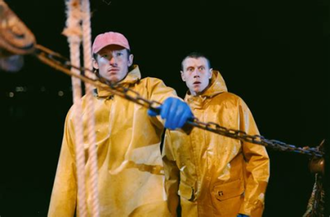
Callum Turner and George MacKay
Never have I been so conscious of how the world view I bring with me to a film affects how I understand it. Rose of Nevada begins with a succession of beautiful, lingering, colourful, close-up shots of decay - rocks and wood covered in lichen, metal chains eaten away by rust, a fishing harbour that has seen better times. Then two crossed pieces of wave-worn wood leap out at me like an abandoned crucifix. A small fishing boat floats by the quayside, and a middle-aged man looks over it, and his first words are "Jesus Christ!" On its hull is the name, 'Rose of Nevada.' Nevada: snowy. A rose in winter.
It turns out that the deserted boat was lost at sea thirty years previously, in 1993. Its return is mysterious, uncanny. The man who finds it is the owner who lost it three decades ago. And immediately he wants to send it back out to sea and make money out of it. Maybe it will restore the fortunes of the community. But who, in this broken Cornish fishing village, will crew it?
We see a young man picking up provisions at the food bank and taking it to his young partner and their small child. He stops to bring in from the rain his elderly next-door neighbour, a distracted woman mourning the son she lost when the Rose of Nevada went missing. The young fisherman had not joined the crew that day, and when the boat and crew were lost, the common verdict was that it was because they were short-handed, and in shame the young man threw himself to his death from the cliffs. His mother has never recovered.
Our contemporary young man volunteers to join the crew for the boat's next voyage. A skipper emerges from nowhere, looking disturbingly like the photograph of the skipper from thirty years ago. Another young man, fleeing a difficult relationship, volunteers as well, and off they go.
And when they get back into port, it is 1993 again. The two young men are taken to be the original crew members. The second one accepts the role with alacrity, for reasons that the viewer will find obvious. But the first young man insists that he is not who they think he is, the son of the couple whose son threw himself into the sea in 1993. The villagers assume he is over-tired and delusional, driving him to the edge of despair. But he opts to take an action which could be seen as self-sacrificing and redemptive. The film ends without the meaning or the outcome of that action becoming clear.
Whether award-winning Cornish writer and director Mark Jenkin intended any of the Christian significance which I found in the film, I do not know. I hope the fact that I found some will not cause him offence! But the story line stayed with me for days and nights afterwards, like a passage of Scripture revealing more and more of itself as I meditated on it.
The acting in this disturbing film is perfect and the filming extraordinary. The frequent close-up sequences made me feel I was really there, on board ship in a storm, hauling fish from the hold, walking in the rain in the village. When the lights came on, it was a shock to find myself in a BFI screening room in the West End of London.
Starring George MacKay, Callum Turner, Rosalind Eleazar, Francis Magee and Mary Woodvine, the film was co-financed by Film4 and BFI and goes on general release in April 2026.
 Facebook
 Twitter
 LinkedIn
 Print
Print Email
Email
















 Facebook
 Twitter
 YouTube
 LinkedIn
 Pinterest