


Gospel in Art: Blessed are the poor in spirit
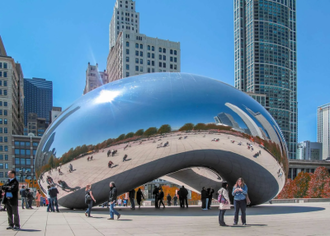
Cloud Gate, by Sir Anish Kapoor, Millennium Park, Chicago, Illinois, USA, 2004 - 2006, © Alamy
Source: Christian Art
Gospel of 1 February 2026
Matthew 5:1-12a
At that time: Seeing the crowds, Jesus went up on the mountain, and when he sat down, his disciples came to him. And he opened his mouth and taught them, saying:
'Blessed are the poor in spirit, for theirs is the kingdom of heaven. Blessed are those who mourn, for they shall be comforted. Blessed are the meek, for they shall inherit the earth. Blessed are those who hunger and thirst for righteousness, for they shall be satisfied. Blessed are the merciful, for they shall receive mercy. Blessed are the pure in heart, for they shall see God. Blessed are the peacemakers, for they shall be called sons of God. Blessed are those who are persecuted for righteousness' sake, for theirs is the kingdom of heaven. Blessed are you when others revile you and persecute you and utter all kinds of evil against you falsely on my account. Rejoice and be glad, for your reward is great in heaven.'
Reflection on the sculpture
When we see a great sculpture, we instinctively want to move around it. We want to see it from all angles. We want to see what it looks like from myth front, the sides, the back. Some sculptures invite that more than others. Michelangelo's Pietà, for all its beauty, must be viewed from a single vantage point, protected behind glass. We can;'t see the sides or the back (though one wish I have is to see it one day from all sides). Other sculptures, however, allow us to circle around them slowly, revealing their richness layer by layer, angle by angle.
I often think of the Beatitudes as just such a sculpture: not carved in marble, but in words. In this finely chiselled text, Jesus offers a portrait of the human person as God intends us to be. In fact, he is also revealing something of himself, for he alone is the perfect image of what humanity is meant to become. The Beatitudes are as such a kind of sculpture of Jesus himself, to be admired from all angles. He is not describing eight different people in the Beatitudes with eight different qualities. He is presenting one life, one way of being, seen from eight different angles! Each Beatitude turns the figure slightly, showing another facet of discipleship, a life so rich that it cannot be captured in a single description. That is why "blessed" is a better word than "happy": this is not about fleeting emotion, but about living a life open to grace and destined for joy.
As we slowly walk around this portrait, we begin to recognise its coherence. Poverty of spirit leads to gentleness; sensitivity to the world's brokenness gives rise to mourning; mourning awakens a hunger for justice; justice flowers into mercy. Purity of heart keeps intention focused on God rather than self. Etc... But Jesus is being honest: this way of life will not always be applauded. It may lead to loss, misunderstanding, even suffering. But it is the only way that will ultimately align our lives with the very heart of God.
Cloud Gate (also affectionately known as "The Bean") is a monumental stainless-steel sculpture by Sir Anish Kapoor, installed in Chicago's Millennium Park in 2006. Its mirror-polished steel surface reflects the city skyline, the sky, and everyone who approaches it, bending reality into a constantly shifting image. This is not a sculpture you see from a single viewpoint. It demands that you move beneath it, into the concave underside Kapoor calls the omphalos (Greek for "navel"), where reflections multiply and turn the viewer into part of the artwork itself. Seen from every angle, above and below, the sculpture refuses a single viewpoint.
LINKS
Gospel in Art: https://christian.art/
Today's Reflection: https://christian.art/daily-gospel-reading/matthew-5-1-12a-2026/
 Facebook
 Twitter
 LinkedIn
 Print
Print Email
Email











 Facebook
 Twitter
 YouTube
 LinkedIn
 Pinterest