


Gospel in Art: Jesus appointed Judas Iscariot, who betrayed him
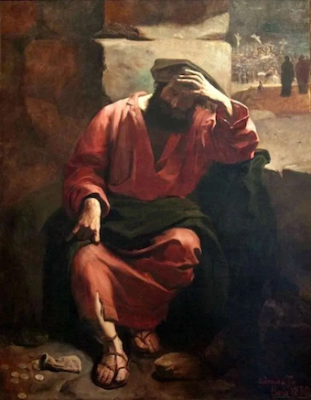
Judas' Remorse, by José Ferraz de Almeida Júnior © National Museum of Fine Arts, Rio de Janeiro, Brazil
Source: Christian Art
Gospel of 23 January 2026
Mark 3:13-19
At that time: Jesus went up on the mountain and called to him those whom he desired, and they came to him. And he appointed twelve, whom he also named Apostles, so that they might be with him, and he might send them out to preach, and have authority to cast out demons. He appointed the Twelve: Simon, to whom he gave the name Peter; James the son of Zebedee and John the brother of James, to whom he gave the name Boanerges, that is, Sons of Thunder; Andrew, and Philip, and Bartholomew, and Matthew, and Thomas, and James the son of Alphaeus, and Thaddaeus, and Simon the Zealot, and Judas Iscariot, who betrayed him.
Reflection on the painting
In today's Gospel, Jesus gathers around him those he desired to closely help him: twelve disciples called by name, including Judas Iscariot. Mark writes with the knowledge of what Judas would later do, yet he still affirms that Judas was among those Jesus wanted. Jesus chose him freely, just as he chose the others. There is no suggestion that Jesus deliberately selected a betrayer; instead, he believed in Judas' potential for good and entrusted him with a real share in his mission, just as he did with the others. Jesus wanted Judas, and Judas accepted this call by his own free will... but in the end Judas did not ultimately want Jesus.
This dynamic touches our own discipleship. The Lord's call comes to us again and again throughout our lives: "Come, follow me." But our response must be freely given, continuously, consistently. He invites us first to companionship, to live close to his heart in prayer. From that friendship springs a mission: he sends us out to share what we have received. The call and response constantly get renewed and refreshed. Like the twelve, we are wanted by Christ; the question becomes whether we want him in return, and whether we consistently say 'yes' to his call at every stage in our life.
Our moving painting is by José Ferraz de Almeida Júnior (1850-1899), one of Brazil's most important 19th-century painters, bringing the Realist tradition of artists like Courbet and Millet into Brazilian art. He became celebrated for scenes that evoke profound human feeling: realism combined with emotion. The Remorse of Judas (Remorso de Judas), painted in 1880, is one of his most famous works. In this large canvas, Almeida portrays Judas Iscariot in the hour of his deepest despair just before his suicide, haunted by the weight of his betrayal as Christ is being crucified in the background. The fallen coins at his feet and the play of light and shadow emphasise his isolation, confusion, and overwhelming guilt, capturing not merely a biblical episode but the intensity of conscience and human sorrow that follows a tragic, wrong choice. The painting draws us into Judas's inner anguish, a reminder of the raw emotional consequences of betrayal and the complexity of the human heart.
LINKS
Gospel in Art: https://christian.art/
Today's Reflection: https://christian.art/daily-gospel-reading/mark-3-13-19-2025-2/
 Facebook
 Twitter
 LinkedIn
 Print
Print Email
Email















 Facebook
 Twitter
 YouTube
 LinkedIn
 Pinterest