

Pope Leo's Message for World Day of the Sick
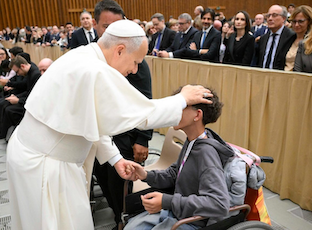
Source: Vatican Media
Pope Leo encourages reflection on the figure of the Good Samaritan, ahead of the World Day of the Sick, which will be celebrated this year at the Shrine of Our Lady of Peace in Chiclayo, Peru.
In his Message, released today, Pope Leo notes that this image "is always relevant and essential for rediscovering the beauty of charity and the social dimension of compassion" and helps further "direct our attention towards the needy and all those who suffer, especially the sick."
In the Gospel according to St Luke, Jesus responds to a scholar of the law, who asks him to identify the neighbour he must love, with this story. A man traveling from Jerusalem to Jericho was attacked by robbers and left for dead. While a priest and a Levite passed him by, a Samaritan took pity on him, bandaged his wounds, took him to an inn and provided for his care.
Pope Leo said he chose to reflect on this biblical passage through the lens of the late Pope Francis' 2020 Encyclical Fratelli tutti on human fraternity and social friendship.
There, compassion and mercy towards those in need are not reduced to a merely individual effort, but are realised through relationships: with our brothers and sisters in need, with those who care for them and, ultimately, with God who gives us His love, he said.
The Pope goes on to divide his message into the gift of encounter in three ways: "The joy of offering closeness and presence"; "The shared mission of caring for the sick"; and, "Always driven by love for God, to encounter ourselves and our neighbour."
"In the parable, when the Samaritan saw the wounded man, he did not 'pass by.' Instead, he looked upon him with an open and attentive gaze - the very gaze of Jesus - which led him to act."
With this in mind, Pope Leo highlights that love is not passive, but goes out to meet the other. Being a neighbour is not determined by physical or social proximity, but by the decision to love. This is why Christians become neighbours to those who suffer, following the example of Christ, the true divine Samaritan who drew near to a wounded humanity.
"The gift of encounter flows from our union with Jesus Christ," he said, stressing, "We recognise him as the Good Samaritan who has brought us eternal salvation, and we make him present whenever we reach out to a wounded brother or sister."
While acknowledging that we live "immersed in a culture of speed, immediacy, and haste-a culture of discard and indifference that prevents us from pausing along the way and drawing near to acknowledge the needs and suffering that surround us," Pope Leo observes that it is precisely in this hectic scenario that we can discover joy from helping others.
The Pope goes on to discuss compassion as a profound emotion that compels us to act, that "springs from within and leads to a committed response to another's suffering."
"In my experience as a missionary and Bishop in Peru," he says, "I have personally witnessed many who show mercy and compassion in the spirit of the Samaritan and the innkeeper," seen in family members, neighbours, healthcare workers, those engaged in pastoral care for the sick, and many others who stop along the way to draw near, heal, support, and accompany those in need.
"By offering what they have," he says, "they give compassion a social dimension, and this experience, occurring within a network of relationships, transcends mere individual commitment."
Pope Leo writes that for this reason, in his recent Apostolic Exhortation Dilexi Te, he referred to the care of the sick not only as an "important part" of the Church's mission, but as an authentic "ecclesial action.'"
Moreover, the Holy Father recalls quoting Saint Cyprian to illustrate "how this dimension serves as a measure of a society's health."
"To be one in the One" means truly recognising that we are members of a single Body that brings the Lord's compassion to the suffering of all people, each according to our own vocation.
In the double commandment, "You shall love the Lord your God with all your heart, and with all your soul, and with all your strength, and with all your mind; and your neighbour as yourself" (Lk 10:27), we recognise the primacy of love for God and its direct consequences for every dimension of human love and relationship.
"Love for our neighbour," he says, "is tangible proof of the authenticity of our love for God," adding that "to serve one's neighbour is to love God through deeds."
Pope Leo recalls that Pope Benedict XVI observed that "as a spiritual being, the human creature is defined through interpersonal relations" and that it "is not by isolation that man establishes his worth, but by placing himself in relation with others and with God."
The Holy Father says: "the true remedy for humanity's wounds is a style of life based on fraternal love, which has its root in love of God." He expresses his hope "that our Christian lifestyle will always reflect this fraternal, "Samaritan" spirit."
The Pope invites the faithful to join him in praying to the Blessed Virgin Mary, Health of the Sick, to assist all who suffer and are in need of compassion, consolation, and a listening ear, with the following ancient prayer, often invoked in families for those living with illness and pain.
"Sweet Mother, do not part from me.
Turn not your eyes away from me.
Walk with me at every moment
and never leave me alone.
You who always protect me
as a true Mother,
obtain for me the blessing of the Father,
Son and Holy Spirit."
Pope Leo XIV concludes his Message by imparting his Apostolic Blessing to all who are sick, to their families, and to those who care for them, healthcare workers and pastoral workers alike, and in a special way to all participating in this World Day of the Sick.
Read the full message here: https://press.vatican.va/content/salastampa/it/bollettino/pubblico/2026/01/20/0053/00096.html#en
 Facebook
 Twitter
 LinkedIn
 Print
Print Email
Email






 Facebook
 Twitter
 YouTube
 LinkedIn
 Pinterest