

Gospel in Art: The Paralytic of Capernaum is lowered from the roof
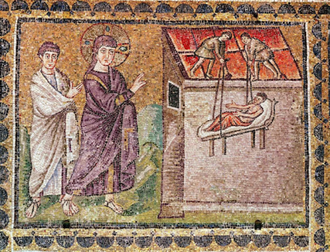
The Paralytic of Capernaum is Lowered from the Roof (from Scenes from the Life of Christ). Sant'Apollinare Nuovo, Ravenna, Italy © Wikimedia
Source: Christian Art
Gospel of 16 January 2026
Mark 2:1-12
When Jesus returned to Capernaum after some days, it was reported that he was at home. And many were gathered together, so that there was no more room, not even at the door. And he was preaching the word to them. And they came, bringing to him a paralysed man carried by four men. And when they could not get near him because of the crowd, they removed the roof above him, and when they had made an opening, they let down the bed on which the paralysed man lay. And when Jesus saw their faith, he said to the paralysed man, 'Son, your sins are forgiven.' Now some of the scribes were sitting there, questioning in their hearts, 'Why does this man speak like that? He is blaspheming! Who can forgive sins but God alone?' And immediately Jesus, perceiving in his spirit that they thus questioned within themselves, said to them, 'Why do you question these things in your hearts? Which is easier, to say to the paralysed man, "Your sins are forgiven", or to say, "Rise, take up your bed and walk"? But that you may know that the Son of Man has authority on earth to forgive sins' - he said to the paralysed man - 'I say to you, rise, pick up your bed, and go home.' And he rose and immediately picked up his bed and went out before them all, so that they were all amazed and glorified God, saying, 'We never saw anything like this!'
Reflection on the Mosaics
There are moments in every life when our own strength is not enough; when we need others to lift us, guide us, and accompany us. The paralysed man in today's Gospel is blessed with such friends. He longs to come into the presence of Jesus, but he cannot get there on his own. So his companions carry him, not just through the busy streets, but all the way to the house where Jesus is teaching. And when the crowd blocks the doorway, they refuse to be discouraged. They climb, they improvise, they break through the roof itself . They overcome every obstacle so their friend can meet the One who brings healing.
That opening in the roof becomes a powerful symbol: a sign of open hearts, open faith, open trust. Jesus sees not only a man lowered before him, but a community of love. And so, before restoring movement to his limbs, Jesus restores first his soul: "Your sins are forgiven." Grace flows first into the deepest places of hurt, and only then does physical healing follow. The man rises, carrying the very stretcher that once carried him. the stretcher is a reminder of old pre-healing times. He doesn't discard his stretcher, no, he walks away with it. We too must never forget of how things were before we were healed, so we can appreciated all God has done for us, and continues to do so.
Those who witnessed the scene are left astonished, praising God. And all of it began with the quiet determination of a few friends who refused to give up. Supporting a friend in their moment of weakness can unleash a ripple of grace that touches many lives, including our own.
The mosaics of Sant'Apollinare Nuovo in Ravenna form one of the most remarkable visual narratives of Christ's life in early Christian art, stretching along the nave with scenes from his ministry: miracles, parables, and encounters rendered in luminous glass tesserae. Ravenna's extraordinary mosaic tradition grew out of its role as a political and cultural crossroads; once the capital of the Western Roman Empire and later governed by the Ostrogoths, it became deeply shaped by the artistic language of Byzantium when the city returned to Eastern imperial rule under Emperor Justinian. With direct links to Constantinople, Ravenna absorbed the Byzantine love of mosaic shimmering surfaces, and theological storytelling in colour and light. Sant'Apollinare Nuovo shows this synthesis beautifully: Roman architectural order combined with a distinctively Byzantine spiritual radiance. Our scene depicts the Gospel reading of today with Jesus shown as the largest, most prominent figure.
LINKS
Gospel in Art: https://christian.art/
Today's Reflection: https://christian.art/daily-gospel-reading/mark-2-1-12-2026/
 Facebook
 Twitter
 LinkedIn
 Print
Print Email
Email











 Facebook
 Twitter
 YouTube
 LinkedIn
 Pinterest