


Gospel in Art: Saints Basil the Great and Gregory Nazianzus, Bishops, Doctors
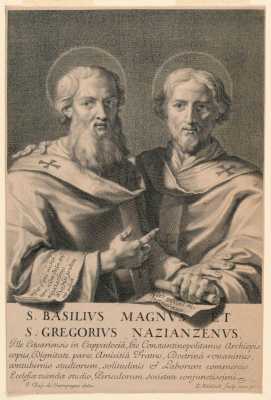
Saints Basil the Great and Gregory Nazianzus, After Jean Baptiste de Champaigne, engraving by Gérard Edelinck late 17thC © Alamy
Source: Christian Art
Gospel of 2 January 2026
Matthew 23:8-12
At that time: Jesus said to his disciples, 'You are not to be called rabbi, for you have one teacher, and you are all brothers and sisters. And call no man your father on earth, for you have one Father, who is in heaven. Neither be called instructors, for you have one instructor, the Christ. The greatest among you shall be your servant. Whoever exalts himself will be humbled, and whoever humbles himself will be exalted.'
Reflection on the Copper Engraving
Today we celebrate Saints Basil the Great and Gregory of Nazianzus. Both served as bishops in the 4th century, and are now honoured as saints and doctors of the Church. Their lifelong friendship began during their studies in Caesarea, Cappadocia, and deepened while they were in Athens. Reflecting on their bond, Gregory later wrote, "We seemed to have one soul, inhabiting two bodies." (Orationes of Saint Gregory 43:20). Both men hailed from remarkable families: Basil's maternal grandmother was a martyr, while his paternal grandmother, parents, and three siblings were also canonised. Gregory's father, converted to Catholicism by his wife, became a priest and later the Bishop of Nazianzus, a role he held for nearly forty-five years, living into his nineties. They raised three children, all of whom were eventually recognised as saints.
During Basil and Gregory's lifetime, the Church was battling the widespread heresy of Arianism, which denied the divinity of Christ. This doctrine acted like a corrosive disease within the Church, sowing divisions. Saints Basil and Gregory were instrumental in countering this heresy and restoring unity within the faith community, particularly in the Eastern Church. However, their efforts came at a great personal cost. They endured hostility, slander, physical violence, and threats from the emperor, other bishops, and even members of the faithful. Despite these challenges, they remained resolute and focused on their mission, leaving behind a legacy of profound theological writings that continue to inspire and instruct. Their works, especially on the divinity of Christ and the Holy Trinity, stand as enduring pillars of Christian theology. Yet, their greatness was not solely intellectual. Their sainthood was rooted in their holiness, they way they lived their day to day life in love and generosity.
In art, the two saints are often depicted together. In fact, in Byzantine art they are often portrayed alongside Saint John Chrysostom as well. The copper engraving we are looking at is a somewhat unusual 17th century Western depiction of the two saints. It brings together the talents of two outstanding figures of the Flemish Baroque: Jean-Baptiste de Champaigne and Gérard Edelinck. Jean-Baptiste de Champaigne (1631-1681), a nephew and pupil of the great Philippe de Champaigne, worked in Paris where he developed a clear, disciplined approach to painting, making his compositions especially well suited for devotional imagery. Gérard Edelinck (1640-1707), one of the greatest engravers of his age, translated de Champaigne's painted design into copper with beautiful precision. Born in Antwerp but active at the French court, Edelinck was celebrated for his ability to render light, texture, and expression through engraved lines alone. Together, painter and engraver created works that allowed powerful religious images to circulate widely, bringing theology, art, and devotion into the hands of a much broader public.
LINKS
Gospel in Art: https://christian.art/
Today's Reflection: https://christian.art/daily-gospel-reading/matthew-23-8-12-2025/
 Facebook
 Twitter
 LinkedIn
 Print
Print Email
Email















 Facebook
 Twitter
 YouTube
 LinkedIn
 Pinterest