


An Unlikely Cornerstone: The Life and Times of Dom Victor Farwell
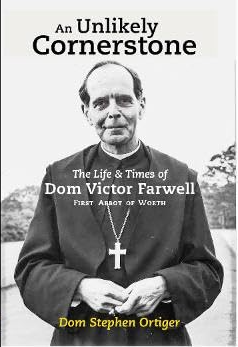
Too often in Britain might we encounter conversations where Abbots and Abbesses are assumed to be artefacts of the past - or Abbeys a form of institution consigned to noble ruin , in countryside outposts only cared for by English Heritage. As we move towards the New Year though a fresh biography of the founding Abbot of Worth Abbey in Sussex knocks such assumptions for six and points the way to monastic vistas of other reading from which our imagination - and spirituality - might benefit in 2026.
The future Abbot Victor Farwell was born in Roehampton in 1913. His family was Catholic and Roehampton, 'the last village in London,' was to some extent a Roman Catholic enclave. The Jesuits sustained a large study house there where Gerard Manley Hopkins had lived. The Sacred Heart Sisters ran educational institutions while the Poor Servants of the mother of God a home for disabled citizens. These gathered in some ways around the lively parish of St Joseph's, also cared for by the Jesuits. The young Farwell would have seen members of these Religious Orders about the place, and his family home.
The future monk never shone academically. In fact, the book's author, another Abbot of Worth Stephen Ortiger, notes that it was a source of lifelong regret for Farwell that he was never, upon entering Downside Abbey near Bath, sent to Oxford or Cambridge. Instead, he spent time at the seminary of Osterley in West London to bring him up to the scratch that Downside's highly academic monastic community expected. One gets a glimpse of Downside's self-defined standards and complex dynamics of class, conversion, ecumenism, research, and aspiration in another brilliant biography of an Abbot Christopher Butler: Monk, Theologian and Bishop also published this year but by Douai Abbey's innovative Weldon Press.
Worth was founded from Downside in 1933. It became an independent Abbey in 1965. Farwell became its Abbot and held that post for 31 years. He established a lay community to live alongside the monastic community. This still endures in a fresh form as the non-geographical Lay Community of St Benedict with eminent members such as Baroness Hollins of Wimbledon and former health leader Phil Gray.
Farwell persuaded the monastic community to find a missionary house in Peru. He brought Religious Sisters to share the Worth estate. Remarkably he commissioned architect Francis Pollen to design a circular and modern Abbey Church that embodied aspirations of the Second Vatican Council. As if to deepen that commitment Worth became the first house in the English Benedictine Congregation (EBC) to dispense with Latin for its 'work' of praying the divine office. Even when frail, in the late 1980's, he announced to gathered Catholic students that he hoped for 'Worth to become a British Taizé'. While not all these projects have endured today, many do and Worth's school is thriving. It sits amidst a campus where, in 1978, Farwell and the community hosted 16,000 visitors as an alternative to the rock festivals of Reading, Glastonbury, and the Isle of Wight where English Benedictine monks had already by then been constant presences, in 'the Jesus tent' , for a decade.
Indeed, look at their annual reports and Worth and other English Abbeys and their apostolates combined remain vital rural employers, crucial centres of care for the homeless, important educators across the lifespan, and welcome more visitors and worshippers each year than the more high - profile Anglican Holy Trinity Brompton or its Alpha offshoot. Beyond the English Benedictines the Premonstratensians have successfully moved to London again and the Cistercians at Mount St Bernard's in Leicestershire now have not only beer to sell, but a new profile, thanks to the extraordinary volume, depth and quality of multi - media outputs from its former Abbot Bishop Erik Varden.
Among women St Cecilia's Abbey in Ryde is thriving and new lay female scholars are inspiring a whole new generation of approaches to 'monastic studies'. Perhaps the most exceptional of these is the anthropologist Isabelle Jonveaux whose carefully observed empirical ethnographic work teases out the way in which monastic lives embody spirituality through time, architecture, study, divine liturgy, silence, work, and grace. Jonveaux was recently at the Pontifical Institute of San Anselmo in Rome to share her research with monks from across the world.
What emerges from the pages of Farwell's life then is the contribution of a single religious leader of significant note. More than that it is the life of one, who by inspiring others, laid the foundations for a beating cycle of prayer, an institution which is a major employer and one that has a long standing reach into wider affairs which at first glance today might surprise both the reader - and Victor Farwell himself. What emerges too is a life hidden from view among so many, but which new pathways of enquiry and scholarship are opening for the future. In this way this life forms part of a weave of lives of incredible importance.
In a Britain and a British Church that recognises all its talents, monasteries and contemplative spiritualities might even more assuredly then be celebrated. Rather than consign them to the grant applications of English Heritage their chains of memory, current impact and present innovations are worthy of note. Perhaps most crucially their ability to combine such gifts with depths of groundedness in a world where so many feel unwillingly torn from roots, clearly has the potential to be among our most vital beating hearts of renewal.
An Unlikely Cornerstone: The Life and Times of Dom Victor Farwell, by Stephen Ortiger OSB. Publisher: Three Peaks PressISBN: 978-1-902093-19-2 , Price: £10.00
 Facebook
 Twitter
 LinkedIn
 Print
Print Email
Email














 Facebook
 Twitter
 YouTube
 LinkedIn
 Pinterest