

Speaking the language of love
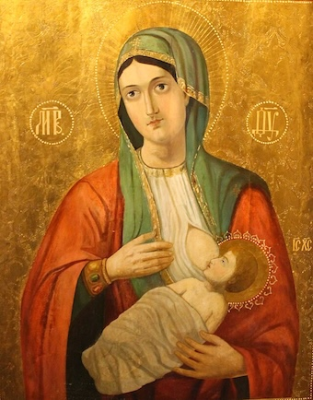
Holy Virgin feeding Baby Christ, 20th c. Museum of Ukrainian home icons, Radomysl Castle, Creative Commons Attribution-Share Alike 3.0
The carol, 'In the bleak midwinter' by Christina Rosetti is regularly in the top 10 of the vote for nation's favourite carols. Verse 5, however is frequently omitted - its the one which says:
Enough for him, whom cherubim
Worship night and day,
A breastful of milk
And a mangerful of hay;
AI tells me that, 'This verse describes the intimate and humble nature of the Incarnation' but suggests that the 'primary reason for its frequent omission in many hymnals and choral arrangements is a perceived prudishness regarding the explicit mention of a "breastful of milk" (referring to Mary breastfeeding Jesus. Our ancestors would have no such problems. The Nursing Madonna, in which Mary is shown breastfeeding the child Jesus was a common theme in paintings until after the Council of Trent (1545 - 1563) when it was discouraged in public on the grounds of 'propriety'.
Pope Francis had no such prudishness - he frequently encouraged women to breastfeed their babies when they cried during long ceremonies in the Sistine chapel encouraging mothers to breastfeed just as Mary breastfed Jesus.
Pope Francis described breastfeeding as 'the language of love' and this phrase came to mind when reading about research done by Dr Katie Hinde. Katie Hinde thought she was studying milk, what she found was a conversation. In 2008 Katie Hinde was studying breast milk from rhesus monkeys and her analysis of the milk produced some astonishing results.
- Mothers with sons produced milk richer in fat and protein
- Mothers with daughters produced more volume with different nutrient ratios
- Milk changes by time of day
- First time mothers produced more cortisol so babies who drank it became more active and playful, as well as being better at coping in stressful situations. And Hinde found the same results when she studied human breastmilk.
When a baby nurses tiny amounts of saliva travel backward through the nipple into the mother's breast tissue carrying signals about the baby's health, instigating what Hinde describes as 'a biological dialogue'. Within hours the mother's milk changes creating more white blood cells and targeted anti-bodies, producing exactly the 'medicine' the baby needs. The milk returned to normal once the baby had recovered.
Katie Hinde says that from being simple nutrition, breast feeding is one of the most sophisticated communication systems biology has ever produced. It is a living, responsive conversation between two humans, or as Pope Francis would say, both mother and child are, 'speaking the language of love'.
In Advent we repeatedly call to Jesus to 'come'.
Geoffrey Preston in his book, 'Hallowing the time' writes:
'Our repeated, "Come" answers to the repeated 'come' of the Lord in scripture. , Abraham, "Come to the land that I will show you"; Lazarus, Come forth: Come follow me, Peter, Andrew, James, John; come to me all who are weary and heavy laden. The history of all God's dealings with us can be read as a history of those repeated calls backwards and forwards between people and God.' 'Hallowing the time' - Geoffrey Preston OP. This year has given new meaning to the 'repeated call' or conversation between God and a woman for now God is intrinsically bound to the whole of creation as is celebrated on January 1st when we celebrate Mary, the Mother of God.
1st January is also World Day of Prayer for Peace. In his message for this day Pope Leo says:
'We need to encourage and support every spiritual, cultural and political initiative that keeps hope alive, countering the spread of "fatalistic terms…… For, as has been suggested, "the best way to dominate and gain control over people is to spread despair and discouragement, even under the guise of defending certain values."
2025 could easily have been a year of 'despair and discouragement for those of us working for world development, but at the end of the year on 15th December RESULTS UK launched in parliament three 'Good news on nutrition' briefings which gave me hope and perked me up no end. Produced by Sunit Bagree, Senior Policy Advocacy Officer (Nutrition), these reports shed light on the positive stories around nutrition, and consider how the UK can learn from these to best work towards the SDG 2 target of ending all forms of malnutrition by 2030. The first of these concerned Women and girls. The first article gave good news on breastfeeding in Sierra Leone.
'Breastfeeding is a hugely effective way of ensuring child survival and health.' Bagree writes, 'Not only is breastmilk safe, nutritious and sustainable, it contains antibodies which help protect babies from infections and diseases, and breastfed children perform better on intelligence tests. Women who breastfeed also have a reduced risk of cancer and other diseases.' Supporting breastfeeding is a highly impactful and cost effective intervention for reducing childhood mortality and morbidity due to malnutrition.
Sierra Leone is one of only six Global South countries projected to achieve 70% of exclusive breastfeeding prevalence for babies under six months old by 2030. Supported by official donors, including the UK, it has adopted many approaches to reach this position. Exclusive breastfeeding messages are communicated via radio, awareness drives and mother-to-mother support groups. Training hospital staff, and setting up processes to cascade these trainings, has enabled maternity facilities in Sierra Leone to become more trusted centres of breastfeeding.
More recently, the country's 'Stronger with Breastmilk Only' campaign has targeted religious leaders. Capacity-building programmes (incorporating perspectives from the Quran and Bible) have made religious leaders influential advocates for exclusive breastfeeding. They are determined to improve infant and young child feeding practices by promoting the importance of exclusive breastfeeding for the first six months of life in Sierra Leone Religious leaders are empowering mothers and families to make informed decisions and nurture healthier infants for the future during baptisms and naming ceremonies. "Amidst the joyous celebrations that follow the birth of a baby, we emphasize the importance of providing the nourishment and protection that breast milk offers during a child's first six months," says Sheik Ibrahim Sesay of Masjid Atayiba in Freetown. "By integrating these vital messages into the gatherings, we are doing our bit to ensure that the blessings bestowed upon newborns are complemented by a strong nutrition foundation".
I think Pope Francis would approve!
The final verse of 'In the bleak midwinter' (or as my former vicar used to call it, "the BMW"
What can I give him, Poor as I am?
If I were a shepherd I would bring a lamb,
If I were a wise man I would do my part,
Yet what I can I give him, Give my heart.
As I look back on 2025 I know that these positive stories and development gains would not have been achieved without the voices of millions of ordinary people saying that international development matters. Kitie Arie, CEO of Results UK has this to say:
'At every event in which we hear an MP speak about international development, they almost always say the same thing: "Let us know you care about this!" Politicians know the power of grassroots campaigners, and they know that your voices have a real impact on government policy. So please take heart in this as we head into the new year.'
At a time when it is easy to be disheartened, please do not forget that grassroots advocacy can and does make a difference, and that our efforts have contributed to decisions that will save millions of lives around the world!' Perhaps this is one way of 'doing my part?' in 2026?
References
Good news on nutrition - https://results.org.uk/publication/good-news-on-nutrition-the-complete-series/
 Facebook
 Twitter
 LinkedIn
 Print
Print Email
Email






 Facebook
 Twitter
 YouTube
 LinkedIn
 Pinterest