

The West Bank: a year of confinement and control

Grim wall around Bethlehem ICN/JS
Toine Van Teeffelen, Pax Christi partner and Educational Adviser in Palestine writes:
Here are a number of unsettling developments on the West Bank in the past year that have received little attention in the mainstream media in general.
1. Traveling between cities has become problematic. This applies primarily to trips from the West Bank to Jerusalem. But few people are allowed to pass; with rare exceptions, Palestinian workers are no longer allowed to work in Jerusalem or Israel. But also the traffic within the West Bank itself has become unpredictable. Regional - and sometimes even local - commutes can cause delays for hours or force people into complicated detours. The consequences can be felt in all domains of daily life: economics, education, health care, family visits and much more.
2. International travel is also complicated. The Allenby Bridge - currently the only exit route for Palestinians from the West Bank - is unpredictable.
There are all kinds of "facilitating" services and additional payment options to make the passage through three authorities (the Palestinian National Authority, Israel and Jordan) more bearable. Nevertheless, the bridge can suddenly be closed, for reasons ranging from "safety" to staff strikes. For anyone who has to catch a flight from Amman, the whole company becomes nervous.
3. More and more areas within the West Bank are being closed off to Palestinians. Earlier this year, tens of thousands of refugees were driven out of three refugee camps in the north of the West Bank. In the Jordan Valley, tens of kilometers of a new Wall will be built, cutting farmers off from their land. The so-called "seam zone" between the Wall and the Green Line - the internationally recognized border between Israel and the West Bank - accounts for about 9% of the West Bank. This area is becoming increasingly less accessible to Palestinians, and residents are grappling with issues with residence status and freedom of movement. Many people, including school children, avoid traveling through settlements because it is dangerous. As a result, Palestinians are increasingly being pushed back into densely populated urban centers and their immediate surroundings.
4. During two years of destruction and deadly violence in Gaza, there was hardly any space for public celebrations on the West Bank. While the situation in Gaza remains extremely worrisome, there is slightly more space on the West Bank for festivities, such as the Christmas celebrations in Bethlehem. These celebrations are low-key and emphasize both Palestinian culture and the Christian message. In a broader sense, there are an increasing number of initiatives aimed at bringing Palestinian realities, culture and stories back to life.
5. Many people fear that what has happened in Gaza is a premonition of what awaits the West Bank. The atmosphere is one of caution and vigilance. Constant Israeli surveillance - via cameras, facial recognition technologies and other high-tech tools - combined with a comprehensive permitting system and the presence of collaborators, is increasingly turning the West Bank into a totalitarian occupation regime. People assume that the Israeli authorities know all the details of their personal lives. With Gaza, the West Bank has become a laboratory for testing military technologies - technologies that, despite the destruction and repression they cause, support Israel's military export industry and economy.
6. Against this backdrop, courageous Israeli and international volunteers are supporting Palestinian farmers, particularly in the Jordan Valley and areas south of Hebron, east of Ramallah and northern West Bank. In a classic non-violent manner, they guide and protect Palestinian herders, Bedouin and olive pickers from young settlers who often try to provoke confrontations. These confrontations then "justify" interventions by the Israeli army, leading to arrests (or deportations) of volunteers and sometimes the sealing of land on so-called security grounds - practically in preparation for takeover. International aid organizations are experiencing increasing difficulties in obtaining permits for their staff to work in the West Bank, let alone Gaza. At the same time, international presence remains essential for the protection of citizens.
7. This brings us to another remarkable phenomenon: the increasing interference of army and colonists. The distinction between the two is fading more and more. Armed settlers keep Palestinian cars under control, and settlements are often guarded by settlers in army uniform. Over 120 outposts have been set up in recent years, usually small, makeshift structures on hilltop to harass Palestinian villages or farmers. These outposts are then "secured" by the army and eventually legalized for settlement. The same process occurred in some of the 19 new settlements legalized by the Israeli government a few days ago.
8. There is a clear sense of urgency among the nationalist right wing (a majority) in Israel. People are trying to take full advantage of Trump's term, allowing colonization of the West Bank, if not actively encouraged, even now cracks within parts of the MAGA movement are visible in support of Israel's politics.
9. Palestinians are economically vulnerable. The Palestinian economy depends on the Israeli economy. Palestinian banks can make international transactions exclusively through Israeli banks. Many families rely on salaries from the Palestinian Authority, but receive only a portion of what they receive. Politically weak the PNA has been designated to international financial support, which has decreased sharply. At the same time, people are increasingly being pushed toward digital financial transactions, which poses a major problem for those unfamiliar with computers or smartphone technology.
10. Finally a noticeable non-development. It would be obvious that the West Bank will play an important role in the rebuilding of Gaza. Palestinian professionals and institutions on the West Bank are well positioned to do that: they share language, culture, proximity, trust and expertise. Israel's policy of complete separation between Gaza and the West Bank prevents this cooperation, while the U.S. keeps the issue going. Because of that, a vital and natural form of Palestinian solidarity and reconstruction remains deliberately blocked.
Bethlehem, 23/12/25
 Facebook
 Twitter
 LinkedIn
 Print
Print Email
Email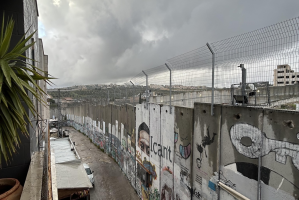












 Facebook
 Twitter
 YouTube
 LinkedIn
 Pinterest