


Gospel in Art: Feast of the Holy Family
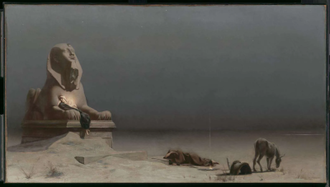
Rest on the Flight into Egypt by Luc Olivier Merson, 1879 © Museum of Fine Arts, Boston
Source: Christian Art
Gospel of 28 December 2025
Matthew 2:13-15, 19-23
When the Magi had departed, behold, an angel of the Lord appeared to Joseph in a dream and said, 'Rise, take the child and his mother, and flee to Egypt, and remain there until I tell you, for Herod is about to search for the child, to destroy him.' And he rose and took the child and his mother by night and departed to Egypt and remained there until the death of Herod. This was to fulfil what the Lord had spoken by the prophet: 'Out of Egypt I called my son.'
But when Herod died, behold, an angel of the Lord appeared in a dream to Joseph in Egypt, saying, 'Rise, take the child and his mother and go to the land of Israel, for those who sought the child's life are dead.' And he rose and took the child and his mother and went to the land of Israel. But when he heard that Archelaus was reigning over Judea in place of his father Herod, he was afraid to go there, and being warned in a dream he withdrew to the district of Galilee. And he went and lived in a city called Nazareth, so that what was spoken by the prophets might be fulfilled, that he would be called a Nazarene.
Reflection on the painting
Matthew is the only Gospel writer who tells us about the dreams of Joseph. Mark and John do not include infancy narratives, and Luke focuses almost entirely on Mary's experience. Only Matthew places Joseph at the centre of the early story and reveals how God guided him through a series of four dreams. These dreams are essential to Matthew's theology: Joseph is portrayed as a man who listens deeply, discerns faithfully, and acts immediately. Each dream safeguards the unfolding of salvation history, protecting Mary and little Jesus.
Our Gospel reading recounts two of Joseph's four dreams, both connected to the Flight into Egypt. In the first part of our reading (2:13-15), an angel appears to Joseph at night with an urgent command: "Rise, take the child and his mother, flee to Egypt." Herod seeks to destroy the newborn Messiah, and Joseph must act without delay. Their journey fulfils the prophecy Hosea 11:1: "Out of Egypt I have called my son."
After Herod's death, Joseph receives a second dream, the second part of our reading (2:19-23), instructing him to return to Israel. Yet when he learns that Archelaus, Herod's violent son, reigns in Judea, Joseph receives a fourth dream, warning him to avoid that region. He withdraws instead to Galilee, settling in Nazareth, fulfilling yet another scriptural foretelling.
In our striking painting of the Holy Family's flight into Egypt, we are invited into a moment of quiet vulnerability. Joseph dozes beside a dying campfire, exhausted, while the donkey nibbles at sparse desert grass. Joseph and the donkey in our painting remind us of the harshness of their journey and the fragile beginnings of the Incarnation. On the left, Mary and the infant Jesus rest peacefully in the protective paws of a great sphinx, the ancient Egyptian symbol of a civilisation long fallen. Its gaze lifts toward the first appearing stars, as if acknowledging a power greater than all earthly empires. The sphinx becomes a potent metaphor: the newborn Christ, cradled against this relic of pagan glory, will bring low every empire built on pride, violence, or self-sufficiency. Pagan kingdoms have risen and fallen; secular powers still rise and fall. And in our own age, we see secularism lifting its head once more, confident in its strength. Yet this painting quietly proclaims the eternal truth: it is not worldly power that endures, but the gentle, hidden, world-changing presence of the Holy Family.
LINKS
Gospel in Art: https://christian.art/
Today's Reflection: https://christian.art/daily-gospel-reading/matthew-2-13-15-19-23-2025/
 Facebook
 Twitter
 LinkedIn
 Print
Print Email
Email









 Facebook
 Twitter
 YouTube
 LinkedIn
 Pinterest