

Freedom Song
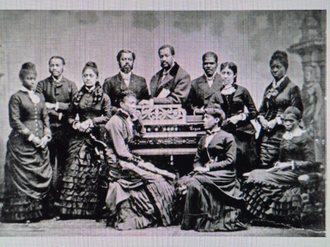
Fisk Jubilee Singers
The concert performance of Freedom Song, the story of the Fisk Jubilee Singers, at the University of Southampton last Friday 12th December was superb, deeply moving and inspiring. Conducted by Harvey Brough, who was also responsible for the music, and with words by Justin Butcher, a packed auditorium learned a great deal of black history - not least through Southampton race equality activist and historian Don John's fascinating introductory contextualising - and the story of the Fisk University and its celebrated singers in particular.
Working from diaries, historical records and the choir's own songbook, composer Harvey Brough and playwright Justin Butcher have reconstructed their struggles.
In 1871 a group of singers from Nashville, Tennessee, took to the road to raise money for their university. But this was no ordinary student choir. The Fisk Jubilee Singers were freed slaves. Their mission was not only to build the first black university after emancipation, but to fight for the right of all African-Americans to be educated.
Facing down racial abuse and physical hardship, they introduced the world to plantation spirituals. 'Songs of sorrow' such as 'Steal Away' and 'Swing Low Sweet Chariot' were forged in the crucible of slavery. They have gone on to become anthems of freedom and equality.
The singers toured the USA and Europe. They serenaded Queen Victoria and enchanted Prime Minister Gladstone and performed in concert halls and cathedrals across Britain. Sponsored by the president of the Ragged School Union, Lord Shaftesbury, they sang at Ragged Schools in Hackney and in Dr Barnardo's school at Hope Place. They went on to thrill audiences around the world and remain beacons of the civil rights movement.
Four professional soloists - Emily Dankworth (soprano), Melanie Marshall (alto), Wills Morgan (tenor), and Michael Henry (bass) - acted and sang with great range, emotion and expression and were commendably supported by the University of Southampton Voices choir under Brough's accomplished guidance. Professional musicians Dan Moriyama (piano) and Gareth Fowler (guitar) were very fine.
Freedom Song premiered in London in 2018 in a performance by Vox Holloway choir where Brough is resident composer and director. Vox Holloway was founded by Justin Butcher in 2009 as a community choir open to all. Butcher was excellent in his role of George White - the tour manager of the Jubilee Singers.
The evening was a glorious celebration of the power of music to overcome oppression and bring people from all backgrounds together.
Here is the history of the Fisk Jubilee Singers. The name Jubilee was chosen because of its powerful spiritual resonance of social justice and restoration. The radical nature of Christianity nourished and inspired the choir just as it had the spirituals they sang.
The early years: 1871 - 1873
Fisk University was founded in Tennessee in 1866, just after the American Civil War, for the education of freed slaves. By 1871, it was over-enrolled and in deep financial trouble. Desperate to find a way through the crisis, the university treasurer, George White, brought together a group of the most talented students to form a small choir and, in a move of astonishing boldness and faith, they set out to 'sing out of people's pockets the money that must be found' to secure the future of their university.
Over the next few years, they travelled through Ohio, Pennsylvania and other states, performing to audiences that were often moved by the exquisite singing. But they were also frequently mocked and racially abused and often collected barely enough money to cover their costs. The singers struggled to cope, and George White was frequently close to despair. But he led them on, unwavering in his belief in their talent and their mission.
Initially, their music was geared to appeal to white audiences. But slowly they introduced people to 'plantation songs', 'songs of sorrow and suffering' - music with a poignancy and a visceral passion that most of their audiences had never heard before. When they finally arrived in New York, they became an overnight sensation. They even sang at the White House for President Grant.
As their confidence grew, they refused to sing to segregated audiences and, when they were abused by the railroad companies, they made sure the owners knew. At one point, George Pullman, director of the Union Pacific Railroad, came to their aid. In Newark, on hearing that they had been turfed out of their hotel, local people took them in and on the night after this 'disgraceful affair' the board of education in nearby Jersey City voted to integrate its schools. Now known as the Fisk Jubilee Singers, they were building a reputation and, according to the New Jersey Journal, were 'moulding and manufacturing public sentiment.'
Touring Great Britain: 1873 - 1874
'The Jubilee singers are to appear in London. I heard them sing once and I would walk seven miles to hear them sing again … they reproduce the true melody of the plantations and are the only persons I ever heard accomplish this on the public platform.' Mark Twain
In 1873, the Earl of Shaftesbury, encouraged by Mark Twain, invited the Jubilee Singers to perform in London. They sang everywhere - in Westminster Abbey, in Downing Street for Gladstone and his family, and for Queen Victoria.
They travelled to Glasgow and across the north of England, singing in freezing cold churches and packed concert halls. Audiences were stirred and challenged as never before. And in 1874 they returned to Nashville having raised over £10,000, which eventually paid for the building of Jubilee Hall.
As well as singing to the elite in British society, they also sang in hospitals, schools, soup kitchens and orphanages. They performed in Downs Chapel, Hackney and in many other east end venues. After they sang for orphan children at the Hackney Juvenile Mission, John Newman, the manager of the Mission felt that 'such singing from the soul should not be forgotten, and speedily set to work to teach the children of the Mission the songs the Jubilee singers had sung - the East London Jubilee Singers of Hackney was born.'
The Jubilee Singers
Ten singers set off on that first tour in 1871. Seven were teenagers - the youngest, Minnie Tate, was only 14, the oldest, Benjamin Holmes, was 25. Ella Sheppard, who managed the choir with George White, was only 20. All but two had been born slaves. Having taught himself to write, Benjamin Holmes had first read Lincoln's Emancipation Proclamation while imprisoned in a slave pen. After the Civil War, he, Isaac Dickerson and Maggie Porter faced down threats of violence to teach freed slaves in country schools, even though many were being burned down by the Klan.
The courage and resourcefulness of these youngsters, set against the deluge of racism that swept across many States after the Civil War, cannot be overstated. They faced down threats, intimidation, ridicule and physical hardship before they achieved recognition. But the power of their music, as well as the dignity and intelligence they demonstrated, won over even the most hostile audiences and extended the cause of freedom beyond a small network of radicals and missionaries.
Despite their huge success and the toll that years of travelling had on their health and well-being, they remained deeply committed to their mission of securing education for all African-Americans and promoting the cause of freedom.
Much later, the Fisk Jubilee Singers became icons of the civil rights movement and Fisk students, directed by Paul Kwami, are singing 'spirituals' around the world today. Jubilee Hall still stands as the first permanent building of Fisk University and, in 1974, it was declared a National Historic Landmark.
EPILOGUE
The British Empire dominated the trans-Atlantic slave trade for nearly 250 years, from the reign of Elizabeth I until Britain abolished the slave trade in 1807. During that time British ships carried an estimated 3-4 million enslaved Africans to the Americas. For every slave taken to the United States, 12 were taken to the Caribbean. Britain declared slavery illegal in the colonies in 1833. In 1863, when Abraham Lincoln made the declaration of emancipation, there were 4 million people of African origin in slavery in the United States.
The modern-day slave trade is one of the fastest growing industries in the world, currently enslaving more than 46 million people across the globe and representing $150 billion a year in illegal profits.
Read more about Vox Holloway: https://voxholloway.com/
 Facebook
 Twitter
 LinkedIn
 Print
Print Email
Email









 Facebook
 Twitter
 YouTube
 LinkedIn
 Pinterest