

Pope Leo: The message of 'Nostra aetate' remains urgent as ever
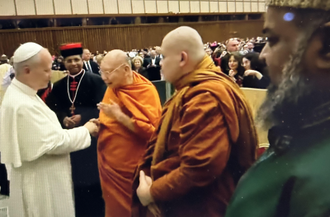
Pope greets faith leaders - Screenshot
Source: Vatican Media
Pope Leo XIV on Tuesday evening, presided over 'Walking Together in Hope' a celebration of 60 years of Nostra aetate, the Second Vatican Council's Declaration on Interreligious Dialogue.
The event, held in the Paul VI Hall, was attended by representatives of world religions, members of the diplomatic corps accredited to the Holy See, and Vatican and Church officials committed to interreligious dialogue.
"Sixty years ago", with the publication of Nostra aetate, the Second Vatican Council's Declaration on the relation of the Church to non-Christian Religions, "a seed of hope for interreligious dialogue was planted," the Holy Father said. "Today, your presence bears witness that this seed has grown into a mighty tree, its branches reaching far and wide, offering shelter and bearing the rich fruits of understanding, friendship, cooperation and peace."
Nostra aetate, the Pope said, "opened our eyes to a simple yet profound principle: dialogue is not a tactic or a tool, but it's a way of life - a journey of the heart that transforms everyone involved, the one who listens and the one who speaks."
Referring to the title of the anniversary celebration, "Walking Together in Hope", Pope Leo said, "We walk this journey" not by compromising our beliefs, but by remaining true to our convictions. Authentic dialogue, he continued, "begins not in compromise but in conviction - in the deep roots of our own belief that gives us the strength to reach out to others in love."
Later, recalling the Jubilee of Hope and noting that "hope" and "pilgrimage" "are realiti common to all our religious traditions," Pope Leo said, "This is the journey that Nostra aetate invites us to continue - to walk together in hope."
This, he said, is not the work of a single religion, nation, or generation, but "a sacred task for all humanity, to keep hope alive, to keep dialogue alive, and to keep love alive in the heart of the world."
Pope Leo began his address by recalling the many people of all beliefs who have worked over the past sixty years "to bring Nostra aetate to life," even to the point of giving their own lives, "martyrs for dialogue, who stood against violence and hatred."
We are where we are today, he said, "because of their courage, their sweat, and their sacrifice."
Insisting that the message of Nostra aetate remains "highly relevant today," Pope Leo recalled the Council's lessons: that humanity is drawing closer together, that all human beings belong to one human family with one origin and one goal; that all religions try to respond to "the restlessness of the human heart"; and that the Catholic Church "rejects nothing that is true and holy in these religions."
Pope Leo also recalled the origins of the Declaration, which stemmed from a desire for a document describing "a new relationship between the Church and Judaism." This desire was realised in Nostra aetate's fourth chapter, which forms "the heart and generative core of the entire declaration."
That chapter, the Pope continued, led to the final chapter, which teaches that "we cannot truly call on God, the Father of all, if we refuse to treat in a brotherly or sisterly way any man or woman created in the image of God."
In the final part of his statement, the Pope reminded religious leaders that they "share a sacred responsibility: to help our people to break free from the chains of prejudice, anger and hatred; to help them rise above egoism and self-centredness; to help them overcome the greed that destroys both the human spirit and the earth.
"In this way," he said, "we can lead our people to become prophets of our time - voices that denounce violence and injustice, heal division, and proclaim peace for all our brothers and sisters."
He reminded them of the "great mission" with which they have been entrusted: "to reawaken in all men and women their sense of humanity and of the sacred."
"This, my friends, is precisely why we have come together in this place," he said, "bearing the great responsibility, as religious leaders, to bring hope to a humanity that is often tempted by despair."
Pope Leo concluded his remarks with the words of Pope Saint John Paul II, who, in Assisi in 1986, said: "If the world is going to continue, and men and women are to survive in it, the world cannot do without prayer."
And thus he invited them all to pause together for silent prayer, with the invocation, "May peace come down upon us and fill our hearts."
LINKS
Nostra aetate:
www.vatican.va/archive/hist_councils/ii_vatican_council/documents/vat-ii_decl_19651028_nostra-aetate_en.html
Watch Tuesday's service on the Vatican Media Youtube channel: www.youtube.com/watch?v=Mmlm0QwpqAQ&t=120s
 Facebook
 Twitter
 LinkedIn
 Print
Print Email
Email














 Facebook
 Twitter
 YouTube
 LinkedIn
 Pinterest