


Sunday Reflection with Canon Robin Gibbons: 3 August 2025
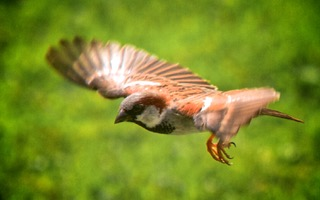
Sparrow in flight
Eighteenth Sunday in Ordinary Time
i. Brevity
One word comes to my mind when reflecting on this Sunday's readings, and that is 'brevity', in particular the brevity of human existence, Qoheleth in our first reading from Ecclesiastes doesn't exactly give us the term, but he talks about the emptiness, the vanity of human life when cut off from God. Part of the opening of Chapter 1, which doesn't form part of our main reading this Sunday makes this point: One generation departs and another generation comes, but the world forever stays'.(Ecc 1:4)
This may well be obvious but where is his thought taking us? I believe, but this is my perception, that we are being made to face the egoism of human life and helped to understand that it has a frailty-where success can change, health can suddenly turn into illness, where in fact everything has its limitations. But as Qoheleth and our readings will show, when this is frail life is linked firmly to God's presence, things shift, the axis of our world lies not here but in the Kingdom.
ii. Psalm 90: A call to joy
Our responsorial psalm (90) continues this meditation on the passing of life, verse four picks up the more sombre tone of Qoheleth;' A thousand years in your eyes are merely a day gone by.'(Ps 90:4)
Yet before we descend into a form of maudlin depression, the psalmist puts the brakes on any gloom we might have, praying that each of us may in the circumstances of our life gain wisdom of heart, by making the most of each day, beginning with our waking and ending in our sleeping, directing it towards the Living Holy One, so that we may try to live in a different manner, putting our faith and trust in God with hope that we may be surprised by joy: 'Fill us at daybreak with your mercy, that all our days we may sing for joy'. (Ps 90:14)
And joy is a gift much associated with those persons who are open to the presence of the Spirit of the Lord in their daily lives. Seraphim of Zarov one of the most loved of Russian saints, had like Francis of Assisi, a total openness to the presence of the Spirit in all forms of life. Seraphim saw joy as one of the great gifts of the Spirit because it enabled one to understand a little the mystery of suffering, but also see where it ended in the joy of the resurrection of the dead!
This snippet of advice from him allows us to hold on to the notion that life is brief, but eventful. "You cannot be too gentle, too kind. Shun even to appear harsh in your treatment of each other. Joy, radiant joy, streams from the face of one who gives and kindles joy in the heart of one who receives'. This isn't the type of joy that is a sudden flash of delight, here we have a more suffused joy, deep at work through its radiance in our hearts, and shared even unknowingly through our ministry of care and kindness each and every day.
This unknowing joy is perhaps what Paul means when he writes to the Colossians: 'your life is hidden with Christ in God'(Col 2:3) for he too senses that radiant glory coming not only from Christ, but suffusing us, a hint of who we are through Christ but also of what we will become, and where we are going, for life is a pilgrimage to the Kingdom. Paul reminds us that we are very much a new self and need to put off those shackles which bind us, for even if we perceive them differently they have to be let go in order that we might be all in all in Christ!
iii. Bede's parable of the sparrow.
I keep thinking about the venerable Bede's description of human life as a sparrow flying through the great hall, coming in from the dark, finding the warmth and lift for a moment and then going out to who knows where, he is talking to the King of Northumbria about pagan life of the unknowingness of our place in this short time we have. In one sense we are like that sparrow, where we came from we do now know, and yet begin to learn in the outpouring of Divine love that comes to us in hints and guesses, that the Creator knew us before we were in our Mother's womb and when we are gone from this life, will be there to welcome us home. For the Christian this is a joy that surprises us , but also fills us with a deeper purpose.
Here are Bede's words on that brevity of life:
" The sparrow, flying in at one door and immediately out at another, whilst he is within, is safe from the wintry tempest, but after a short space of fair weather, he immediately vanishes out of your sight, passing from winter to winter again. So this life of man appears for a little while, but of what is to follow or what went before we know nothing at all." But this is not the end of the image for in another last sentence, Bede then points out that in Christ we do have knowledge and hope, going into the dark is going out to a greater encounter, to his own wonderful image of Christ the never ending Morning Star. This is his hint: 'Therefore, if this new lore brings anything more certain and more wise, it is worthy of that that we follow it'. A very different twist on things!
In practical terms the teaching of Jesus in the gospel today hands us the tools to cope with the shortness of life, and that is to place it in a bigger context, our life of faith that shall not end. There is nothing wrong in possessions or wealth themselves, it is what we do with them and how we use them for good which matters, but at all times the Lord gives us this mantra : 'be rich in what matters to God!'. Amen.
Lectio
From St Bedes Ecclesiastical History of the English People
The parable of the Sparrow
It seems to me thus, dearest king, that this present life of men on earth, in comparison to the time that is unknown to us, [is] as if you were sitting at your dinner tables with your noblemen, warmed in the hall, and it rained and it snowed and it hailed and one sparrow came from outside and quickly flew through the hall and it came in through one door and went out through the other. Lo! During the time that he was inside, he was not touched by the storm of the winter. But that is the blink of an eye and the least amount of time, but he immediately comes from winter into winter again. So then this life of men appears for a short amount of time; what came before or what follows after, we do not know. Therefore, if this new lore brings anything more certain and more wise, it is worthy of that that we follow it.'
St Seraphim of Sarov the Wonderworker
"Acquire the Spirit of Peace and a Thousand Souls Around You Shall Be Saved" ( St Seraphim of Sarov )
"My joy, I beg you, acquire the Spirit of Peace. That means to bring oneself to such a state that our spirit will not be disturbed by anything. For one must go through many sorrows to enter the Kingdom of Heaven. This is the way all righteous men were saved and inherited the Heavenly Kingdom…" -St Seraphim of Sarov, from his conversation with N Motovilov.
"Oh, if you only knew what joy, what sweetness awaits a righteous soul in Heaven! You would decide in this mortal life to bear any sorrows, persecutions and slander with gratitude…."
One should always endure all things with gratitude, for God's sake.
Our life is but a minute in comparison with eternity. Therefore, according to the Apostle, "the sufferings of this present time are not worthy to be compared with the glory to come which shall be revealed in us" (Romans 8:18).
When someone disparages and abuses you, try as far as possible to forgive him, in accordance with the Gospel: "Of him that taketh away thy goods ask them not again" (Luke 6:30).
When people revile us, we should consider ourselves unworthy of praise. If we were worthy, all would defer to us.
We should always and foremost humble ourselves, following the teaching of St. Isaac of Syria: "Humble yourself and you will see the glory of God within yourself."
Therefore let us love humility, and we shall behold the glory of God. His glory is imparted to us in proportion as we become humble.
If there were no light all things would be dark. Similarly, without humility there is nothing in man but darkness.
 Facebook
 Twitter
 LinkedIn
 Print
Print Email
Email















 Facebook
 Twitter
 YouTube
 LinkedIn
 Pinterest