


Gospel in Art: Jesus further instructed the Twelve
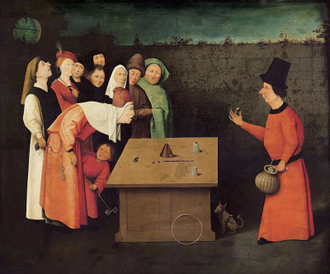
The Conjurer, by Hieronymus Bosch © Saint-Germain-en-Laye Civic Museum, France
Source: Christian Art
Gospel of 13 July 2024
Matthew 10:24-33
Jesus instructed the Twelve as follows: 'The disciple is not superior to his teacher, nor the slave to his master. It is enough for the disciple that he should grow to be like his teacher, and the slave like his master. If they have called the master of the house Beelzebul, what will they not say of his household?
'Do not be afraid of them therefore. For everything that is now covered will be uncovered, and everything now hidden will be made clear. What I say to you in the dark, tell in the daylight; what you hear in whispers, proclaim from the housetops.
'Do not be afraid of those who kill the body but cannot kill the soul; fear him rather who can destroy both body and soul in hell. Can you not buy two sparrows for a penny? And yet not one falls to the ground without your Father knowing. Why, every hair on your head has been counted. So there is no need to be afraid; you are worth more than hundreds of sparrows.
'So if anyone declares himself for me in the presence of men, I will declare myself for him in the presence of my Father in heaven. But the one who disowns me in the presence of men, I will disown in the presence of my Father in heaven.'
Reflection on the painting
In today's gospel reading, following on from the one we heard yesterday, Jesus continues to instruct his disciples before sending them out on their first independent mission to spread the Good News. As always, whatever he tells his disciples also applies to us. Today he is instructing us that our ministry requires focus. We always need to keep the big picture in mind, yet we also need to pay attention to the detail if we want to be successful in our ministry.
Just as focus is essential in ministry, it is crucial in art. Artists often highlight a specific section or detail, directing the viewer's eye to the painting's focal point. For instance, when drawing a landscape that includes a mountain, a house with a road leading to it, and perhaps some sheep and people, the artist must decide on the focal point. Is it the house, the people, or the mountain? The chosen focal point helps the viewer to read the painting more easily and understand its subject.
Our painting by Hieronymus Bosch, 'The Conjurer,' painted between 1496 and 1520, has a very clear focal point. If you draw two diagonal lines from each corner of the painting, the centre point is the conjurer's cup. Our eye is immediately drawn to it, even before noticing the surrounding figures. The conjurer, situated on the right, captivates and entertains his audience with a game of cups and balls. The central character on the left, a man of rank, leans forward with his eyes fixed on the pearl in the conjurer's hand, unaware that his money purse is being stolen. His misplaced focus makes him vulnerable to deception. Bosch uses animals to symbolize human traits that allow for such deception and victimization. The little owl emerging from the conjurer's basket signifies cunning intelligence, while the frog jumping out of the victim's mouth represents the extent to which he has abandoned reason and succumbed to animalistic impulses.
This illustration of focus in art mirrors the lesson in today's gospel: just as an artist's focus guides the viewer's understanding, our spiritual focus directs our path and ensures we remain vigilant and true to our mission.
LINKS
Gospel in Art: https://christian.art/
Today's Reflection: https://christian.art/daily-gospel-reading/matthew-10-24-33-2024/
 Facebook
 Twitter
 LinkedIn
 Print
Print Email
Email












 Facebook
 Twitter
 YouTube
 LinkedIn
 Pinterest