


Gospel in Art: Feast of Saint Cecilia
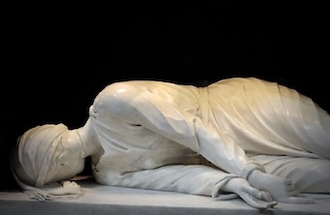
Saint Cecilia, by Stefano Maderno, 1599-1600 © Santa Cecilia in Trastevere, Rome / Christian Art
Source: Christian Art
Gospel of 22 November 2023
Luke 19:11-28
While the people were listening, Jesus went on to tell a parable, because he was near Jerusalem and they imagined that the kingdom of God was going to show itself then and there. Accordingly he said, 'A man of noble birth went to a distant country to be appointed king and afterwards return. He summoned ten of his servants and gave them ten pounds. "Do business with these" he told them "until I get back." But his compatriots detested him and sent a delegation to follow him with this message, "We do not want this man to be our king."
'Now on his return, having received his appointment as king, he sent for those servants to whom he had given the money, to find out what profit each had made. The first came in and said, "Sir, your one pound has brought in ten." "Well done, my good servant!" he replied "Since you have proved yourself faithful in a very small thing, you shall have the government of ten cities." Then came the second and said, "Sir, your one pound has made five." To this one also he said, "And you shall be in charge of five cities." Next came the other and said, "Sir, here is your pound. I put it away safely in a piece of linen because I was afraid of you; for you are an exacting man: you pick up what you have not put down and reap what you have not sown." "You wicked servant!" he said "Out of your own mouth I condemn you. So you knew I was an exacting man, picking up what I have not put down and reaping what I have not sown? Then why did you not put my money in the bank? On my return I could have drawn it out with interest." And he said to those standing by, "Take the pound from him and give it to the man who has ten pounds." And they said to him, "But, sir, he has ten pounds…". "I tell you, to everyone who has will be given more; but from the man who has not, even what he has will be taken away.
'"But as for my enemies who did not want me for their king, bring them here and execute them in my presence."'
When he had said this he went on ahead, going up to Jerusalem.
Reflection on the sculpture
Today we celebrate the feast of Saint Cecilia. Little is know about her life. Born in Rome in the late 2nd Century AD, she suffered martyrdom circa 230AD under Roman Emperor Alexander Severus (reign 13 March 222 - 22 March 235). According to legend, despite her vow of virginity, her parents forced her to marry a pagan nobleman named Valerian. During the wedding, Cecilia sat apart singing to God in her heart, and for that, she was later declared the saint of musicians. When the time came for her marriage to be consummated, Cecilia told her husband that watching over her was an angel of the Lord, who would punish him if he sexually violated her but would love him if he respected her virginity. According to legend, when Valerian asked to see the angel, Cecilia replied that he could see the angel if he would go to the third milestone on the Via Appia and be baptised by Pope Urban I. Out of love for his wife, he followed her advise and then saw the angel standing beside her, crowning her with a chaplet of roses and lilies.
Today's marble sculpture of Saint Cecilia by Stefano Maderno, executed in 1599-1600, shows Cecilia extending three fingers with her right hand and one with her left, testifying to the Trinity: one God , three persons (Father, Son, Holy Spirit). The sculpture beautifully conveys a heaviness which recalls the weight of a body no longer living. Note also the thin but very noticeable slash in Cecilia's neck, the mark of her beheading.
Stefano Maderno's sculpture is said to replicate the way that Antonio Bosio (born in Malta in 1575, he was the founder of Christian archeology in Rome and the first scholar to apply the study of ancient Christian texts to a systematic investigation of the Roman catacombs) described the Saint at the moment of her discovery: 'namely on her side, uncorrupt, clothed in drapery, and with her veiled hair turned eerily towards the ground'. This fostered a legend that our sculpture was modelled on the very corpse of St Cecilia herself. However, it has since been concluded that the statue is Maderno's own composition, inspired by the words of Bosio as well as studies of ancient sculptures.
LINKS
Gospel in Art: https://christian.art/
Today's Reflection: https://christian.art/daily-gospel-reading/luke-19-11-28-2023/
 Facebook
 Twitter
 LinkedIn
 Print
Print Email
Email















 Facebook
 Twitter
 YouTube
 LinkedIn
 Pinterest