


Nuncio addresses UN on Middle East, Palestinian question
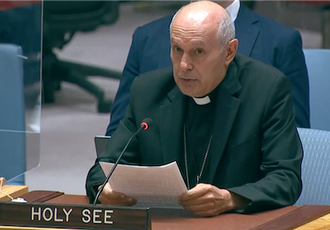
Archbishop Caccia delivers statement
Source: Holy See Mission
Yesterday, 26 July, Archbishop Gabriele Caccia, Permanent Observer of the Holy See to the United Nations, delivered a statement to the Security Council during an Open Debate on the situation in the Middle East, including the Palestinian question.
In his remarks, Archbishop Caccia began by highlighting that since the adoption of resolution 2334 half a decade ago, the international community remains no closer to the achievement of an independent and sovereign Palestinian State or to the realization of the right of Israelis to security, within internationally recognized, pre-1967 borders. He cited the Secretary-General's most recent report, which found an increase in daily violence throughout the Occupied Palestinian Territory and Israel, and the deadliest terrorist attacks in years. The Holy See renews the expression of its deepest regret at the death of civilians killed during those attacks, Archbishop Caccia stated.
The Holy See expresses its deepest sorrow at the death of Ms Shireen Abu Akleh, a Catholic journalist shot and killed in Palestine on 11 May, Archbishop Caccia said. He further relayed the Holy See's condemnation of the behaviour of the Israeli police before Ms Akleh's funeral at the Catholic Hospital of Saint Joseph in Jerusalem.
The Holy See also notes with concern the heightened tensions around the Holy Places in Jerusalem, Archbishop Caccia said, which form an important spiritual and cultural heritage for the whole of humanity. He stated that the Holy See delegation reaffirms its appeal for all parties to maintain the historic status quo within Jerusalem.
In the face of Palestine's many challenges, Archbishop Caccia said, the Holy See reiterates the need for all parties to respect international law, refrain from inflammatory rhetoric, and reject all forms of violence; these commitments are vital for the fostering of genuine encounter, dialogue, and accompaniment on the path to peace. Only along this path, he stated, can a lasting two-State solution be realized.
Addressing the situation in the wider Middle East, the Holy See welcomes the renewal of the Syrian cross-border mechanism for six months, Archbishop Caccia said, though would have preferred a longer extension; he also expressed the Holy See's support for the extension and consolidation of the current truce in Yemen and conveyed the delegation's concern about over-compliance with sanctions in both Syria and Yemen.
The full text of the statement follows.
Statement by HE Archbishop Gabriele Caccia, Apostolic Nuncio, Permanent Observer of the Holy See during Security Council Open Debate on The Situation in the Middle East, Including the Palestinian Question
New York, 26 July, 2022
Mr President,
The Holy See would like to thank the Brazilian Presidency for convening an open debate on this important topic.
Over half a decade since the adoption of resolution 2334, we remain no closer to the achievement of an independent and sovereign Palestinian State or to the realization of the right of Israelis to security, within internationally recognized, pre-1967 borders. This lack of progress is compounded by the fact that, according to the Secretary-General's most recent report, the situation features "the highest number of settlement units advanced since October 2020", "an increase in daily violence throughout the Occupied Palestinian Territory and Israel" and "the deadliest" terrorist attacks in years. In this regard, the Holy See renews the expression of its deepest regret at the death of the civilians killed during those attacks.
Concerning the death of Ms Shireen Abu Aqleh, a Catholic journalist who was shot and killed in the exercise of her profession in Jenin (Palestine) on 11th May, the Holy See expresses its concern and deepest sorrow, as already communicated to the Israeli and Palestinian authorities. Regarding the events that occurred at the Catholic Hospital of Saint Joseph in Jerusalem before her funeral, my delegation cannot but condemn the behaviour of the Israeli police.
Furthermore, the war in Ukraine has threatened the food security of Palestinian families, as well as other civilians throughout the wider region. In light of increased costs due to rising food prices, my delegation encourages all States to consider additional contributions to the UN Relief and Works Agency for Palestine Refugees in the Near East (UNRWA).
The Holy See also notes with concern the heightened tensions around the Holy Places in Jerusalem. These sites form an important spiritual and cultural heritage for the whole of humanity. In his Easter message this year, Pope Francis expressed the hope that "Israelis, Palestinians and all who dwell in the Holy City, together with pilgrims, experience the beauty of peace, dwell in fraternity and enjoy free access to the Holy Places in mutual respect for the rights of each."[1] In this regard, my delegation reaffirms its appeal for all parties to maintain the historic status quo within Jerusalem, the city of peace, and rejects any unilateral measures aimed at changing it, including attempts to alter the multicultural and multi-religious character of the Holy City, which is dear to Jews, Christians, and Muslims alike.
Mr President,
In the face of Palestine's many challenges, the Holy See reiterates the need for all parties to respect international law, refrain from inflammatory rhetoric, and reject all forms of violence. Such commitments are vital for the fostering of genuine encounter, dialogue, and accompaniment on the path to peace. It is only along this path that a lasting two-State solution can be realized. My delegation urges political leaders on all sides to demonstrate the requisite will to nurture the trust necessary for resuming final status negotiations.
Now, please allow me to offer a few words on the situation in the wider Middle East. The Holy See welcomes the six-month renewal of the Syrian cross-border mechanism, though a longer extension to allow aid organizations to better plan deliveries would have preferred. Given the immense humanitarian needs of the Syrian people, which are at their highest level since the war began, the cross-border mechanism should remain in place until the situation improves and cross-line deliveries can adequately address the Country's humanitarian challenges.
Turning to Yemen, my delegation welcomes the extension and consolidation of the current truce. It is the hope of the Holy See that the ceasefire can pave the way toward lasting peace, facilitate the distribution of aid and contribute to early recovery efforts.
In both Syria and Yemen, my delegation notes with concern the issue of over-compliance with sanctions, in which banks place burdensome requirements on aid organizations or even refuse to do business with them altogether out of fear of punishment, despite the existence of humanitarian exemptions. To tackle this issue, the Holy See encourages all States implementing sanctions to provide precise guidance on permitted activities to financial institutions so that the flow of humanitarian assistance is not impeded. Here, my delegation would like to recall the words of the Holy Father, who has insisted that, "the imposition of sanctions should not strike directly at everyday life, in order to provide a glimmer of hope to the general populace, increasingly caught in the grip of poverty."[2]
I thank you Mister President.
[1] Pope Francis, Urbi et Orbi Message, 17 April 2022.
[2] Pope Francis, Address to the Members of the Diplomatic Corps accredited to The Holy See, 10 January 2022
 Facebook
 Twitter
 LinkedIn
 Print
Print Email
Email





 Facebook
 Twitter
 YouTube
 LinkedIn
 Pinterest