


Sunday Reflection with Canon Robin Gibbons - 27th June 2021
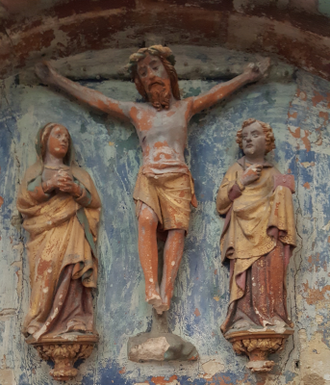
Laon Cathedral Image: RG
Thirteenth Sunday in Ordinary Time - 27th June 2021
Isn't it funny how one phrase in a reading or song can stick out a mile and refuse to let your mind keep quiet! Of all the three readings for this Sunday the mantra that keeps popping into my head is this:
"Because God did not make death,
nor does he rejoice in the destruction of the living".(Wis 1:13)
I must have sat in silence for at least 30 minutes trying hard to fathom what this means, yes, I can go to a concordance or look up some explanation, but it speaks to me differently, for now, at my age, as death itself becomes far more of a reality than it ever has done.
I'm aware I am no longer fobbed off by pious explanations or abstruse theology, for me, as for many, this type of quote can be profoundly disturbing.
I have only to read the paper, listen to the Radio, look on multi media to see little that fills me with a profound joy at this sentence, instead too much destruction, too much annihilation especially by God's so called friend, the human being, too many needless deaths makes me profoundly uneasy. So what can I do?
Perhaps I can start by sharing this, I often feel exasperated, angry, needing consolation.like the people in the play 'The Trial of God', by Elie Weisel, set in a fictional 'trial ' held by the Rabbis in 1649 in the Ukraine, although we must remember these insights were also based on true events witnessed by Weisel in Auschwitz. This demand that God become a defendant, answer for the misdeeds experienced in the world is nothing new, nor is it a bad thing, it shows we desperately care, seek, need, in our curious way, and want to really love the real God, not the one we are told about! When asked about the story of the trial of God in Auschwitz, which many believed was a fictional story (how dare they put the Most High on trial?), Weisel gave this poignant earth shattering ( at least for me) answer: '"Why should they know what happened? I was the only one there. It happened at night; there were just three people. At the end of the trial, they used the word chayav, rather than 'guilty'. It means 'He owes us something'. Then we went to pray."(The Jewish Chronicle, article by Jenni Frazer, September 19, 2008).
This is where we find ourselves stuck in that reading from Wisdom, asking questions, waiting for God to answer. This is where I get to when I ask the same questions, but then as with the Rabbi's answer, after all my wrestling I instinctively turn to prayer, Yes, God does owe me an answer, will I get it? I think 'yes' is the reply. But how? It is something to do with creation and ourselves being 'imago dei', in the image of God. This clue places on us a huge burden, as God's image we ourselves too often fail , evil is our doing, that's the truth, not Gods doing. But how can we restore that image, how can we find a way out of the death we all face? By another Icon, another Image of God that is true, whose trial was a travesty, whose own death shatters the time frame we live in, turns all we know upside down, Jesus the Christ.
The other readings of this Sunday lay before us the simplicity of God in Jesus, he is there, just as he is in our here and now. He cannot take away physical death, but he destroys it as THE ENDING,and he will bring us to immortal life, to become a new creation.
That's my hope. for as Paul writes in 2 Corinthians, it is Christ who does things for our sake, for us and for all. The Word does not abandon us, God is not absent, any trial we make of the misdeeds of the Most High is not answered by argument or anger, but instead by love, compassion, and deep understanding for the problems all of creation. It is Christ who gives us the true verdict. As he did to the little girl he will pull us out of physical death and say to each of us:' little one, arise'! As his power healed the woman with the haemorrhage, he too calls us to touch him in faith, to all of our doubts lamentations, anger, frustrations in faith, he sweeps away our tears and says as he did to the synagogue official: "Do not be afraid; just have faith." (Mk 5: 36)
But what is faith? Where do we weary ones find it for ourselves, perhaps here in great simple love, as in the quote from Dostoyevsky's 'The Grand Inquisitor':
"He [the Grand Inquisitor] saw that the Prisoner [Christ] had listened intently and quietly all the time, looking gently in his face and evidently not wishing to reply. The old man longed for Him to say something, however bitter and terrible. But He suddenly approached the old man in silence and softly kissed him on his bloodless aged lips. That was all his answer. (Dostoyevsky, The Brothers Karamazov. V. 5.)
Lectio Divina
Hope: a quote from Steven Hawking
"Remember to look up at the stars and not down at your feet. Try to make sense of what you see and wonder about what makes the universe exist," Hawking said of the meaning of life. "Be curious. And however difficult life may seem, there is always something you can do and succeed at."
From Robert Brown's Introduction to Elie Wiesels 'The Trial of God'
The trial lasted several nights. Witnesses were heard, evidence was gathered, conclusions were drawn, all of which issued finally in a unanimous verdict: the Lord God Almighty, Creator of Heaven and Earth, was found guilty of crimes against creation and humankind. And then, after what Wiesel describes as an "infinity of silence", the Talmudic scholar looked at the sky and said "It's time for evening prayers", and the members of the tribunal recited Maariv, the evening service. (Brown, Robert McAfee, in the Introduction to The Trial of God, p. vii)
Extract from the poem, The Gates of Paradise
by Dorothy Sayers
…Come hither, come hither thou darkling man
And bear me company
This lamp I hold will give us light
Enough for thee and me
Judas walked with the grey-clad man
And fear is in his heart
Speak yet again thou man in grey
And tell me what thou art
I bought a burden of deadly sin
And needs must pay the price
I bear it hither in my hand
To the gates of paradise
Sin cannot lie upon thy heart
So heavy as on mine
Nay, sinner whosoever thou art
Tis a heavier load than thine
He hath not asked Judas' name
And Judas makes no sign
If sin is heavy on thy heart
And I must bear its weight
It is fit that we should go together
To tryst at Hades gates
Judas walked with the grey-clad man
And feared to tell his name
He clasped his hand in the barren land
Bright burned the lanterns flame
Brotherli-wise and hand in hand
To paradise they came
Satan looked out from Hades gate
His hand upon the key
Good souls before I let you in
First tell me who ye be
We be two men that died of late
And come to keep hell tryst,
This is Judas Iscariot
And I am Jesus Christ
Fr Robin is an Eastern Rite Catholic Chaplain for Melkites in the UK. He is also an Ecumenical Canon of Christ Church Cathedral, Oxford. You can follow him on Twitter: @RobinGibbons2
 Facebook
 Twitter
 LinkedIn
 Print
Print Email
Email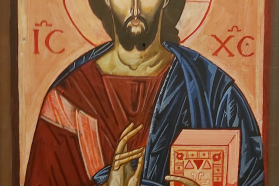








 Facebook
 Twitter
 YouTube
 LinkedIn
 Pinterest