


Today's Gospel in Art - John the Baptist appeared in the wilderness
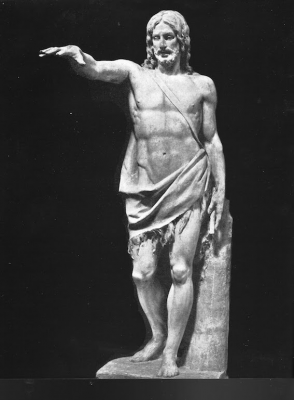
St John the Baptist by Jean-Baptiste Houdon 1808 © Galleria Borghese / Christian Art
Gospel of 6th December 2020 - Mark 1:1-8
The beginning of the Good News about Jesus Christ, the Son of God. It is written in the book of the prophet Isaiah:
Look, I am going to send my messenger before you;
he will prepare your way.
A voice cries in the wilderness:
Prepare a way for the Lord, make his paths straight.
and so it was that John the Baptist appeared in the wilderness, proclaiming a baptism of repentance for the forgiveness of sins.
All Judaea and all the people of Jerusalem made their way to him, and as they were baptised by him in the river Jordan they confessed their sins.
John wore a garment of camel-skin, and he lived on locusts and wild honey. In the course of his preaching he said, 'Someone is following me, someone who is more powerful than I am, and I am not fit to kneel down and undo the strap of his sandals. I have baptised you with water, but he will baptise you with the Holy Spirit.'
Reflection on the Sculpture
Today's reading is the very start of the Gospel of Saint Mark. And the first person Mark introduces is St John the Baptist. The root of St John's message is simple but profound: 'Life is not about me'. St John didn't preach about himself, he preached about someone else, someone who would come after him: Jesus. John wasn't interested in being the centre of attention. He wasn't interested in the praise of others. He was only interested in preparing the way for Christ, and he didn't let personal ambition get in the way.
St John's message was as startling as his physical appearance. He was not a richly clothed man. As we read in our reading today, he wore a scratchy camel's hair cloak and stuck to a diet of locusts. Our sculpture by Jean-Baptiste Houdon, here at the Borghese Gallery in Rome, depicts this contrast between a confident regal pose and the camel hair cloak. The leather pilgrim's belt round his chest reminds us of his long period of isolation before he burst onto the public scene to preach about the need for a baptism of repentance for the forgiveness of sins.
What is interesting about this sculpture is that Houdon first made an écorché for this sculpture. An écorché is a figure drawn, painted, or sculpted showing the muscles of the body without skin. These are usually highly academic sculptures, to really define the study of the body. I share with you the image of the écorché which Houdon did, before sculpting the figure of St John the Baptist. As a result of the study of the body, we have a perfectly toned and sculpted figure of St John. St John prepared the way for Christ's perfect obedient sacrifice of love...The écorché model prepared the way for the final version of the sculpture...
LINKS
Today's story - https://christian.art/en/daily-gospel-reading/628
Christian Art - www.christian.art/index.php
 Facebook
 Twitter
 LinkedIn
 Print
Print Email
Email













 Facebook
 Twitter
 YouTube
 LinkedIn
 Pinterest