

The Passion in Seven Objects: 4 . The Cross
In the days leading up to Easter we try to enter more deeply into what Jesus is doing as he walks the way to the cross. I offer these brief meditations in that spirit, each day using one of the objects that appears in the gospels.
8th April
4. THE CROSS
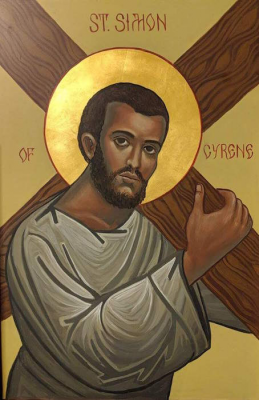
They compelled a passer-by, who was coming in from the country, to carry his cross. It was Simon of Cyrene (Mark 15: 21a).
Was Simon of Cyrene plucked at random from the crowd, or had he made some sign of his sympathy with Jesus? It might be the latter, and a soldier, seeing this, lights on him: 'You agree with this man? Very well. Take a turn in carrying the cross then.' Not only is this incident commemorated in all three synoptic gospels, but the verse quoted above goes on to name his children as Alexander and Rufus, suggesting that Simon was well known to the fledgling Christian community. So there is a strong possibility that Simon had links with the followers of Jesus, and they remembered him afterwards.
Jesus, already weakened from the scourging, is staggering under the weight of the cross. Then, suddenly, a command is snapped, and Simon is grabbed from the crowd and forced to take the cross-beam from the condemned man. It's always the same with the cross. There is an element of compulsion. Sometimes we quote a little glibly the words of Jesus about taking up our cross and following him, but it's not usually something that we take up, more something that we accept after it has been thrust on us. On that day, Simon of Cyrene was abruptly told to do it. And in any real cross in life, we too have no choice.
You can't wriggle free from the cross. Disabled people coping with their disability. People caring for a partner with dementia. A marriage that is somehow going sour. A boss who treats you shabbily in a job that is financially essential for you. Being bullied at school or in social media. An autistic child. Addictions. Bereavement. Sometimes we can come to terms with our cross. But for a time, or even for a lifetime, it is there on our shoulders. Others like Simon of Cyrene can come to our aid, but essentially the burden is ours
Carrying our cross - and helping others with theirs - is often a case of doing our duty. This doesn't mean that love is not present. Love takes many forms. It can be honouring a commitment. Or making a fresh start. Love can require stoicism or courage. Love can co-exist with exhaustion, irritation or even anger. Dorothy Day, the American writer, pacifist, rebel and founder of the Catholic Worker movement, liked to quote some startling words from Dostoevsky: 'Love in action is a harsh and dreadful thing compared to love in dreams'. She lived with the poor. She opened her doors to the homeless. She campaigned against war and on behalf of exploited workers. Her diaries show that she found it hard and had to struggle with depression at times. On some occasions she wanted to run away and live alone. She persevered. Love and determination are often partners in carrying the cross, or helping others to carry theirs.
A final thought. Cyrene is in north Africa, in what today would be Libya, so the only one to help Jesus carry the cross was a son of Africa. This should be a source of pride for the people of Africa. They may also feel that it has often been their lot to help others carry their burden. Step into any care home in Britain today and you will find that many of the carers come from countries such as Nigeria, Ghana, Kenya, Zimbabwe. And, we ought to add, from the Philippines. This ministry of caring for our elderly is carried out without heroics and is often underestimated in importance, just as we underestimate the cost to those who cross oceans to help feed their families.
Jesus, you called us friends,
and friends are there for one another.
Looking on you walking that path,
we yearn to help you,
but wonder if we have the strength, the courage.
You turn to us and remind us
that you will be found among the struggling people of the world,
who long for someone to help them with their cross.
And you tell us also that when we carry our own,
your shoulder will be there to help us too.
Give us this sense of your presence, this blessing, we pray.
 Facebook
 Twitter
 LinkedIn
 Print
Print Email
Email













 Facebook
 Twitter
 YouTube
 LinkedIn
 Pinterest