
CAFOD welcomes EU agreement on transparency legislation for mining sector
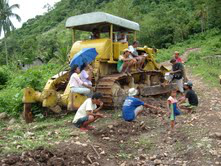
Philippines: protesters try to block road
For 10 years CAFOD partners and campaigners have been calling on the UK government for new laws to ensure people in developing countries can find out about and benefit from the activities of oil, gas and mining companies working in their communities. Last night these transparency laws were finally agreed by EU member states in a provisional deal with the European Parliament.
CAFOD private sector analyst Anne Lindsay said: “Today CAFOD can celebrate the achievement of a long-held goal to make some of the world’s richest companies more accountable. For 10 years we have been pressing for mandatory reporting requirements for oil and mining companies through the global Publish What You Pay campaign. That demand will now become a reality.”
The new EU Accounting and Transparency Directives will now include project-by-project, as well as country-by-country, reporting, so that communities have meaningful, detailed information about the money their governments are receiving from extractives companies. They also include a helpful definition of ‘project’ linked to the legal agreement, contract or licence, rather than leaving companies free to decide their own definitions.
Anne added: “Currently too many poor communities living in resource-rich countries do not see the benefits from foreign mining operations. Zambia is rich in copper with a thriving export market and yet, with one doctor per 10,000 people and life expectancy at just 47 years, the country is still trapped in a cycle of aid dependency. Being required to report payments made to them by companies will encourage government officials to make sure that natural resource deals, often worth millions of pounds, are in the best interests of their people.”
The new agreement rules out exemptions or loopholes which could allow unscrupulous companies to find ways out of disclosing the payments they make. Vitally, it also includes a low payment threshold for disclosure, so that payments over 100,000 Euros will be made public. Industry lobbyists had tried to set this threshold much higher at 1 million Euros.
Responding to the agreement between the European Council and the European Parliament, CAFOD director Chris Bain said: “This is a huge step forward for the millions of poor women and men living in countries rich in oil, gas and minerals. Finally they will know the details of the payments companies are making to their government for each project, so that they can hold their government to account concerning how the money raised from their natural resources is being used.
“The UK government has listened to thousands of CAFOD and Publish What You Pay campaigners who have petitioned MPs, MEPs and ministers by letter, email and in person over the last two years. We are now looking to the other members of the G8 to follow the example of the US and Europe and set a truly global standard.”
Background
PWYP’s 10 years of work culminating in the agreement on the EU Accounting and Transparency Directives has included CAFOD's Open the Books campaign calling on the UK government to champion country-by-country reporting, with a mass lobby of Parliament – Tea time for change - in June 2011 which saw hundreds of supporters sit down with their MPs to discuss the issues. The Prime Minister responded in July 2011 by endorsing the call on the EU to ask extractives companies to publish what they pay for the minerals they take.
In February 2012, CAFOD supporters urged UK government ministers to close the loopholes in the proposed EU legislation. Then, during a tour of Europe last summer, Nobel prize winner Aung San Suu Kyi gave her support to calls for businesses to open up their books.
In September 2012, the European Parliament’s Legal Affairs Committee voted in favour of a proposal for equally stringent rules and suggested applying country-by-country reporting to other sectors. Business Minister Jo Swinson made a public commitment that the UK would play a leading role in negotiating a strong transparency law to cover the extractive industry.
In 2010, exports of oil, gas and minerals from Africa were worth roughly seven times the value of international aid to the continent. Taken together, the United States and the European Union represent 73 per cent of the value of the world’s publicly listed oil, gas and mining companies.
CAFOD is a member of the Publish What You Pay coalition. Publish What You Pay (PWYP) is a global network of more than 650 civil society organisations that are united in their call for oil, gas and mining revenues to form the basis for development and improve the lives of citizens in resource-rich countries. PWYP undertakes public campaigns and policy advocacy to achieve disclosure of information about extractive industry revenues and contracts.
 Facebook
 Twitter
 LinkedIn
 Print
Print Email
Email



 Facebook
 Twitter
 YouTube
 LinkedIn
 Pinterest