

Visiting the home of St Anthony's Messenger Magazine
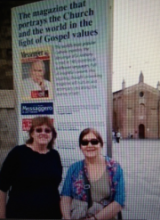
Ellen and Jo in Padua
If you have written for St Anthony's Messenger for as long as I have - around 15 years - it's about time to visit the magazine's base in Padua. The prompt came from Jo Siedlecka, who now also writes for the Magazine's International Edition, as well as being the editor of Independent Catholic News. We spent a long weekend in Padua in early October, enjoying the tail end of summer 2012 and discovering the background inspiration for the world's most popular Catholic monthly. The magazine is read in 148 countries in eight different languages.
Padua is famous for having been home to St Anthony, a Franciscan friar who lived and died there at the age of 36 on 13 June 1231. The remains of St Anthony are preserved in the Basilica of St Anthony, the destination of many pilgrims from around the world and one of the city's main attractions. The Messenger offices are in a street alongside and what a lovely welcome the staff gave us, making us feel that we were members of the 'Messenger' family.
St Anthony has always had a special place in my family. When my elderly mother was a girl she was given half a crown by my grandmother and sent off walking to town to buy some food items. Strolling along with a friend and swinging her bag, by the time she arrived at the shop the half crown was gone. They retraced their steps for about a mile but there was no trace of the coin, and both girls were frightened to return home without shopping or money - the early 1930s were hard economic times. The two girls knelt and in desperation prayed to St Anthony. When they stood up, they noticed the half crown on the road at their feet and were able to return to the shop, but not before thanking St Anthony. To this day my mother is devoted to him. She has a large statue of St Anthony in her bedroom and named her first son after him.
That connection people feel with St Anthony was highlighted by Fr Mario Conte, the Franciscan editor of the magazine's International Edition, who gave us a fascinating tour of the Basilica lasting several hours. The enormous building presents a remarkable fusion of styles: Romanesque, Gothic Byzantine and Moorish. The whole time we were there, people were queuing to touch the saint's sarcophagus, offer intercessions and place momentos thanking for blessings received. Fr Mario was present on 6 January 1981 when the original thirteenth century tomb was opened and the remains found, draped in his habit and a red cape. Relics - including his jaw and tongue - remain on show today in reliquaries behind the high altar. Fr Mario was clearly moved when recalling that day.
Fr Mario also walked us around other famous sites of Padua. The building of the Palazzo della Ragione, for example, helped revolutionise construction techniques and designs in the Middle Ages. Beautiful little piazzas in its vicinity were filled with young people from Padua University. Did you know, the first woman to achieve a university degree was Elena Lucrezia Cornaro Piscopia from Padua University in 1678?
Prato della Valle is a great elliptical square, which aside from being the city's largest square is also one of Europe's largest, second only to Moscow's Red Square. The square features a central island green, surrounded by a canal adorned with statues of famous personalities from the past. We shall remember it particularly for the Feast of St Justina on 7 October, when hundreds of Paduans, in medieval dress and carrying candles, processed through the old city and around the Prato della Valle to the Basilica of St Justina, a patron saint of Padua. It was a privilege to join them this year.
Padua's Scrovegni Chapel was massively impressive. Built in the early 1300s by the Scrovegni family, a wealthy Paduan family of bankers, the artist Giotto was commissioned to cover the chapel with frescoes covering a sequence of stories from the Old and New Testaments, culminating in the death and resurrection of Jesus and the Last Judgement. In 1305, after only two years of work, the chapel was decorated throughout and was consecrated a second time. Giotto work in the Scrovegni chapel is considered by many to be his masterpiece. We were only allowed entry for 15 minutes but it was plenty of time to marvel at the genius of the artist and the emotional intensity of his work.
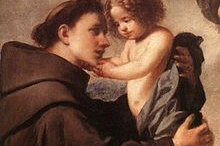
In the last year of Anthony's life, when he became ill, he took respite at the woodland retreat of Camposampiero. There he lived in a cabin built for him in the branches of a walnut tree. This explains all the paintings which show Anthony in a tree; in fact, one by Anigoni covers the back wall of the Basilica. Anthony, following his mentor St Francis, had an affinity with the natural world, and one story tells of him preaching to fish after humans refused to listen, shown in a fresco at Camposampiero. We think of St Anthony finding our lost items, but in Padua Anthony is known for his closeness to God's creatures, his concern for human rights - particularly of women and of people in debt - and of the welfare of children. He once said: "only the poor and humble hear the message of Christ".
On our final morning we heard young people from the chamber choir of the University of Bonn sing beautiful polyphonic music at the high Mass in St Anthony's Basilica. Throughout the Mass members of the international congregation honoured St Anthony at his tomb. This gentle saint is still connecting with devotees nearly 800 years after his death.
For more information on the Messenger of St Anthony see: www.messengersaintanthony.com
 Facebook
 Twitter
 LinkedIn
 Print
Print Email
Email






 Facebook
 Twitter
 YouTube
 LinkedIn
 Pinterest