

Lebanon: Pope praises courage of young Syrians

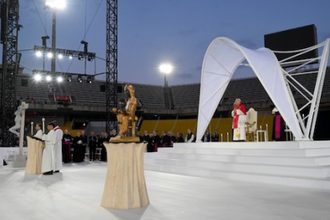
Pope Benedict XVI expressed admiration for what he called "the courage" of Syria's youth on the second day of his visit to Lebanon. The 85 year old Pontiff was addressing an open air meeting of around 15,000 young people at the Maronite Christian patriarchate in Bkirki, a mountain village outside Beirut.
Addressing Syria's youth, the Pontiff said: "I want to tell you how much I admire your courage." He added: "I am sad because of your suffering and your bereavement."
Though the gathering was predominately Christian it was attended by young people from all faiths and none.
Addressing the many Muslims in the crowd the Pope said: "Together with the young Christians, you are the future of this fine country and of the Middle East in general. Seek to build it up together. And when you are older, continue to live in unity and harmony with Christians."
Turing to the region's Christians, the Pope urged them to remain in the Middle East to build a better society for everyone in the region.
He said: "In a constantly changing world you are faced with many serious challenges, but not even unemployment and uncertainty should lead you to taste the bitter sweetness of emigration, which involves an uprooting and a separation for the sake of an uncertain future."
He added: "You are meant to be protagonists of your country's future and to take your place in society and in the Church."
The Vatican has made no secret of its fears about the alarming exodus of Christians from the region in recent years. Because of the political sensitivity surrounding the issue of emigration there are no official statistics but a range of estimates put the current Christian population of the region at five per cent, down from around 20 per cent eighty years ago. Other reports suggest the number of Christians in the Middle East could be halved by the end of the decade.
Earlier in the day, Pope Benedict said religious freedom was fundamental for stability and stressed that forgiveness was key to reconciliation and harmony between cultures and religions. During his speech at the presidential palace in Baabda, northeast of Beirut he said: "Religious freedom has a social and political dimension which is indispensable for peace."
He added: "It is not uncommon to see the two religions within the same family. If this is possible within the same family, why should it not be possible at the level of the whole of society?"
As the Pope was making his speech, a riot broke out at Lebanon's largest gaol in Roumieh as inmates called on the Pope to ask the government to grant them amnesty.
Thousands lined the streets leading to Baabda Palace to greet the Pope including Christians who had travelled from Egypt and Jordan and more than 200 Chaldean Christians, who had travelled from war torn Iraq.
Iraq's Chaldeans are one of the oldest Christian communities in the world and along with other Iraqi Christians suffered persecution in the long bloody aftermath of the 2003 US-led invasion of the country.
The number of Christians living in Iraq has more than halved since the invasion. Prior to the ousting of Sadaam Hussein more than a million Christians lived in Iraq, now there are less than 500,000.
Two years ago Al-Qaeda claimed responsibility for killing 46 Christians including two priests in an attack on a Syriac Catholic church in Baghdad. The Hammurabi Human Rights Organization in Iraq estimates that up to 1,000 Christians have killed and a further 200 have been kidnapped since 2003.
The Pope travelled to Baabda Palace in the now familiar bullet-proof, glass-encased Popemobile. The motorcade was escorted by a presidential guard on horseback. It was also greeted by Lebanese dabke dancers dressed in traditional costume, who performed on the road, a few feet away from the approaching Popemobile.
The Pope's visit comes at the same time as region-wide violence, sparked by a US-made film insulting Islam's Prophet Mohammad, intensified.
Following riots in Tripoli after Friday morning prayers where a demonstrator was killed and posters of the Pope were pulled down, Lebanese religious figures have reiterated their support for the Pope's visit and for the Christians of Lebanon.
Grand Mufti of Lebanon Sheikh Mohammad Rashid Qabbani, in a written message he delivered to the pontiff, said "any attack on any Christian citizen is an attack on Islam". He added: "Muslims and Christians make up one nation and have equal rights and duties."
On Sunday morning the Pope will celebrate an open air Mass at Beirut City Centre Waterfront at 10am. More than half a million people are expected to attend the service where the Pope will also consign the Post-Synodal Apostolic Exhortation.
In the afternoon he will preside at an ecumenical gathering in the Syro-Catholic Patriarchate of Charfet, which will conclude his visit to Lebanon. He is scheduled to leave Lebanon and return to Rome at 7pm.
 Facebook
 Twitter
 LinkedIn
 Print
Print Email
Email





 Facebook
 Twitter
 YouTube
 LinkedIn
 Pinterest