

St Robert Southwell and St Peter Damian
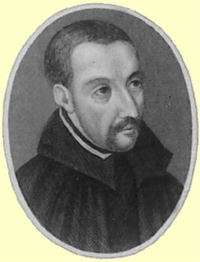
Martyr, Jesuit priest and poet. St Robert was born in Horsham St Faith, Norfolk, in 1561, and spent much of his childhood in Sussex.
He studied at Douai and Paris and wanted to be a priest from his earliest youth. In 1578, when he was barely 17, he was admitted to the Jesuit novitiate in Rome. After his ordination in 1584 he was appointed prefect of studies at the English College. Two years later he was sent to the English mission with fellow Jesuit Henry Garnett. They arrived a year after it had become high treason for a priest trained abroad to be in the country. Harbouring them was also a felony. Robert must have been well aware of the risk he was taking. The Jesuit priest Edmund Campion had been martyred three years earlier.
On his arrival he attended a meeting at Hurleyford House in the Thames Valley, which mapped out a new strategy for the survival of the Catholic Church in England. It was attended by the court composer William Byrd and several leading Catholics of the day. A solemn sung Mass was celebrated.
That day Robert met Anne Dacre, countess of Arundel and Surrey. Her husband was a prisoner in the Tower and Robert visited him there. For the next six years he lived in a small room at Arundel House in the Strand, known only to a few trusted friends and servants. He spent the days in prayer and writing. At night he came out to minister to Catholics in London and the country. It was a dangerous way to live and several times he narrowly escaped being caught by priest-hunters.
In response to the Proclamation of 1591, claiming that Catholics were proscribed for treachery only, not for religion, he composed his Humble Supplication to Her Majesty - a devastating attack on the government.
Despite the secrecy of his existence, he became an influential figure in literary society. Robert's writings were extremely popular with his contemporaries such as Ben Johnson who declared that he wished he had written some of Robert's poems. The best known of his poems are The Burning Babe and Saint Peter's Complaint (1595), in which he made experiments with verse that critics believe were further developed by other poets, including Shakespeare.
In 1592 he was arrested by Richard Topcliffe, a professional priest-hunter who had already tortured, raped and killed a number of recusants. For several weeks he was tortured at Topcliffe's house in Westminster. He was then locked away in the Tower for three years. Finally in 1595 he was put on trial where even the judge expressed shock at the ordeal he had been subjected to by Topcliffe. The sentence however, was inevitable. Robert was hung drawn and quartered at Tyburn, together with a notorious highwayman, in front of a huge crowd. After praying for the country and the Queen he said: "whether we live or die we belong to the Lord... All you angels and saints assist me."
St Robert was the last Catholic to be executed in this way at Tyburn. His reputation went far beyond Catholic circles and his writing and his death helped to work a profound change in the moral climate of England.
He was beatified in 1929 and canonised as one of the Forty Martyrs of England and Wales in 1970.
and St Peter Damian
Bishop of Ostia, Cardinal and Doctor of the Church. Born in Ravenna in 1007, he was the last of seven children. His mother felt she couldn't cope with yet another child and refused to breastfeed him, effectively condemning him to certain death. A friend intervened, taking the child in her arms and scolding the mother who repented of her rash behaviour and took care of him like the others. When she died, Peter was raised first by his sister Rodelinda and then by a brother who treated him and forced him to do the most menial tasks. Finally, he was entrusted to his eldest brother, Damiano, who was Archpriest in a parish near Ravenna and who took care of young Peter and his education. As a sign of gratitude, Peter added the name Damian to his own.
His first biographer, St John of Lodi, recounts two significant episodes of Peter Damian's youth. One day the boy found a coin: delighted, he thought he would buy a cake or a toy. Then, suddenly, he realized that anything he bought would give him only momentary joy, so he decided to take the money to a priest and have a Mass said for his deceased parents. On another occasion, when he was having lunch with a poor blind man, he chose the better quality white bread for himself, and offered the guest the darker bread. At that moment he felt like a bone had stuck in his throat. He repented of his selfishness and the moment he exchanged his own bread with that of the blind man, the bone disappeared. It was this episode that convinced him to consecrate himself to God alone, and to embrace the monastic life.
Driven by a need for solitude, meditation and prayer, Peter Damian retired to the Camaldolese monastery of Fonte Avellana, in the year 1035. He quickly became the spiritual guide of the monks and his fame spread so rapidly that he was invited to teach in other monasteries as well. Returning to Fonte Avellana, he was elected Prior. He reorganized the hermitage and inspired the establishment of new houses in neighboring regions. His fervent activity was noticed by the Bishop of Ravenna who asked for his assistance, obliging him to leave the quiet and recollection of his monastery.
The Church at this time was afflicted by two evils: Simony, the buying and selling of ecclesiastical offices; and Nicolaism, a heretical sect which advocated pagan practices and sexual immorality. Pope Stephen IX called Peter Damian to Rome in 1057 to help him reform the clergy. The Pope quickly made him a Cardinal and Bishop of Ostia. Over the next six years he was sent on missions to Milan to quell an uprising, and later to Cluny, to defend the rights of the Benedictine abbots against the Archbishop of Macon. He worked with Pope Gregory VII in fighting against investiture, after the Emperor, Henry IV, abrogated the right to appoint bishops and abbots, incurring excommunication by the Pope. A few years after the death of Peter Damian, the Emperor begged for pardon and, dressed as a penitent, threw himself at the feet of the Pope at the Castle of Canossa, in 1077.
Returning to his monastery from a peace mission in his hometown of Ravenna, Peter Damian died during a visit to the Benedictine monastery in Faenza. He was immediately acclaimed as a saint by the people. Pope Leo XII proclaimed him a Doctor of the Church in 1828.
 Facebook
 Twitter
 LinkedIn
 Print
Print Email
Email




 Facebook
 Twitter
 YouTube
 LinkedIn
 Pinterest