


The Neanderthal and the Terminator: A Catholic take on the debate around Lethal Autonomous Weapons
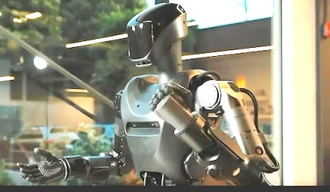
'Killer Robot'
This November UN delegates will gather in Geneva to discuss the regulation and potential prohibition of 'Lethal Autonomous Weapons Systems' in warfare (LAWS) - frequently referred to as 'killer robots'.
LAWS are a special class of weapons system that uses sensor suites and computer algorithms to independently identify a target, and employ an onboard weapons system to engage and destroy the target - without manual human control of the system.
Ahead of the conference, UN Secretary-General Antonio Guterres called for clear prohibitions and restrictions to curb the use of these "merciless and morally repugnant weapons".
Whilst Guterres correctly describes these weapons as 'merciless' - we must acknowledge that these machines resemble us, they discharge and embody the brutality of our will - they are as 'merciless' as us.
The first known deployment of humanoid military robots to an active combat zone took place in February 2026, when two Phantom MK-1 units (manufactured by US company Foundation Future Robotics) were deployed to Ukraine for type-testing in logistics and reconnaissance roles. However, according to Time Magazine, Foundation is also preparing Phantoms for potential deployment in combat scenarios for the Pentagon.
Whilst the discussion around the deployment of LAWS and the automation of warfare more broadly is complex and wide-ranging, several key themes have emerged in critical debate:
The weaponization of technology, the role of technology in human affairs and human oversight of the AI 'kill-chain'.
The weaponization of technology
It was Pope Francis that perhaps best summed-up the weaponization of technology when addressing delegates at a G7 session on AI in 2024.
Pope Francis counselled that "when our ancestors first sharpened flint stones to make knives, they used them to cut hides - and to kill each other. The same could be said of other more advanced technologies, such as the energy produced by the fusion of atoms within the Sun, which could be used to produce clean, renewable energy - or to reduce our planet to a pile of ashes".
Given Man's propensity to weaponize technology and the consequent "tragedy of armed conflict" he concluded that LAWS should be banned, and that "no machine should ever choose to take the life of a human being".
His example spanned the human-epoch, and indeed history demonstrates the depths of Man's barbarism when God is removed from the human horizon, and he elects to use his God-given consciousness and freedom to turn against his own being.
Mindful of this danger, Pope Benedict XVI frequently cautioned that "human freedom must be constantly won to serve love and justice by every generation".
Although several US companies have announced that their humanoid robots will not be utilized in military operations, Foundation's co-founder Mike LeBlanc told The Financial Times that from his point of view, there was "no question of the morality of building a 'Terminator'" and added that "combat is the noblest" of all the tasks that the robots would eventually be able to perform. LeBlanc also told Time Magazine that ultimately "the aim for the robot is to wield any kind of weapon that a human can".
Amnesty International has reported that the US is not alone in investing heavily in the development of lethal autonomous weapons. Sankaet Pathak (Foundation CEO), confirmed this telling Time Magazine that a "humanoid-soldier arms race is already happening". Of course, no weapon once conceived ever lain unused.
The role of technology in human affairs
It is 45 years since Saint John Paul II told scientists assembled in Hiroshima that "they must forge an alliance with the human conscience if Man is to be truly served".
He was drawing on Catholic theology, which teaches that the 'moral-sacred' branch of human reason has primacy over the 'technical-scientific' branch.
The former defines 'what may be done', the latter 'what can be done' - i.e. that the only standards and limits that can constrain science and technology are the current levels of Man's ability to develop it.
In purely scientific-technological terms, it is 'progress' if Man is able to produce weapons that are increasingly powerful in their destructive power.
It is only when a 'moral-sacred' standard has primacy in terms of what 'Man ought to do', and 'to what ends' that civilization can safeguard the proper status of science and technology in human affairs and prevent it from being Man's destruction.
Human oversight of the AI 'Kill-Chain'
The 'Kill-Chain' is the formal military procedure used to identify, track, engage, and destroy an enemy target. AI has now rendered the use of fully autonomous, automated 'human out of the loop' weapons systems possible.
The US government does not currently support a ban on LAWS. A Department of Defense briefing paper of March 2026 states that "human judgment over the use of [lethal] force does not require manual human control of the weapon system - but rather a broader human involvement in decisions about how, when, where, and why the weapon will be employed".
Speaking to Time Magazine, Colby Adcock, co-founder and CEO of Scout AI, declared that "there are [AI] agents that can replace all of the kill-chain, and they're way better and faster and smarter".
"Way better, faster and smarter" is a phrase that should chill us. It is Eichmann's efficiency of death; the meticulous precision, the speed of annihilation.
According to Intelligence Community News, Scout AI booked $11 million in contracts with the Department of War in its first year, and publicly demonstrated a fully autonomous, end-to-end strike mission executed by AI agents.
In the encyclical Magnifica Humanitas Pope Leo wrote "the development and use of AI in warfare must be subject to the most rigorous ethical constraints, to guarantee respect for human dignity and the sanctity of life. Additionally, that "the decision to use lethal force cannot be delegated to opaque or automated processes, but must remain under effective, self-aware and responsible human control".
Prior to the UN conference, he called for AI to be "disarmed" and encouraged those states meeting in Geneva to take concrete steps toward banning LAWS.
It has been said during this debate that removing the human from the kill-chain 'dehumanizes' war. The notion is absurd - as if leaving humans to do the killing somehow 'humanizes' war. The decision to kill is always a sacrilegious inflation of man's authority, and a breach of God's covenant with humanity.
In conclusion, we may think of ourselves as sophisticated, with our 'smart' bombs, bullets, rockets and robots - but Mankind hasn't matured an inch in two million years - from the first fashioned flint to the 'Terminator' - we still dispose of human differences by disposing of human beings.
Craig RA Hesketh is a member of Pax Christi UK, and a former trade union official, based in Greater Manchester
LINK
UK Parliamentary Petition link: https://petition.parliament.uk/petitions/782836
 Facebook
 Twitter
 LinkedIn
 Print
 Email



















 Facebook
 Twitter
 YouTube
 LinkedIn
 Pinterest