


Churches say COP31 failure leaves vulnerable people waiting
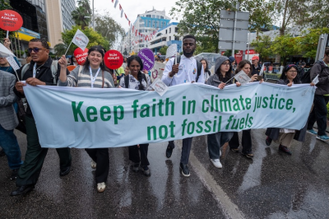
Marchers walk through centre of Antalya during COP31 climate march, calling for climate justice. Photo: Valter Hugo Muniz/WCC
"Every delay leaves communities already facing climate impacts with harder choices about how to protect their homes and livelihoods," said Rev Charissa Suli, president of the Uniting Church in Australia, on 23 November, after COP31 ended on 22 November without an overarching agreement. The Uniting Church is a member church of the World Council of Churches (WCC).
Prof Dr Mathew Koshy Punnackadu, WCC commissioner for Climate Justice and Sustainable Development, said the conference concluded without consensus on the proposed Antalya Pact, the conference's main political agreement, which governments did not adopt. In his message the same day, he said the church must go beyond awareness and declarations.
It must advocate on environmental policy, hold corporations to account and contribute to public policy. "Protecting creation is not merely a charitable activity. It is an ethical, theological and public responsibility," he said.
"This is not simply a failure of negotiations. It is a failure of moral responsibility and global solidarity," said Rudelmar Bueno de Faria, general secretary of the ACT Alliance. The final texts, he said, contained neither a transition away from fossil fuels nor a concrete commitment on adaptation finance. Adaptation finance is money that helps countries and communities cope with climate impacts already happening. Bueno de Faria said the most vulnerable people will keep bearing the worst effects of climate change.
Suli attended COP31 with church and civil society leaders from across the Pacific. She called on Australia to stop approving new coal and gas projects, and to back the proposed Fossil Fuel Non-Proliferation Treaty. The treaty would end fossil fuel expansion, phase out existing production and support affected workers and communities. She also asked governments with the greatest resources and responsibility for past emissions to provide predictable grants (money that, unlike a loan, does not have to be repaid) that affected communities can access and direct.
The WCC took part in COP31 with a delegation, as part of the Ecumenical Decade of Climate Justice Action (2025-2035). On 24 November, the WCC executive committee, meeting in Manila, said the COP31 outcome highlights a political and moral failure, with corporate profits and national interests placed above communities, and called for an equitable phase-out of fossil fuels and grant-based finance for adaptation.
 Facebook
 Twitter
 LinkedIn
 Print
 Email











 Facebook
 Twitter
 YouTube
 LinkedIn
 Pinterest