

A Monument of Charity - St Vincent's Hospital and Catholic Health Care in New York City
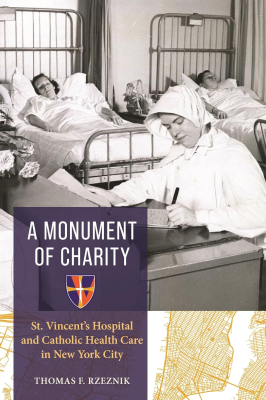
A Monument of Charity - St Vincent's Hospital and Catholic Health Care in New York City - by Thomas Rzeznek. Publisher: New York University Press 2026.
Living amidst Britain's tiny Catholic community it is easy to forget the breadth and depth of social innovations to meet need that the Catholic Church unlocks worldwide. These are core, rather than an add on, business because there are at least twice as many of them globally as there are parishes: For example, the SVP has 1.5 million volunteers worldwide.
In Germany Klaus Kramer the gifted Bishop of Rotenberg Stuttgart previously directed the annual 'carol singers' initiative where 300,000 children sing house to house to raise funds for the missions. It is the largest child to child solidarity movement in the world. Meanwhile, there are 230,000 Catholic educational institutions worldwide. These range in character from Portsmouth Abbey's sophisticated Benedictine School in Rhode Island, USA to the pioneering Catholic Universities of Erbil in Iraq and Zambia in that nation's Copperbelt as well as remote rural home schooling supported by Jesuit run community radio stations.
This exceptional new book, A Monument to Charity, tells the story of the launch, growth, innovation, impact, and eventual demise of a trail blazing contribution amidst such innovations over time, namely St Vincent's Hospital in New York City.
St Vincent's was founded in 1849 by the Sisters of Charity of New York. Originally established by the future Saint Elizabeth Ann Seton in Baltimore, the Order had become a Diocesan congregation by 1846. Now, seeing the immense needs of a migrant Irish community, they brought to life a hospital for the poor funded entirely by charitable donations. This then is a history of social entrepreneurship, gifted women religious leading where lay people of any kind had not yet led and a drive to service that not only transformed the lives of the poorest but also fashioned the future of American Catholicism as a whole. The Sisters were among those to offer nursing to Abraham Lincoln's soldiers during the American Civil War. Long before the law required it, they employed those of all classes and colours and had no colour bar in who they would serve either. Their training of each other was exceptionally high in quality and, over time, this enabled them to establish a major nursing school dispersing its alumni across New York - and the country. No wonder then that while great Catholic philanthropists such as the Raskob family helped fund their ever-extending need for new facilities and doctors as the professions within medicine multiplied those like them were joined by leading lights among New York's Jewish and other senior figures. By 2010 when it closed the hospital had a supporting staff, volunteer, and donor cast of thousands.
For readers of a modern mind Thomas Rzeznik's study will fascinate because St Vincent's location put it right at the heart of responses, first, to the rise of AIDS before retro virals and then, to 9/11 as the local became global in New York. In this sense the book is a social history of the city across over 150 years,
For those interested in prelates and politicians Cardinal Spelman's creation of the Al Smith Foundation Dinner in 1945 will intrigue. This White Tie Dinner still happens each October, is today a usually compulsory stopping off point for Mayors, Presidents and Presidential hopefuls, and tickets are expensive to come by. Intended at first to garner resources for St Vincent's it's brief has widened to be a fundraiser for the vast eco system of Catholic charities in New York. It is still usually hosted at the Waldorf Astoria Hotel by the Archbishop of New York.
For those looking for medical history the work is rich too: One sees the appearance of the first anti septics as 'Listerism' is first made known to America, the professionalisation of nursing, the emergence of staff unionisation. The first psychiatric provision is made, for as Andrew Scull has recounted in his Desperate Remedies Psychiatry's Turbulent Quest to Cure Mental Illness (2022) the psychiatrists were to win their battle for dominance with psychoanalysis in New York. There is also a huge community outreach programme to admire as it prevents so many conditions among the very poorest neighbourhoods becoming worse.
All the time the sisters remain trustees insisting that any fees charged must enable the poorest to pay less, and all the time urging others to give more. I was not sure whether to laugh or cry as I read how state social insurance, when it came, simply could not account for the sisters' giving of their skill and graft for love and not payment. The state won because the sisters were only able to bill for the value of their time if they functioned as though they had salaries. Mutual aid it seems was constrained by accountants and the bureaucracy but not broken for the sisters reinvested these funds back into the work.
Indeed, for readers interested in Religious Orders there is plenty of material to draw out the strong characters from among the Order who led over extended periods. Sometimes they contributed nationally too, sometimes they would work more nights than most. Others still had to insist on being Superior of the community in which all the nursing sisters lived lest (reading between the lines) those who had had to have had their work corrected by day got haughty when the senior Sisters of the hospital came home at night to a domestic hierarchy. Indeed, the narrative that Rzeznek draws out of the constant need to navigate cash flows and donors, Archbishops and bankers, policy makers and patients, hospital life, constant prayer, food, sleep and Community life leaves one in awe of the sisters' genius (and breathless).
In 2008 the hospital announced one of its most ambitious appeals for development ever. Two years later, while the financial sector crashed too, it was gone. It was a body blow to the Order for whom it had given purpose and through which so much renewal, care and service had occurred. By April 2023 they announced they would no longer continue to take new novices. But the lessons to be drawn from their experience are legion.
Today there remain six hundred Catholic hospitals in America and a further 1600 Catholic provided health facilities in the nation. In Africa alone there are a further 6,447 hospitals and 2,300 homes for the elderly and orphanages not to mention healthcare jewels such as Mount Alvernia in Singapore. Living in Britain's tiny Catholic community our inclination might be to admire in this book what has been and react with sadness to the institution's closure. In these lively global Catholic health hotspots however A Monument to Charity will be more usefully read as a source of inspiration, a handbook of analysis, and a vibrant history ready to give life to even greater achievements for the poor, especially in the future. For this Thomas Rzeznek, the Archdiocese of New York - and most especially the Sisters of Charity of New York - deserve considerable thanks.
Dr Francis Davis is an award-winning social entrepreneur and academic. He is a governor of the Chaldean Catholic University in Erbil, Iraq having previously taught at Oxford and Cambridge.
 Facebook
 Twitter
 LinkedIn
 Print
 Email







 Facebook
 Twitter
 YouTube
 LinkedIn
 Pinterest