


EU Bishops issue declaration on Artificial Intelligence
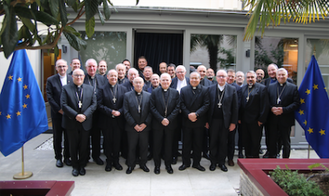
Autumn Plenary Assembly of COMECE
Source: COMECE
The bishops of the European Union call on the EU and its Member States to ensure that Artificial Intelligence (AI) remains firmly at the service of the human person, the common good and peace.
The call comes in a declaration adopted at the conclusion of the Autumn Plenary Assembly of COMECE, held in Brussels from 14 to 16 October on the theme 'Magnifica humanitas: Europe, Human Dignity and the Common Good'.
In their statement, entitled: 'Europe's responsibility in the time of Artificial Intelligence: A call to safeguard the Human Person' - the bishops acknowledge the significant opportunities offered by AI for integral human development and the common good, while stressing that its rapid development also raises profound anthropological, ethical, social and legal questions.
"Humanity stands at a decisive moment in which technological progress must be guided by a renewed commitment to the dignity of every person, justice and fraternity", the bishops state.
The bishops recognise the efforts already undertaken to regulate AI and encourage the European Union to assume leadership in this field in accordance with its founding values and mission.
They call on Europe to act "with urgency, ambition and responsibility" to strengthen its digital capacities and contribute to the research, design and development of AI technologies, promoting a genuinely human-centred vision.
According to the bishops, the EU should also play a positive and leading role in international cooperation and AI governance, ensuring respect for human rights, preventing harmful uses of technology and promoting equitable access to its benefits. This responsibility must be shared by European institutions, businesses, intermediary organisations, educational communities and citizens.
The statement sets out eight principles which the bishops strongly encourage the European Union and its Member States to implement and promote in international fora:
- Human dignity and human agency must remain paramount.
- The common good, solidarity, subsidiarity, care for creation and justice must guide technological innovation.
- Responsibility, transparency and accountability must accompany AI.
- AI must not become a source of discrimination, exclusion or manipulation.
- AI must not diminish or displace the uniqueness of the human person, and human beings must not be reduced to data or commodities.
- The digital and technological commons require responsible governance.
- Democracy and the rule of law must be protected.
- AI must contribute to peace and human fraternity.
The bishops conclude by stressing that the future of AI cannot be determined solely by technological capabilities or economic interests.: "Artificial Intelligence must remain a means at the service of the human person, the common good and peace. Its future must be shaped not only by what technology can do, but by what human dignity, responsibility, solidarity and fraternity require."
Read the full statement: 'Europe's responsibility in the time of Artificial Intelligence: A call to safeguard the Human Person'
 Facebook
 Twitter
 LinkedIn
 Print
 Email

















 Facebook
 Twitter
 YouTube
 LinkedIn
 Pinterest