

Holy See at UN: The death penalty is inadmissible
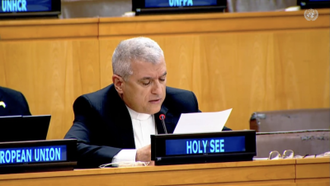
On 7 October 2026, in New York, Archbishop Christophe Z El Kassis, Permanent Observer of the Holy See to the United Nations, delivered a statement at the Third Committee of the 81st session of the General Assembly, under Agenda Item 70: 'Promotion and protection of human rights.'
The Holy See reaffirmed its position that the death penalty is inadmissible because it attacks the inviolability and dignity of the person, a dignity that is never forfeited, whatever the gravity of the crime.
It noted that modern penal systems allow States to protect society effectively without foreclosing repentance and redemption, and that executions leave no recourse in cases of miscarriage of justice.
While victims and their families are owed solidarity, support and prompt, impartial and humane justice, the Holy See stressed that taking another life cannot restore what was lost, and that punishment should repair the social bond and reintegrate the offender rather than seek vengeance. Welcoming the many States that have abolished the death penalty or established moratoria, it urged those that retain it to introduce a moratorium on executions without delay as a step towards abolition, to commute existing sentences, to guarantee fair trials with adequate legal defence, and to invest in rehabilitation and restorative approaches.
The full text of the statement follows.
Statement by HE Archbishop Christophe Z El Kassis
Permanent Observer of the Holy See to the United Nations
at the Third Committee of the 81st session of the General Assembly
Agenda Item 70: Promotion and protection of human rights
New York, 7 October 2026
Mr Chair,
"Human rights are inviolable, since they are 'inherent in the human person and in human dignity.' Consequently, they are universal and inalienable. Precisely because they are grounded in the common dignity of every man and woman, they have practical consequences and legal effects, for 'it would be vain to proclaim human rights if, at the same time, everything were not done to ensure the duty of respecting them, respect by all, in all places and for all.' Among these rights, the first is the right to life."[1] The defence of life must therefore be consistent and universal, extending to every person, at every stage and in every circumstance.
For this reason, "the death penalty is inadmissible because it is an attack on the inviolability and dignity of the person."[2] This God-given dignity is never forfeited, no matter the gravity of the crime. Advances in penal systems now allow States to protect society effectively without foreclosing the possibility of repentance and redemption.
Further considerations reinforce the case for abolition. When the death penalty is enforced, there is no recourse in the event in case of a miscarriage of justice.
Conversely, the victims and their families are entitled to solidarity, support and a justice that is prompt, impartial, and humane. However, the taking of another life cannot restore what has been lost. The purpose of punishment is not vengeance, but rather to repair the social bond, protect the common good, and reintegrate the offender.
Mr Chair,
The Holy See is encouraged by the fact that many States have abolished the death penalty in law or established moratorium. Nevertheless, executions continue in too many places. Pope Leo XIV has expressed the hope that "efforts are made to abolish the death penalty, a measure that destroys all hope of forgiveness and renewal."[3]
In this spirit, States that retain the death penalty should consider establishing, without delay, a moratorium on executions as a step towards abolition. They should also commute existing sentences and guarantee fair trials with adequate legal defence, as well as investing in rehabilitation and restorative approaches that facilitate renewal.
It is clear that "only when a society safeguards the sanctity of human life will it flourish and prosper."[4]
Thank you, Mr Chair.
[1] Pope Leo XIV, Encyclical Letter Magnifica Umanitas, 55.
[2] Catechism of the Catholic Church, 2267 (revised text, 2018).
[3] Pope Leo XIV, Address to the Members of the Diplomatic Corps accredited to the Holy See, 9 January 2026.
[4] Pope Leo XIV, Video message to the participants in the event "A Beacon of Light in Darkness," DePaul University, Chicago, 24 April 2026.
 Facebook
 Twitter
 LinkedIn
 Print
Print Email
Email







 Facebook
 Twitter
 YouTube
 LinkedIn
 Pinterest