


Lourdes: Pope meets abuse victims
Source: Vatican Media
On Sunday evening, Pope Leo XIV met in Lourdes with four men and three women who suffered abuse by members of the clergy.
The seven victims endured abuse in parishes, boarding schools, congregations, or ecclesial movements.
Their different stories and life journeys first intersected on September 14, when they met to get to know one another and discuss the experiences, expectations, and requests they would share with the Pope.
The meeting took place at the bishop's residence, a short walk from the Marian Shine of Our Lady of Lourdes, and lasted two hours, from 5.30 to 7.30pm.
Among those present was Bishop Gérard Le Stang of Amiens, president of the Council for the Prevention of and Fight against Paedophilia within the French Bishops' Conference.
The Holy See Press Office released several details of the encounter.
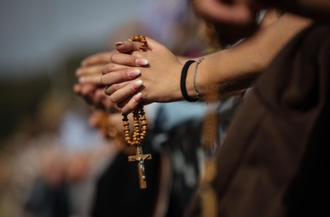
"The Pope met each of them individually and in private, listening to their stories, to the pain and suffering they had endured-sometimes, sadly, with the complicity or silence of those who could have helped them-and to their proposals to ensure that this does not happen again. He spent a few moments in prayer with some of them," read a statement released on Sunday evening.
At the end, shortly after 7pm, the Press Office reported, "the Pope gathered with everyone in a room of the bishop's residence and addressed a few words to them, thanking them for their painful testimony and reaffirming his commitment to ensuring that the evil they had experienced would not happen to others."
Pope Leo then expressed his closeness to the victims and, through them, "to those who have suffered and still suffer from the wounds of the abuse they endured."
Finally, "expressing his hope that they could work together so that the community of the faithful might increasingly become a place where men and women of every age can find comfort and healing, the Pope asked those present to pray for him and imparted his blessing upon them."
The identities of five of the seven victims attending the meeting are known: Jean-Marie Delbos, now 80, one of the key witnesses in the serious abuse case involving Notre-Dame de Bétharram boarding school; Jérôme Guillement, assaulted as a teenager by a priest in his parish and now a coordinator in the Qualité de la relation éducative mission; and Véronique Garnier of the Foi & Résilience collective, author of two books in which, after a very long period of silence and personal rebuilding, she recounts her experience of severe and repeated abuse by the parish priest of her community in Nancy.
Also present were Olivier Mardi, an activist and co-founder of Voix Libérées de Touraine, who, together with his brother Frédéric, suffered abuse by Father Bernard Tartu while participating in the Petits Chanteurs de Touraine choir; and Bertrand Virieux, a cardiologist and founder of the now defunct Lyon association La Parole Libérée. As a boy, he was abused by Father Bernard Preynat, the former priest who died in 2024 and was convicted of abusing young Scouts between 1971 and 1991.
The other two participants chose to remain anonymous, including one person abused by Abbé Pierre, a prominent figure in the French Church.
The seven people who conveyed to the Pope the gravity of the scourge of abuse in the Church were "selected" by the French Bishops' Conference and the Conference of Men and Women Religious of France, following contact with around 40 groups and individuals.
All had put forward ideas and proposals for the meeting, and its organizers sought to ensure the fairest possible representation.
The small number of participants-which drew protests from some groups-was a deliberate choice intended to allow a substantive exchange, as Pope Leo XIV himself had requested.
The group nevertheless gave the Pope letters from some of the groups or individuals contacted by the Bishops' Conference's Child Protection Service.
Earlier on Sunday morning, Pope Leo referred to the "painful scourge of abuse of minors committed by members of the clergy or within the Church" in his address to the Bishops, whom he met before Mass in Lourdes.
The Pope called on the Bishops to exercise "the utmost vigilance", while recalling the "utmost determination" with which the Bishops' Conference had "adopted courageous measures to respond to them (the victims, ed.), listening, seeking truth, justice, forgiveness, reparation and a firm commitment to a culture of prevention and protection against such crimes."
This was a reference to the process of transparency, reforms and compensation initiated by the French Bishops and guided primarily by the findings of the 2021 CIASE Report.
The report was the work of the independent commission established in 2018 by the Bishops' Conference itself, and reported that more than 210,000 minors had been victims of abuse by almost 3,000 priests and religious between 1950 and 2020.
The Bishops have raised the issue of abuse at all their recent plenary assemblies and have sought to ensure that victims who had previously denounced the Church's indifference were heard.
"I know that some moments have been very difficult for your Conference," the Pope said in Sunday morning's address, reiterating the need to "continue along the path already taken, maintaining the utmost vigilance."
An hour after meeting, the seven survivors of clerical sexual abuse shared the emotions of their encounter with the Pope, whom they called a man of "deep listening" and "incredible empathy," who was "struck" and "wounded" by the stories he heard.
"We worked for a month to establish the format of this meeting. We were supposed to see him for an hour, but instead we met him for an hour and fifty minutes," said Olivier Mardi, an activist and co-founder of Voix Libérées de Touraine. "We had asked for it to be divided into two parts: first a group meeting, then individual meetings, one-to-one. And yesterday evening we received the reply that the Pope wanted to see us privately first, and then as a group."
"The Pope himself requested a very small number. Initially five, then we reached seven," explained Jérôme Guillement, who was assaulted by a priest as a child. The seven victims prepared everything together, among themselves and with the Pope: "The arrangements were worked out directly with him and with us: how to speak, how to address him, the subjects we wanted to tell him about."
The result was this evening's memorable encounter. "The first hour was very intense, since each person had an average of around 15 minutes," Guillement continued. "He received many requests and listened to detailed accounts. And what we can simply say is that we felt we were with a man who was truly listening. I have rarely met anyone who listened so deeply."
"In his response, he expressed his commitment, speaking first about his emotions," Mardi added. "He said he was profoundly affected, deeply wounded. He spoke of open wounds, still open after meeting the Spanish victims. He was completely in tune with our stories. And I think that is precisely the transformative aspect."
All five victims said they were "touched" by the Pope's "profound empathy": "You could feel that he picked up on the smallest detail, that he was extremely attentive. I could even say that he enjoys this kind of interaction, because I could see that he was at once very attentive and very focused on every word."
Bertrand Virieux, co-founder of La Parole Libérée, established exactly ten years ago, in 2016, stressed that the resonance of this evening was "worldwide", not just "French". He too said he was "truly struck by this Pope" and by "his non-verbal communication, his depth, his listening". "This has brought me reconciliation."
"When I saw the Pope up close, I could not believe it. Because at one point I felt a sudden surge of emotion," confided Jean-Marie Delbos, a victim and key witness in the serious abuse case involving the Notre-Dame de Bétharram boarding school. "I have not had many deeply emotional moments in my life, because I have a very strong character. I asked him to bless my mother. And then, when he saw the state I was in, he put both arms around me. I never would have thought that it would be the Pope embracing me. It was an extraordinary moment. It has been 65 years since that happened, when I lost my faith."
"I don't go to Mass," Delbos continued. "Today I went to Mass for the first time in 60 years. Even during Mass, when I saw the Pope… I had moments of emotion. I swear to you, when he gathered us together and said, 'I bless you', well, I made the sign of the cross. Even me, a well-known atheist."
Today's encounter is certainly not the end of the journey. "For me," Delbos said, "it will be over when the smoke comes out of the chimney. Until then I will remain here, but with a new understanding of the Church, of this Pope who has shaken me."
Everyone's impression was that "this time something happened". Some had been "sceptical" or had "feared this meeting". After leaving the Bishop's House, "each of us really felt we had glimpsed eternity… Something really happened; it happened on earth."
It was a different feeling from that morning's Mass. Véronique Garnier, of the Foi & Résilience collective, who was abused by her parish priest in Nancy, said: "Frankly, I was feeling really low. I was saying to myself, 'What am I doing here?' Then, by contrast, the afternoon was simple. We were told that the meeting had been brought forward a little; [the Pope] arrived sooner than expected."
"I felt relieved because I was able to tell him everything I wanted to, because there was more time," continued Garnier, one of the three women at the meeting; the other two chose to remain anonymous. "Initially, we had planned two or three minutes each; we had timed everything. In reality, we had plenty of time."
The Pope, Véronique added, has "a very strong presence… He told us to have some sweets, a simple thing, and he gave us hope that something could change. He was not listening superficially, with fine words that never lead to very much. I think the change lies in the depth of his presence, something non-verbal, his listening, the way he welcomed what we were telling him, his reactions to what we said."
Above all, they sensed that he was fully informed. "He has an academic background in law. He knew my story and asked very precise questions," Guillement added.
"So you can feel that he is someone who did the work beforehand and will continue working afterwards. And I sensed that he is a committed man; indeed, he spoke of commitment. I also felt that he is a determined man. He knows that this change, this transformation, will take time. He is not naïve; he knows that these things will continue to happen, and that we must remain vigilant. And that touched me deeply, because there is both a very emotional side, very empathetic, very focused on feelings and listening, and at the same time a very determined manner, powerful when he speaks."
One of the key terms to emerge during the meeting was the "systemic nature" of the abuse committed over these decades in the French Church, how it was addressed, and how prevention measures were implemented. It was also a prominent term in the 2021 CIASE report.
The Pope, Olivier Mardi said, "has a very clear view of the systemic dynamics, because this is an issue that obviously affects the Church, but also Catholic education".
"What enables or allows these individuals to continue perpetrating abuse is really the systemic dimension that exists within the institution, that existed and still exists."
"Much has been done in France", and "the Pope acknowledged that the Church has indeed done a great deal in France", and that "the French bishops have put measures in place that make France something of a pioneer in this area", the group stressed.
But "an enormous amount of work remains to be done". Work and commitment, including on the Pope's part: "That was really important to hear."
A journey is now beginning, and Pope Leo XIV "will make it with us", the victims affirmed. "We have our own paths… He understood very well; he was very precise about joining forces with outside organisations to work together. And in this, he responded very positively to our proposals, our very concrete requests."
Many proposals were presented: "Of course, he did not answer immediately, but he knows he has work to do. And that is rather encouraging."
"I proposed dissolving the Congregation of the Fathers of Bétharram," Delbos exclaimed. The congregation is also present in Africa and Latin America.
"We will remain vigilant," was the concluding promise from the Pope's "guests". "Today we made numerous requests. We are waiting for answers." Lourdes, meanwhile, remains "a key milestone".
 Facebook
 Twitter
 LinkedIn
 Print
Print Email
Email









 Facebook
 Twitter
 YouTube
 LinkedIn
 Pinterest