

Pope Leo begins Apostolic Journey to France
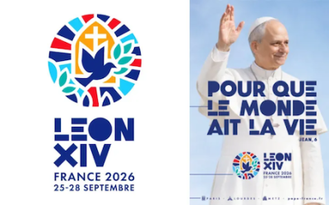
Source: Vatican Media
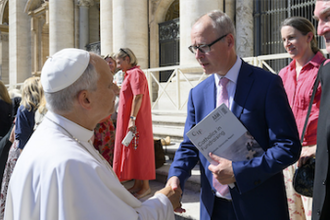
Pope Leo XIII began his Apostolic Journey to France this morning, leaving Rome Fiumicino International Airport at 7.50am local time accompanied by more than 80 journalists from 10 countries. He told them: "I, above all, am travelling to France, as to anywhere else in the world, as a follower of Jesus Christ wanting to proclaim peace, the peace of Christ throughout the world. It is a message which at this time, as we all know, is particularly important," before greeting each reporter individually and thanking them for their work.
Asked by a CNN reporter about colleagues who had issues accessing the White House in recent weeks, the Pope said that he was "very happy that here you are all welcome... I think, is very important and that we have it all the way around, for everyone."
A New York Times journalist asked the Pope about the development of AI. Pope Leo said: "Our Vatican Commission, in fact, is in contact with many of the leaders in the AI world, and we are continuing, if you will, the dialogue that I hope to have begun or continued in the encyclical... I think from their perspective, many of them, they're very much open to looking for ways of making sure that AI does not displace or ultimately destroy humanity, but rather than be a tool for human beings. Good things are beginning at least."
Another American journalist for the National Catholic Reporter asked the Pope if he will support his alma mater, Villanova University, in an upcoming basketball game to be held in Rome against Notre Dame. "They tell me that the people coming to the match, 90% are from Villanova and 10% Notre Dame, so the voice of the people of God will be very strong on the Villanova side," the Pope replied.
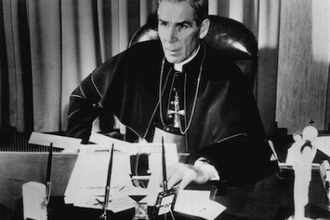
A reporter from OSV News, asked the Pope about the beatification of Archbishop Fulton Sheen and what he meant to the Pope personally. "We watched him as a family, and it was a way of spending some time together as a family with the truth, the teachings that he shared in such a enthusiastic, lively way, especially considering that day and age watching on TV, this Catholic bishop, who was originally from Illinois," said the Pope. "The message that he had was something that really came home to people. I think it helped us as a family."
A journalist working for the Spanish radio COPE gave the Pope a cross made from wood from the wildfires that devastated the Western Mediterranean country this summer. Around 300,000 hectares burned in Spain this year according to the European Forest Fire Information System. The cross contains charred remains collected near the Chapel of Our Lady of La Nueva in Getafe, Madrid, one of the few churches spared by the flames.
"In the face of natural disasters, we must show responsibility and care for our common home," the Pope said. Above all, he added, we must pray" explaining that this is the first thing he does when faced with such tragedies.
A Venezuelan photojournalist gave him a book with 74 letters from survivors from the earthquake that devastated the nation in June and caused over 6,000 deaths.
Another Spanish journalist asked him about the migration crisis in Ceuta, the Spanish enclave in northern Africa, to which he answered that he has followed the issue since the beginning and that responses need to be found in order to avoid this emergency. "It was really a humanitarian crisis," he said.
The Papal plane landed at Paris Orly International Airport, at 10am. After a welcome ceremony, the Pope had a private meeting with the President of the Republic, Emanuel Macron, at the Élysée Palace.
Afterwards, Pope Leo gave his first public address in France tothe authorities, civil society, and diplomatic corps. He recalled his own French heritage and assuring the nation of his prayers.
Pope Leo said France has served as a cultural, artistic, and spiritual beacon for Europe and the world for centuries.: "The many brilliant French scholars who were also faithful Catholics demonstrates clearly how the sciences and the arts, literature, and philosophy can contribute to the good of humanity when they are directed toward the pursuit of beauty, goodness and truth, that the world may have life," said the Pope.
He expressed appreciation for the mastery shown by French architects and artists in rebuilding the Cathedral of Notre-Dame after the 2019 fire. Calling it an "impressive technical achievement," the Pope said the reconstruction of Notre-Dame showed that something considered irreparably destroyed can be reborn through mutual cooperation.
Pope Leo said France bears deep Christian roots and the nation's soul draws from Christianity "a rich spiritual, cultural, intellectual, artistic, and missionary élan."
In 16th-century humanism, French philosophers united the ancient Greek and Roman heritage with the Christian faith and promoted the recognition of human rights based on the nature of the human person, especially religious freedom.
Pointing to France's national motto, he said, liberty, equality, and fraternity "refer to universal ethical imperatives that also find in the Gospel message an inexhaustible source of inspiration and fulfilment."
Pope Leo then noted his focus in Magnifica Humanitas on artificial intelligence, saying respect for human dignity and our fundamental rights and freedoms must keep pace with societal change and technological progress.
"If we are to avoid losing our humanity amid a 'paradise of machines' invading and conditioning our daily lives," he said, "there is an urgent need for education in ethical discernment and the capacity to acknowledge the moral good."
Turning to France's "rich and varied social fabric," the Pope praised the efforts of Catholic men and women who continue to care for the welfare of the poor and underpriviledged.
The Church, he added, seeks to be "the living face of God's own mercy and compassion," recalling the charitable legacy of St. Vincent de Paul.
Pope Leo XIV noted that our modern sensibilities seek to eliminate every form of suffering, saying this tendency often "brings the risk of self-delusion."
"When science and technology are not guided by a deeper wisdom," he said, "they can offer immediate solutions that apparently address people's wishes and their pain, but can seriously divert them from the greater good to which they aspire."
Mutual respect and the protection of every human life is a duty borne by every person, he said, noting that it begins with conversion of heart and mind and requires selfless commitment to the good of others.
Pope Leo encouraged Christians to engage in public service guided by the light of faith, noting that authentic secularity does not exclude religion but values it as an "educational resource."
He thanked France for its support for education and humanitarian work in the Middle East, especially an initiative to help finance over 260 schools and universities. The Pope recalled the ongoing effects of conflict and the scourge of war in land of the Prince of Peace's birth.
"We cannot remain indifferent in the face of their pain, which offends human dignity and cries out to God for justice," he said.
Pope Leo also called for nuclear weapons to be banned and for justice and right reason to prevail, since peace "is not a balance of power" but is rather built each day through dialogue and justice.
In conclusion, Pope Leo XIV urged the French Republic to "remain a tireless champion of peace and multilateralism".
"May France, faithful to its traditional values, work for a peace that is unarmed and disarming, and responsibly offer its unique contribution to that goal," he said. "May your liberty grow in constant concern for the common good.
 Facebook
 Twitter
 LinkedIn
 Print
Print Email
Email













 Facebook
 Twitter
 YouTube
 LinkedIn
 Pinterest