


Hiking in the West Bank
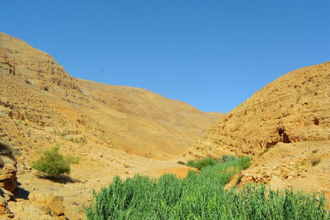
Wadi Qelt, east of Jerusalem, on the way to Jericho. Photo by Nour Tayeh on Unsplash
Toine van Teeffelen writes from Bethlehem: One of the reasons for us to live over the years in the West Bank, apart from practical considerations such as caring for family, is the opportunity to take remarkable walks through the often breathtaking rolling hills.
The landscape is surprisingly diverse. From Bethlehem, for example, a twenty-minute drive is enough to reach the desert. Along the way, you come across unexpected treasures, such as archaeological sites hidden in wadis that have not yet been fenced off or surrounded by marked trails and guardrails.
The mild climate is an advantage. Our family treasures the memories of these walks: picnicking beside a hidden spring, hiking through wadis, or simply enjoying the silence of the landscape. The trails through Wadi Qelt, in the desert east of Jerusalem on the way to Jericho, are best known. But there are also beautiful hiking areas much closer to Bethlehem, such as Wadi Khreitoun and the paths winding through olive groves and orchards around the village of Battir. Amid the constant violence and repression of the occupation, these moments of peace and beauty are beyond price.
Years ago, Palestinian tourism organizations developed long-distance hiking routes with overnight stays in local villages. Well-known examples include the trail from Nazareth to Bethlehem and the internationally oriented Abraham Path. The organization I worked for over many years, the Arab Educational Institute, organized annual school trips to Muslim and Christian holy sites, many of them located in beautiful natural settings.
Today, however, walking in nature has become almost impossible. Many areas have become either inaccessible or life-threatening for Palestinians. At the same time, settlers have, in a sense, appropriated hiking. Not to become immersed in the landscape, as the Palestinian writer and lawyer Raja Shehadeh so beautifully describes in Palestinian Walks: Notes on a Vanishing Landscape, but to claim the landscape, both symbolically and physically. A hidden spring suddenly becomes part of an exclusive biblical landscape said to belong only to Israelis.
A painful example occurred a week and a half ago. During what was described as a hike, armed settlers deliberately entered the Palestinian village of Tell, near Nablus, in a highly provocative manner. The confrontations that followed left two Israelis and four Palestinians dead.
Video footage of the incident shows armed settlers forcing local Palestinians back while gunfire echoes in the background. At one point, a settler strikes a Palestinian over the head with the butt of his rifle. That same Palestinian then manages to wrest the weapon away from the security coordinator of a nearby settlement and shoots him dead. Footage shows another armed man moving among those present while Israeli soldiers stand nearby without intervening.
The settlers follow a well-established method: they establish a new outpost, provoke Palestinians, and seek to provoke a violent response as a step toward dispossession. They want confrontations and violent resistance so they can label the residents as terrorists and portray the village as a stronghold of terrorism. From there, the path to expulsion and the demolition of homes is short. And it works. Almost all Israeli media described the events in Tell as an "attack" carried out by "terrorists."
These new hikes continue. Through WhatsApp groups used by far-right settlers, calls are circulated inviting people to participate in new "memorial hikes" following such confrontations. The planned routes pass directly through nearby Palestinian villages. In a joint statement, the Israeli human rights organizations Adalah, Breaking the Silence, B'Tselem, Physicians for Human Rights Israel, and Yesh Din called on the authorities to prevent these marches from taking place. They serve as a cover for what the organizations describe as pogroms carried out by settler militias.
 Facebook
 Twitter
 LinkedIn
 Print
Print Email
Email

















 Facebook
 Twitter
 YouTube
 LinkedIn
 Pinterest