

Gospel in Art: Feast of Saint Thomas, Apostle
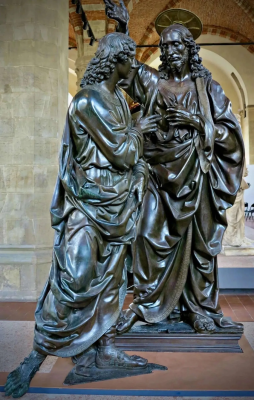
Saint Thomas and Christ by Andrea del Verrocchio 1467-1483, cast bronze © Orsanmichele Church, Florence
Source: Christian Art
Gospel of 3 July 2026
John 20:24-29
Thomas, one of the Twelve, called the Twin, was not with them when Jesus came. So the other disciples told him, 'We have seen the Lord'. But he said to them, 'Unless I see in his hands the mark of the nails, and place my finger into the mark of the nails, and place my hand into his side, I will never believe.'
Eight days later, his disciples were inside again, and Thomas was with them. Although the doors were locked, Jesus came and stood among them and said, 'Peace be with you.' Then he said to Thomas, 'Put your finger here, and see my hands; and put out your hand, and place it in my side. Do not disbelieve, but believe.' Thomas answered him, 'My Lord and my God!' Jesus said to him, 'Have you believed because you have seen me? Blessed are those who have not seen and yet have believed.'
Reflection on the Sculpture
Today we celebrate the feast of Saint Thomas the Apostle. Thomas has come to be known as "Doubting Thomas," yet there was much more to him than his doubt. The risen Lord's face-to-face encounter with Thomas in our Gospel reading today dispelled all his doubts and led him to one of the most profound professions of faith in all the Gospels: "My Lord and my God." Thomas's declaration affirms Christ's full humanity (my Lord) and full divinity (my God).
So, what about doubt? Is doubt a bad thing? Many of us become worried when doubts arise. We imagine that genuine faith means never asking questions, never struggling, never wrestling with uncertainty. But that is not how faith appears in Scripture. Think of Saint Thomas the Apostle, he was simply searching for the truth. He wanted to understand. He wanted to be certain. And significantly, Jesus did not reject Thomas because of his questions. Instead, He invited him closer: "Put your finger here; look, here are my hands."
God does not ask us for blind faith. Blind faith is believing something without thinking. Christian faith is different. It involves trust, certainly, but it is an intelligent trust. God gave us minds to think, reason and ask questions. Throughout history some of the greatest saints, theologians and mystics have passed through periods of doubt and darkness. Their questions did not destroy their faith; often their questions deepened their faith. In fact, the real danger is maybe not to ever doubt. A bit of doubt and questioning is the sign of a searching heart. Doubt asks questions because it wants answers. Doubt keeps knocking at the door because it longs to enter more deeply into the mystery of God. After all, the opposite of faith is not doubt; the opposite of faith is refusing to enter into a dialogue with God.
Our late-15th-century sculpture by Andrea del Verrocchio beautifully captures the poignant dialogue between Jesus and Saint Thomas. The sculpture's expressive detail allows us to almost hear their profound dialogue. The Risen Christ stands in a regal pose, contrasting sharply with Saint Thomas' agitated, nervous, and merely human state. Originally crafted to occupy one of the fourteen niches on the exterior walls of the Orsanmichele Church in Florence, the figures were cast without modeled backs, intended to be viewed only from the front. This artistic choice emphasises the frontal interaction, drawing the viewer into the intimate and transformative moment shared by Christ and Thomas.
Born in Florence as Andrea di Michele di Francesco de' Cioni, Verrocchio trained under Donatello, whose influence is evident in his early works. Verrocchio established a highly successful workshop in Florence, which became a hub for aspiring artists. Among his most famous pupils were Leonardo da Vinci and Pietro Perugino, who would go on to become significant figures in their own right. Though Verrocchio was primarily known as a sculptor, he also painted. He died in Venice in 1488, leaving behind a legacy of artistic achievement that continued to inspire the trajectory of Renaissance art.
LINKS
Christian Art: https://christian.art/
Today's reading: https://christian.art/daily-gospel-reading/john-20-24-29-2026/
 Facebook
 Twitter
 LinkedIn
 Print
Print Email
Email






 Facebook
 Twitter
 YouTube
 LinkedIn
 Pinterest