

Pastoral Letter from Anglican Church leaders after their visit to Holy Land
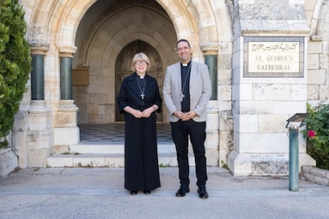
Archbishop Sarah Mullally with Archbishop Hosam Naoum, at St George's Anglican Cathedral, East Jerusalem. Photo: Lambeth Palace
Source: Lambeth Palace
The Archbishop of Canterbury, Sarah Mullally, and the Anglican Archbishop in Jerusalem, Hosam Naoum, have written a pastoral letter to the Episcopal (Anglican) Church in Jerusalem and the Middle East, as well as Anglicans around the global Anglican Communion.
The letter as published at the end of a five-day pilgrimage in the Holy Land undertaken by the Archbishop of Canterbury and the Anglican Archbishop in Jerusalem to meet and pray with Palestinian Christians across Palestine and Israel.
Archbishop Sarah made the pastoral visit at the invitation of Archbishop Hosam, in order to be alongside Anglican clergy and congregations in Palestine and Israel, as well as meeting with other churches leaders and communities in the region. During the visit the Archbishop also met with civil society and interfaith groups working for human rights, coexistence and peace in Israel and Palestine.
A Pastoral Letter from Archbishop Sarah Mullally and Archbishop Hosam Naoum
25 June 2026
Let us not love with words or speech, but with actions and in truth.
(1 John 3:18)
Dear Friends,
Grace to you and peace from God our Father, and the Lord Jesus Christ.
From 19-24 June, 2026, we travelled as disciples of Christ on a pilgrimage through the Holy Land, praying and listening to God, listening to those we met, offering solidarity with those that are suffering, and allowing ourselves to be changed by all that we have seen and heard. To be a pilgrim is to undertake a journey through places, but it is also a journey of the heart and mind. Through this pilgrimage we have found ourselves drawn more deeply into the realities of life experienced by Palestinian Christians and by many others who call this land their home.
During our pilgrimage we have witnessed how the Church remains a place of encounter, hospitality, and witness. Through its schools, hospitals, and ministries, the Church defends human dignity and works for life lived in all its fullness. Amidst many hardships, we have witnessed a resilient Christian steadfastness that chooses love over hate and refuses to let despair have the final word. However, despite their faithful resistance we fear for the long-term future of the indigenous Christian Palestinian presence in the Holy Land that stretches back to the time when our Lord walked this land. This existential challenge demands our focused attention and collective responsibility. The time to act is now.
Across Palestine and Israel, we met families that feel unmoored and traumatised by endless conflict. In Israel, the simultaneous fighting of many conflicts at one time, and the deep-seated aftermath of the horrifying atrocities of 7 October, have created a state of intense sensitivity to potential danger that has transformed society and politics. In the West Bank, unchecked settler violence, forced displacement, systemic discrimination, and expanding checkpoints have left the Palestinian population impoverished, desperate and powerless to enact change. Annexation is already taking place in all but name.
Meanwhile, the profound suffering in Gaza continues. The international community must not look away; it bears a moral responsibility to relieve this agony and help rebuild Gaza's society. We give thanks that despite a health system in catastrophic collapse, the Anglican Al Ahli hospital in Gaza City-alongside Church clinics across the region-continues to serve those in need as an embodied sign of God's healing love.
We pray and call for an end to the enduring injustice in this land. Our pilgrimage was deeply enriched by our meetings with Palestinian and Israeli civil society, ecumenical, and interfaith groups working tirelessly to advance trust, justice, equality, and mutual understanding within and between communities. Their creativity and determination to secure self-determination for the Palestinian people, and a sustainable peace for all, must be amplified.
The conflicts across the Middle East are not merely local conflicts. They are symptomatic of a deeper political and spiritual crisis - an abandonment of international law and an increasing recurrence of military force to resolve disputes. We hold that war is never the answer. War destroys human life and tears apart the human family. Disputes must be solved in accordance with international law through patient diplomacy, negotiation and a vigorous defence of the rules-based international system. International humanitarian law is not an optional constraint but an unwavering commitment to protect the sanctity of human life and our God-given dignity.
In light of the International Court of Justice's Advisory Opinion of 2024, we urge you to advocate with political representatives to take all necessary measures to establish a credible path towards ending the occupation. This must lead to a viable two-state solution enabling Israelis and Palestinians to live in peace, dignity and security. Jerusalem's status should be determined through negotiation as a shared capital, fully respecting the religious rights of all faiths and preserving both the historic Status Quo and the Hashemite custodianship of the holy sites in Jerusalem as ratified in Article 9 of the 1994 peace treaty between Israel and Jordan.
We are grateful to the Anglican Alliance and other Church partners around the world for their exceptionally generous support to the Diocese of Jerusalem over the past two and a half years. We ask that you continue to generously support these works so that they can continue their life-giving ministries. Maintaining this ministry will become more difficult in the years ahead given the increased financial and regulatory pressures Church institutions face. This ministry is essential to help support the Christian presence in this land.
Our prayer is that by God's grace, we might bear witness to the hope of the Gospel, and that we might offer to this land, its people and to the wider world a foretaste of God's peace and love.
The Most Revd Dame Sarah Mullally The Most Revd Hosam E. Naoum
The Archbishop of Canterbury The Anglican Archbishop in Jerusalem
 Facebook
 Twitter
 LinkedIn
 Print
Print Email
Email







 Facebook
 Twitter
 YouTube
 LinkedIn
 Pinterest