

Gospel in Art: The Nativity of Saint John the Baptist
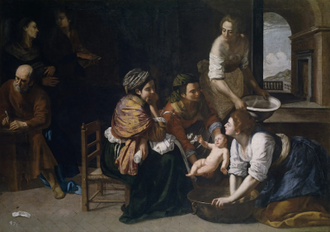
The Birth of Saint John the Baptist, by Artemisia Gentileschi 1633 - 1635 © Prado Museum, Madrid
Source: Christian Art
Gospel of 24 June 2026
Luke 1:57-66, 80
The time came for Elizabeth to give birth, and she bore a son. And her neighbours and relatives heard that the Lord had shown great mercy to her, and they rejoiced with her. And on the eighth day they came to circumcise the child. And they would have called him Zechariah after his father, but his mother answered, 'No; he shall be called John.' And they said to her, 'None of your relatives is called by this name.' And they made signs to his father, enquiring what he wanted him to be called. And he asked for a writing tablet and wrote, 'His name is John.' And they all wondered. And immediately his mouth was opened and his tongue loosed, and he spoke, blessing God. And fear came on all their neighbours. And all these things were talked about through all the hill country of Judea, and all who heard them laid them up in their hearts, saying, 'What then will this child be?' For the hand of the Lord was with him.
And the child grew and became strong in spirit, and he was in the wilderness until the day of his public appearance to Israel.
Reflection on the painting
The naming of a child is always a significant moment. When a new child is born, we immediately want to know the name that the parents have chosen for the child. Today, parents often choose from an enormous variety of names, many of which may have no connection to previous generations. In earlier centuries, however, names were far more likely to be inherited from parents, grandparents or other relatives. The same was true in biblical times. This is why the neighbours and relatives were so surprised when Elizabeth insisted that her son should be called John. "There is no one among your relatives with that name," they protested. Yet when Zechariah confirmed in writing, "His name is John," the speech he had lost months earlier was immediately restored. The choice of this unexpected name signalled that God was doing something entirely new. A new name, a new era. John would grow up to become the great prophet who prepared the way for Christ, announcing that One greater than himself was coming.
The neighbours and relatives in today's Gospel then raise another question: "What then will this child become?" It is one of the most beautiful questions in all of Scripture. We still ask it today whenever we look at a child or young person growing up before our eyes. What will become of him? What will become of her? The question is filled with hope and anticipation, as we wonder what gifts, talents and possibilities may unfold in years to come. Yet it also carries a hint of anxiety. Parents and grandparents naturally worry about the future. Will my child be happy? Will they make good choices? Will they find their path in life? Today's Gospel offers a gentle reassurance. John the Baptist became the man God had called him to be because "the hand of the Lord was with him." Ultimately, that is what matters most. No parent can control every circumstance of a child's life, but they can help place that life in God's hands. When a young person grows up rooted in Christ, nourished by faith, prayer and love, there is every reason for hope. The question "What then will this child become?" finds its deepest answer not in worldly success or achievement, but in becoming the person God created that child to be.
Our painting is by Artemisia Gentileschi, one of the most remarkable artists of the 17th century. Trained in Rome by her father Orazio Gentileschi, she showed extraordinary talent from an early age and was already producing accomplished professional works while still in her teens. This was a remarkable achievement at a time when artistic training, patronage and public recognition were overwhelmingly reserved for men. Inspired by the dramatic use of light and shadow pioneered by Caravaggio, Artemisia developed a powerful artistic voice of her own. Her success brought commissions from some of Europe's most influential patrons, and she became the first woman admitted to Florence's prestigious Accademia delle Arti del Disegno. Today she is recognised not merely as a great female artist, but as one of the great painters of the Baroque period.
In this beautiful depiction of the birth of Saint John the Baptist, Artemisia weaves together two moments from the Gospel story into a single scene. On the left, we see Zechariah seated among neighbours and relatives, carefully writing the words that will change everything: "His name is John." The gathered crowd watches closely, surprised that the child will not receive a traditional family name. On the right, the atmosphere becomes intimate and domestic. Several women tenderly wash the newborn John, wrapping him in loving care as Elizabeth hands the baby over the bowl. Artemisia excels at capturing the ordinary details of family life: the conversations, gestures and quiet activity surrounding a birth. Yet she also allows us to sense that something extraordinary is unfolding. Amidst this seemingly ordinary household scene, God is preparing the arrival of the prophet who will one day point the world towards Christ.
LINKS
Christian Art: https://christian.art/
Today's reading: https://christian.art/daily-gospel-reading/luke-1-57-66-80-2026/
Video: How art called me to the priesthood: www.indcatholicnews.com/news/55096
 Facebook
 Twitter
 LinkedIn
 Print
Print Email
Email








 Facebook
 Twitter
 YouTube
 LinkedIn
 Pinterest