

Bishop Coll: The moral greatness of a nation is shown in how it protects the weakest
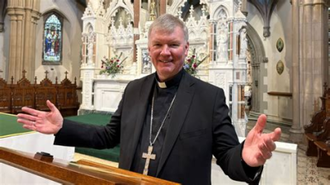
Bishop Niall Coll
Bishop Niall Coll, Bishop of Raphoe, delivered this homily at the International Eucharistic and Marian Shrine of Knock in Ireland, for the Day for Life yesterday.
"The Church does not proclaim the Gospel of Life in order to condemn. Christ always begins with mercy. There is no wound beyond His healing, no past beyond His forgiveness, no life beyond His love."
My brothers and sisters,
In today's Gospel, Jesus speaks words that are both comforting and deeply challenging.
"No one can serve two masters … do not be anxious about your life … Seek first the Kingdom of God."
At first hearing, these may sound like simple words about worry. But Jesus is asking something far more searching. What shapes your life? What do you trust in? What ultimately governs your decisions? Because whatever we trust in most … eventually becomes our master.
We live in an age marked by uncertainty. There is anxiety about war and conflict, about economic security, about the future our children will inherit. New technologies promise much, but they raise profound questions too about what it means to be human. Underneath much of this anxiety sits one fear: that nothing is truly safe unless I secure it myself.
Into that fear, Jesus speaks. He points to the birds of the air, the lilies of the field. They do not control everything … and yet they are cared for. And then He asks a question that should stop us in our tracks: "Are you not of more value than they?"
Those words take us to the heart of the Gospel.
Every human life has immeasurable worth. Not because of intelligence, achievement, or success. Not because a person is wanted, healthy, or independent. Every human life has dignity because every human life is created by God, loved by God, and held by God. Life is not something we manufacture or secure for ourselves. Life is something we receive.
And if that is true, it has to shape how we see every human life - not only our own.
That brings us to some of the most difficult questions facing our society today: the life of the unborn child … the care of those who are seriously ill … the dignity of those living with disability … the place of the elderly … the care of those approaching the end of life.
These are not abstract questions. They involve real suffering, real fears, real families, real human stories - our own included. But the Gospel gives us a foundation that does not shift with public mood. Every human life matters. Every human life possesses dignity. Every human life deserves protection - not because of what it can do, but because God does not let go of what He has made.
One of the dangers facing any society is that it can grow so accustomed to certain assumptions that it stops examining them. What begins as an exception gradually becomes normal. What once troubled the conscience can come to seem unquestionable. History reminds us that societies do not always get these things right. Decisions that appear compassionate and reasonable in the moment can later be viewed with disbelief and regret. Future generations often look back and ask a simple question: did people fully recognise the dignity of every human life - or did they simply go along with what was easiest at the time?
So let me say one thing plainly today, because this 'Day for Life' homily exists precisely so that it can be said plainly: conscience must be free.
Anyone in public life, in any party, must be free to act on a well-formed conscience on questions of life and death without being punished for it. A society that disciplines conscience into silence - even through pressure rather than law - has already let go of something it will not easily get back.
Pope Leo XIV said something recently in Spain worth carrying home with us. Addressing the Spanish Parliament - the first time in history a pope has done so - he said that a truly just society must be built on the inviolable dignity of every human person, a dignity that does not bend to shifting consensus or to the will of the majority. He warned that when that conviction is lost, the law itself loses its deepest purpose - to protect the person, not merely to register what is popular. And echoing Pope Francis before him, he spoke against what both popes have called the throwaway culture, a culture that stops holding on to lives it has decided are no longer useful. He said that the moral greatness of a nation is shown not in how it treats the strong, but in how it protects the fragile. That is not only a word for parliaments. It is a word for society in general.
For centuries the instinct of medicine, of family, of society, was to ask: how do we care for this person? How do we accompany them? How do we relieve their suffering? These remain the right questions. But there is a danger that another way of thinking is taking hold. Instead of asking how we accompany people in suffering, we begin to ask whether suffering can be addressed by removing the sufferer. That shift may be presented as compassion. It may even be presented as mercy.
But true compassion never abandons the person who suffers. Jesus does not eliminate those who are burdened by illness, weakness or pain. He draws near to them. He walks with them. He stays. And He calls us to do the same. The measure of a compassionate society is not how efficiently it removes suffering from view. It is how faithfully it stands beside those who suffer.
At the same time, this Day for Life is not only about challenge. It is also about hope. I see that hope whenever I meet young people who care deeply about justice and human dignity. I see it in families who lovingly care for elderly parents. I see it in those who dedicate their lives to medicine, nursing, hospice care and support for people with disabilities. I see it in every act of kindness that says to another person: your life matters. And I see it, too, in how this generation of young people can now see life before birth in a way no generation before them could - through ultrasound, undeniable, on a screen. That sight has changed hearts in a way that no argument ever could.
And if anyone listening today carries painful memories, regret, or sorrow connected with any of these questions … know this: the Church does not proclaim the Gospel of Life in order to condemn. Christ always begins with mercy. There is no wound beyond His healing, no past beyond His forgiveness, no life beyond His love.
My brothers and sisters, I would put it to you that in the context of contemporary Ireland our primary task is not to win arguments, because we rarely will in the face of the secular consensus which dominates politics and media. Our most important task is to bear witness. To witness with patience. To witness with compassion. To witness with courage. To speak the truth without anger. To defend life without losing love. To uphold human dignity not only in what we say, but in how we treat one another - because every person is made in the image of God, including those with whom we disagree.
Jesus concludes today's Gospel with these words: "Seek first the Kingdom of God." If we place God at the centre, we begin to see life differently. Not as a possession to be controlled, but as a gift to be received. We learn to act from trust rather than fear. We learn to recognise the face of Christ in the weak, the vulnerable and the forgotten.
The true measure of any civilisation is not the power of the strong, but the protection of the weak. The unborn child. The elderly person. The person living with disability. The sick. The dying. These are not burdens to be managed. They are our brothers and sisters. Their dignity is not negotiable, because it is given by God.
May God give us the wisdom to recognise that dignity, the courage to defend it and the charity to uphold it in every human life. Amen.
Bishop Niall Coll is Bishop of Raphoe.
 Facebook
 Twitter
 LinkedIn
 Print
Print Email
Email








 Facebook
 Twitter
 YouTube
 LinkedIn
 Pinterest