

Easter Vigil Homily: Fr Toby Lees OP at St Dominic's Priory
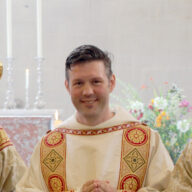
Fr Toby Lees OP
Fr Toby Lees OP gave this homily during the Easter Vigil Mass at St Dominic's Priory - The Rosary Shrine, London NW5.
In late 1944, a Japanese soldier named Hiroo Onoda was sent to a small island in the Philippines. His mission was to destroy the Lubang airfield and a harbour pier. He failed, and as enemy forces took control, he and his fellow troops retreated into the jungle. The war was soon over - but the leaflets dropped to inform stragglers of Japan's surrender on 15 August 1945 were dismissed as fakes by Onoda. He remained hidden in the wilderness among stinging ants and snakes, living on banana skins, coconuts and stolen rice, convinced the enemy was trying to starve them out. He kept fighting - patrolling, engaging in skirmishes, hiding - for 29 years. It was 1974 before his former commanding officer flew to the island to personally relieve him of his duty.
For 29 years, Hiroo Onoda lived as though a reality were still true that had definitely ended in August 1945. What may have made sense in 1945 was crazy in 1946 - it was living in delusion.
It matters what year it is. But, some years seem to matter more than others. Perhaps there's a year in your life that stands out as a defining in some way?
And speaking of years, there is a certain sort of person who thinks that as the years pass we as a society inevitably become wiser and smarter than our forebears. You will have heard the phrase that passes for an argument in much of our public life: "Come on - it's 2026."
As a member of an 800-year-old order and a 2,000-year-old religion, that tends to get used in arguments against me! The implication is that something previously held to be true - especially if it is considered a restrictive moral truth or perennial truth about human nature - can be refuted simply by pointing at the calendar and saying, 'that was then but this is now.' Believing that man might have a soul, believing in things invisible as well as visible, believing that miracles might occur - to a certain class of people, we are supposed to be beyond these things now, and they are dismissed, not with counter-evidence, but with a date, 'We're not in the middle ages anymore!" . . . often by people who will then go and buy healing crystals from a shop in Camden and watch videos about manifesting.
C.S. Lewis had a name for this habit of mind. He called it chronological snobbery: the unexamined assumption that whatever is newer is truer, that our present moment sits at the summit of human wisdom, and that anything older can be safely patronised, ignored, or in some cases ought to erased.
Lewis was himself a recovering chronological snob. One of the most brilliant minds of the twentieth century, a Fellow of Magdalen College Oxford, he had for years deployed his intellect in the service of his unbelief. At the same time, outside of work, he loved the old myths - especially the Norse stories of gods dying and rising - the strange ache they produced in him that he called Sehnsucht, that longing in him so deep that no earthly object could satisfy it. He loved these stories but thought them beautiful lies. His philosophy told him he was just a random configuration of matter and that his deepest desires were subject to ultimate frustration. It depressed him, but at least, he thought, it was true. Better a cruel reality than comforting delusion.
Then one evening in 1931, on a walk through the grounds of Magdalen College, his friend J.R.R. Tolkien, a devout Catholic, said something that cracked Lewis's scepticism open. Lewis had always assumed the Gospel was a myth like the others - beautiful, perhaps pointing at truths about the human person, but not literally true. But Tolkien asked: what if this one is different? What if the Resurrection is the myth that actually happened? What if those old stories of dying and rising gods that produce inexplicable longing in us do so precisely because they are echoes - distorted, partial, groping-in-the-dark echoes - of something that really occurred, in a real garden, outside a real city, on a specific morning in history?
Lewis went home and lay awake turning it over. And by the time he reached Whipsnade Zoo a few weeks later - riding in the sidecar of his brother's motorcycle - he found that he believed. People don't come to belief like that anymore. Bring back the side car! But he came to belief, not because he wanted to. Not because it was comforting. But because the rational arguments had gone all the way through him to his core, answering the objections of his head and the meaning of the Gospel had answered the longings of his heart.
The Resurrection, Lewis realised, is not a belief that can be consigned to the Middle Ages. The year 33AD is not an irrelevant date in the past, but one which makes the significance we assign to 1945 seem like a triviality. 33AD was the year in which death became a gateway to life, the year death lost its sting. The true hinge of history is not 1066, 1588, 1797, or 1940 - prize for anyone afterwards who can tell me the importance of those dates in Britain - the key date whatever country you come from is 33AD, the date when the Powers of Sin, Death, and the Devil lost. Yes, there are last-gasp efforts, but the fatal wound was delivered then on the Cross and with the Resurrection. Everything after that morning is either lived in the light of it or in denial of it. In reality or in delusion. As we began outside this Church, and blessed the Paschal Candle, we rightly noted that Jesus is our Alpha and our Omega and that all times belongs to Him, this is living in reality.
But did it really happen? Did Love win and death lose? Or are we here tonight the deluded remnant? Is this the real life, or is this just fantasy, is this an escape from reality? Do we need to open our eyes. Queen fans will have rhapsodised over that!
When St Paul, writing to the Romans, speaks of being baptised into the death and resurrection of Christ. He is not speaking in poetic allegory. He is speaking about a mystical, but real, participation in an event in history. Writing within twenty years of the Crucifixion, he lists the witnesses: Peter, the twelve, more than five hundred at once - most still alive, the implication seems to be, 'if you don't believe me; go ahead and ask them!'
Consider what had happened to those people. Before the Resurrection, they were hiding. Peter had denied Christ three times. The rest had scattered. And then something happened that turned these terrified, broken men into people who could not be stopped. They went into the very city where Jesus had been killed and announced that he was alive - not that his memory lived on, but that they had seen him, touched him, eaten with him. They were beaten, imprisoned, executed. Peter was crucified. Paul was beheaded. James was stoned - his death recorded by the Jewish historian Josephus. And not one of them recanted. Not one deathbed retraction. The witness of these men, and of course the very first witnesses, the women changes our here and now. We live in an unbroken tradition of handing on their witness in word and in the lives of the saints.
The sceptics say people die for false beliefs all the time. True. But people do not die for what they know to be a lie. The apostles knew whether their claims were true or not. The transformation from fugitives to courageous men who could not be silenced, even at the cost of their lives, demands an explanation. And the only explanation that doesn't require significant mental gymnastics is that they were telling the truth.
And what does it matter that it is true?
The Resurrection is not only the answer to the question of death. It is the answer to despair, to the absence of love and forgiveness, and it is an end to the reign of vengeance and domination. Perhaps the most remarkable words in human history were spoken by an innocent man and all-powerful God, hanging in excruciating pain on the Cross: "Forgive them Father, for they know not what they do." That is the standard of love our God sets. It's a standard the world desperately needs us to live out and to spread.
Look around our country and see what happens when the Cross is not at the heart of our lives. A nation more bitterly divided than at any other point in my life. A loneliness epidemic. A crisis of fatherhood. Extraordinary rates of anxiety and hopelessness among the young.
At the root of it all is a loss of love and hope - the extremist love shown from the Cross, and the radical hope that only the Resurrection can bring. We have no need for optimism, or a sticking our heads in the sand, hoping that things will probably work out, but the theological conviction that the story has a good ending, that a love is at work in the world that cannot ultimately be defeated. If we believe what we profess in the Creed each week, we should be radical extremists . . . radical extremists of hope and love - or, as they are otherwise known, saints.
Let me give you one example. Not a pope or a great Doctor of the Church, but a 24 year-old Italian student who climbed mountains, smoked a pipe, threw parties, played pranks and punched fascists. His name is Pier Giorgio Frassati, canonised just last September. An inspiration to Fr Joseph and Fr Matthew has just translated a prayer book inspired by him. The son of a wealthy Turin newspaper owner, he spent his student years moving through the slums, visiting the sick, finding lodgings for those evicted, supporting widows' families - keeping a small ledger of charitable transactions that nobody knew about because he never told anyone. When his father was too frugal with his allowance, he gave away his bus fare and ran home across the city. When a friend asked why he always travelled third class, he replied with a grin: "Because there is no fourth class." He gave his shoes to a barefoot man in winter and walked home through the snow. When his family left Turin for their summer holiday, he refused, saying: "If everyone leaves Turin, who will look after the poor who remain?"
That is what the ordinary extraordinary of a Christian life looks like when it takes the shape of the Cross and a deep faith in the Resurrection. Pier Giorgio was not afraid of the slums, not afraid of contagion, not afraid of death - though contagion would kill him - because he had understood at some deep level that death is not the last word and that what matters is not how long we live, but how much we love. The Resurrection does not merely promise us something after we die. It changes the texture of how we live now. It makes us free.
Tonight, we are going to baptise and receive into the Church men and women who have heard the questions, 'Did it really happen and does it really matter?' and said: 'Yes - I want to be all in!' To those receiving baptism, confirmation, and the Eucharist tonight: you are not simply joining an institution that professes these things. You are being brought into the Church, the Body of Christ, the means by which the power of the event that cut history in two is made present to you here and now. You are to begin living in the fullness of reality and the never-ending now of life in Jesus Christ.
Jada, Jason, Georgina, Stanley, Adilson, Raymond, Dean, Marija, Daniel, Louise, Charles, Nitara, Katerina . . . the Dominican community here is overjoyed at your yes! The whole Church is overjoyed. Welcome! You are a sign of great hope to us, a cause of real joy. Thank you!!!
If we are not living connected to 33AD, we are like Hiroo Onoda - hiding in the jungle, eating insects and stolen rice, while Christ is offering us something infinitely greater: Himself, in His Body, Blood, Soul and Divinity in the Eucharist. The fullness of reality. Life in Him, the source of all that is.
Onoda fought for 29 years in a war that was over. Satan still fights on, trying to add to the casualties on his side. But the war is over. With the Cross, Love won. With the Resurrection, Death lost.
Tonight you join the winning side, whose battle cry is: Love, Forgiveness, and Hope. It's the strangest battle cry ever - but our Lord is not like other lords, our God is not like other Gods!
We march forward because He is risen! He is risen indeed! Alleluia! Alleluia!
Fr Toby Lees is Assistant Priest at St Dominic's Priory and Priest Director of Radio Maria England.
LINKS
St Dominic's Priory and Rosary Shrine - https://rosaryshrine.co.uk/
Radio Maria: https://radiomariaengland.uk/
 Facebook
 Twitter
 LinkedIn
 Print
Print Email
Email








 Facebook
 Twitter
 YouTube
 LinkedIn
 Pinterest