

Christianity in Kurdistan - from Biblical beginnings to modern fruit
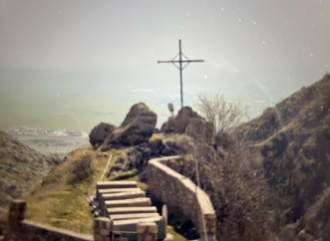
Steps to Rabban Hormidz Monastery, Iraq
Jeremy Fowler lived for eleven years in Iraqi Kurdistan and is now based in Oxford, working on a biography of Roger Cumberland, an American Presbyterian missionary in the region who was killed in Duhok in 1938. The Kurdish people live in the largely autonomous Kurdistan Region of Northern Iraq and within the borders of Turkey, Iran and Syria.
The region of 'Greater Kurdistan' is actually the setting for some of the Bible's great unfolding dramas.
Noah's Ark rested on the mountains of 'Kardu' (Gen 8:4, Syriac Peshitta), Abraham dwelt in Haran (birthplace of Kurdish cultural icons Shivan Perwer and Ibrahim Tatlises- both hugely popular singers), and in 2 Kings 17:6, Israelites exiled by Assyrians settled in the cities of the Medes - ancestors who can be traced to modern Kurds. And although Isaiah called them the Israelites 'lost in Assyria', (Isa 27:13) they retained a distinct identity, and God-fearers among them, we read in Acts 2, made the months-long pilgrimage to Jerusalem in AD 33, where these Medes were amazed to hear Galilean fishermen speaking to them in their language: probably a form of proto-Kurdish (Acts 2:9).
Connecting the dots, they took that message back with them, and we see from early church history that exiled Judaism on the borders of Mesopotamia and Media was a fertile seed-bed for Christian churches. Erbil (ancient Arbela) has a rich Christian history; as does Nusaybin (ancient Nisibis) and Şanlıurfa (ancient Edessa). But the promise of the Day of Pentecost gathered dust a little like a cheque that is never actually cashed in.
Christianity was birthed that day with the revolutionary commitment to the 'wonders of God' being declared 'in the native tongues', not just in the hefty languages of Hebrew or Greek; yet the region of Media, later known as Korduene, was never given translated Scripture in their own language. In fact they weren't even granted an alphabet by the rather ascetic monks nearby, unlike their cousin mountaineers the Armenians who were helped to develop a literate Christian civilisation as early as 405 AD.
A great hero of mine and a fellow-Brit, Henry Martyn, finally cashed a few of these linguistic cheques: he is revered by Iranian believers today for translating the New Testament into Persian (completed in 1812). That had been a long eighteen centuries. And had he not died aged 31, I venture the opinion that he would have knuckled down to Kurdish, this cousin language of Persian. (After all, in his spare time in NE India he dabbled in the revising of an Arabic New Testament, as well as completing his groundbreaking Urdu and Persian translations).
In 1923, the pioneering American missionary Roger Cumberland arrived in Duhok. For 15 years he immersed himself among Kurds and Assyrians, building the 'House on the Hill' in 1929, piping water to the town (including the mosque), constructing a tennis court, and sheltering refugees after the 1933 Simele massacre. But his visionary work to plant Kurdish-speaking churches ended in martyrdom: on June 12, 1938, religious fanatics shot him and his servant dead in his family home in Duhok.
Today, Iraqi Kurdistan stands as a relative sanctuary. Amidst the sectarian violence that followed the 2003 American invasion, and ISIS' reign of terror (2014-17) which drove tens of thousands from the Nineveh Plains, Erbil's Ainkawa district and Dohuk then became places of refuge under the wings of the more protective KRG. Yet Iraq's Christian population has plummeted from 1.5 million to around 150,000-250,000 nationwide, mostly in the Kurdistan Region. Economic hardship, sporadic violence, land disputes, and regional conflicts fuel ongoing emigration. A small but growing number of ethnic Kurdish evangelical converts adds new threads to this ancient tapestry.
In 2017, the whole Bible was published in central Kurdish (Sorani), followed shortly after by a New Testament in Behdini. And in 2026 the Northern Kurdish (Kurmanji) Bible is also set to roll off the printing presses to an increasingly wide readership across Turkey, Syria, Iran, Iraq and Armenia, countries where many are now weary of the dysfunction of Islam's authoritarian vision of society. Cumberland's restored house, now set to become a museum of coexistence, symbolises the hope that persists.
 Facebook
 Twitter
 LinkedIn
 Print
Print Email
Email





 Facebook
 Twitter
 YouTube
 LinkedIn
 Pinterest