


Holy Thursday Reflection with Canon Robin Gibbons
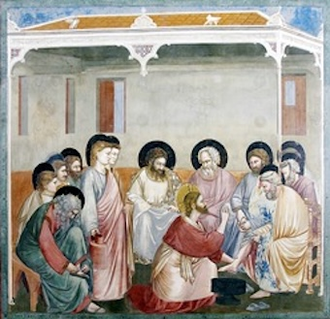
Giotto, Scrovegni Chapel, Padua
Source: Washing of the Feet. The Roman Missal © 2010 International Commission on English in the Liturgy Corporation
April 2nd 2026
Ubi Caritas
On Holy Thursday most of us focus on the institution of the Eucharist at the Last Supper and the watching with that sacramental presence of the Lord, as our altars are stripped bare in preparation for the solemn day of Good Friday.
But the English title for this day, Maundy Thursday from the Latin word mandatum, hints at a profound otherness in what takes place and points to a crucial part of the gospel of John which we proclaim at the evening Mass. Here the focus is on an essential part of the Eucharist of the Lord, a solemn command to love one another, found in the expressing of washing feet.
We need to wrestle with this task of service and love, which is the practical , yet confusing and important symbol of the manifestation in each of our lives of what we receive from the Lord in communion. That is receiving him not only in the Eucharist but also in others in order to create a new life of communion with Him and others.
Here in all their richness and power, are the commanding words of Jesus for us:
"So when he had washed their feet [and] put his garments back on and reclined at table again, he said to them, "Do you realize what I have done for you? You call me 'teacher' and 'master,' and rightly so, for indeed I am. If I, therefore, the master and teacher, have washed your feet, you ought to wash one another's feet. I have given you a model to follow, so that as I have done for you, you should also do."(Jn 13:12-15)
This is the dominical command to wash each others feet, friend and stranger, foe and neighbour, it is inseparable from the command to love . The washing of feet is a profoundly practical command, one that was retained in monastic communities, but which in the renewed liturgy has been brought back into prominence at the evening mass on Maundy Thursday. It is the turning upside down by Jesus of all that we raise up, a reminder that despite its earthly trappings the Church is about loving service not power, about welcoming not turning away, about forgiving not cursing.
Washing by water cleanses us physically and in our liturgy symbolically, it comforts us because another does to us the actions of great gentleness, humility, and a correct intimacy-that is simply loving welcome, belonging, and the experience of this holy washing creates a new relationship, a new life with Christ in a community in which we are all equal under God.
I shall leave this thought there for each of you to embrace!
But whilst this is being done an ancient chant of the Ubi Caritas is sung.
The text is eloquent in its simplicity and haunting in its melody dating back to the 7th century. Many good modern musical translations have been written , for instance the Monks of Ampleforth have a beautiful English setting which they recorded on their CD 'Vision of Peace'. Philip Stopford's Ubi Caritas is well known in Anglican Choral settings.Dom Gregory Murray's God is love fits into a good hymn alternative as does the Taize Communities well known setting.
Ubi Caritas
(Ant.) Ubi cáritas et amor, Deus ibi est.
Congregávit nos in unum Christi amor.
Exsultémus et in ipso iucundémur.
Timeámus et amémus Deum vivum.
Et ex corde diligámus nos sincéro.
Ubi cáritas et amor, Deus ibi est.
Simul ergo cum in unum congregámur:
Ne nos mente dividámur, caveámus.
Cessent iúrgia malígna, cessent lites.
Et in médio nostri sit Christus Deus.
Ubi cáritas et amor, Deus ibi est.
Simul quoque cum beátis videámus
Gloriánter vultum tuum, Christe Deus:
Gáudium, quod est imménsum atque probum.
Sæcula per infiníta sæculórum. Amen.
English Translation
Refrain: Where true charity is dwelling, God is present there.
By the love of Christ we have been brought together:
let us find in him our gladness and our pleasure;
may we love him and revere him,
God the living, and in love respect each other with sincere hearts. Refrain
So when we as one are gathered all together,
let us strive to keep our minds free of division;
may there be an end to malice, strife and quarrels,
and let Christ our God be dwelling here among us. Refrain
May your face thus be our vision, bright in glory,
Christ our God, with all the blessed Saints in heaven:
such delight is pure and faultless, joy unbounded,
which endures through countless ages world without end.
 Facebook
 Twitter
 LinkedIn
 Print
Print Email
Email
















 Facebook
 Twitter
 YouTube
 LinkedIn
 Pinterest