

Text: Professor Todd Walatka at Romero ecumenical service
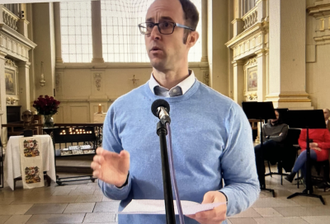
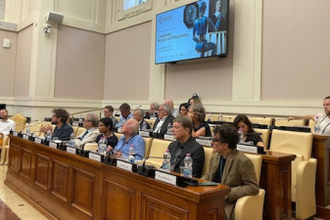
Professor Todd Walatka - Screenshot
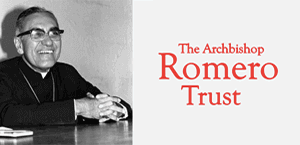
Professor Todd Walatka, Assistant Chair for Graduate Studies at the University of Notre Dame in Indiana, USA gave the following reflection at the St Oscar Romero ecumenical service held in St Martin in the Fields, Trafalgar Square today. The theme was: Inspiration and Hope in Hard Times.
Romans 12 is one of those passages from St Paul that is both beautiful and, if we are honest, rather overwhelming.
"Love must be sincere."
"Hate what is evil, hold fast to what is good."
"Be patient in suffering."
"Persevere in prayer."
"Share with the Lord's people who are in need."
"Practice hospitality."
"Live in harmony with one another."
"Do not repay anyone evil for evil."
"Overcome evil with good."
It is magnificent. And also exhausting.
It can feel less like scripture and more like the writing of a shopping list: do not forget the milk; do not forget the bread; do not forget the cereal. Only this list is rather more demanding.
Be loving.
Be zealous.
Be joyful.
Be patient.
Be generous.
Be peaceful.
Be humble.
Be forgiving.
And by the time we are only halfway through, many of us may feel not
inspired but defeated.And yet this morning, as we remember Oscar Romero, I do not think we
are meant to hear this passage as a crushing list of moral tasks. I think Paul
is doing something else.
He is describing a way of life.
And to understand this way of life, it matters that Paul begins, not with demand, but with grace:
"I urge you, sisters and brothers, in view of God's mercy...
" So what follows is not a test we must pass in order to earn God's love. It is a picture of the life that becomes possible because God has already been merciful to us. We are called not to reach some outlandish moral standard, but rather to a way of life that begins by accepting that we are loved. Once we accept this truth - that we are totally and completely loved - then we can live this life God is calling us to.
With this mercy in mind, Paul then gives us a second aspect of this way of life:
"Do not conform to the pattern of this world, but be transformed by the renewing of your mind."
And when Paul speaks about "this world" here, he is not speaking about God's beautiful creation. Instead, he is speaking about the world we know too well: the world we see on the news, a world of injustice and indifference. I must be honest: when I look at the world, it is incredibly difficult to not be paralyzed by despair.
In my own country, I see migrants and refugees-vulnerable peoples who bring great hope-living in fear.
I see human life treated with contempt, with war treated as a spectacle rather than something to lament.In my home city, I see the enduring struggle to get basic support for those struggling with mental illness and homelessness, a challenge that is both very local and seemingly universal.
In short, I see a world organized by fear, contempt, and a disregard for human life; a world in which the vulnerable bear the cost of the powerful; a world in which strangers and foreigners are treated as threats rather than neighbours.
And that world is not only "out there." It has a way of taking root in us. It tells us who matters and who does not. It teaches us to fear strangers, admire power, protect our own, and settle for less than love.
Paul says: do not be conformed to that. Instead, be transformed.
That, I think, is where Oscar Romero can help us. To start, Romero would be horrified if we simply fell into despair. Instead, he would encourage the same spirit that infused the words we just sang: we are chosen to "bring to birth a new kingdom on earth…to tell the world that God's Kingdom is near."
We are to be transformed in order to live into this Kingdom. What is particularly helpful with Romero is that he did not speak of this Kingdom in vague or pious terms. He spoke about it concretely. As we heard in the reading from Romero, he gave a very clear definition of the Kingdom: it is wherever we come to experience ourselves as brothers and sisters.
That is such a simple line. It is also extraordinarily demanding, but Romero was quite insistent on this point. This is the heart of what we must be about: living towards a world in which we truly come to experience ourselves as brothers and sisters. Any of us who have siblings, of course, know that even relationships of deep love and respect can be filled withtension, disagreement, and frustration. But we know that even in moments when we don't particularly like our sibling, true love can remain.
Romero's basic vision here-that we would come to truly experience ourselves as brothers and sisters is illuminating for understanding St. Paul. I promise I will not go through every line in Romans 12, but a number are still helpful and instructive.
"Love must be sincere."
Of course - because in the Kingdom there is no room for the false courtesies or hypocrisy by which we keep one another at a distance.
"Share with the Lord's people who are in need. Practice hospitality."
Yes - because if the Kingdom is where we come to experience one another as brothers and sisters, then the needy are not interruptions. The stranger is not an intruder. Their need makes a claim on us because they belong with us.
"Live in harmony with one another; do not be proud"
Again, of course - when we look from the perspective of the kingdom, we know-we should feel-that no one is more a child of God than any one else. Pride and contempt only tear us apart.
And then, Paul's concluding point: "Do not repay anyone evil for evil... overcome evil with good.
" Overcome evil with good.
Why? Because vengeance cannot create communion. Retaliation cannot heal the human family. Romero was insistent on this point. Near the end of 1977, clearly exasperated, he says that he has rejected hatred and violence "a thousand times" (11/20/1977). He would reject them another thousand times over the next two years. And, he treasured when people clearly saw this. In another homily, he says that he received a beautiful letter from anordinary person in the archdiocese. The person wrote: "what I most admirein our Church these days is that, despite having suffered such attacks, even killings, never has anyone heard a word of hatred or vengeance; instead, always a word of love and a call to conversion" (8/14/1977).
Romero was clear that hatred and violence never stay where we think we have placed them; they spread outward, and they corrode inward. If we are to experience ourselves as brothers and sisters, we must overcome evil with good.
Romero's words are all the more powerful given the time he lived in. He spoke of brotherhood and sisterhood in the midst of a society being torn apart by terror, repression, lies, and murder. He proclaimed human dignity when doing so threatened his own life. And he did so with hope.
Christian hope is the conviction that in Jesus Christ, God has already declared what is true: that we belong to one another; that no one is a stranger to God; Christian hope is not optimism about the state of the world. Romero had no such illusions. Christian hope is the confidence that violence, contempt, and division are not the deepest truth about us, because in Christ God is making us one family.
And so perhaps the question for us this morning is not simply: how can I manage Paul's long list of commands? But rather: what does it mean, here and now, to live as though Romero was right? What does it mean to live as though the Kingdom really is where we come to experience ourselves as brothers and sisters, as truly part of one family?
Romero himself, of course, offers a wonderful example here-and there are many ways to tell the story of Romero. Romero was famous for how he was seemingly always with his people. One of my favorite lines in Romero's preaching is a very simple one. Reflecting on his close relationship with somany communities in his diocese, he simply says, "I am so happy not to be alone" (7/2/1978). Romero's own faith and hope was strengthened by his people, by the ordinary people who refused to give up. Romero knew that God was making a people, and he was grateful to belong to them.
Romero was equally famous for his love for and with the poor. This was not abstract. He did not "care about the poor" as an idea. He walked alongside those who suffered, listened to them, and allowed their reality to shape the way he saw the world. This reminds me of a question that the great liberation theologian Gustavo Gutiérrez was fond of asking, "If you say you love the poor, what are their names?" Romero knew their names. You can hear them every week in his preaching and written in his diary.
Romero knew that the Kingdom comes to life when we have real fellowship with real people, particularly with those who are frightened, displaced, grieving, forgotten, and burdened.
And Romero sought that same communion even where there was conflict.
He did not confuse unity with pretending that everything was fine. He told the truth plainly, and he stood where he needed to stand. But he was always trying to win people back to communion rather than simply defeat them.
That was true in personal slights, when he would reach out for forgiveness;
it was true in his strained relationships with fellow bishops when he did what he could to bring unity; and it was true even in the face of terrible violence. Here, the most striking moment remains his direct address to the killers of his friend, Fr. Rutilio Grande. In his homily at the funeral for his friend, Romero says:
""Who knows if those who are responsible for this criminal act…. are hearing these words on a radio there in their hideout and in their conscience? We want to tell them, 'Brother criminals, we love you, and we ask God to pour forth repentance into your hearts because the church is incapable of hatred; the church has no enemies'" (March 14, 1977). This is not cheap grace or a willingness to ignore injustice. Itincludes a sharp call for repentance and conversion.
However, it is equally clear that Romero put no limits to the brothers and sisters welcomed into God's Kingdom.
Of course, the worst thing we could do would be to admire Romero from a distance, as though he belonged to a nobler species of Christian than we could ever hope to be. We honor him best by receiving again the vision that governed his life: be satisfied with nothing less than the Kingdom of God, nothing less than the world remade in mercy and justice, nothing less than human beings discovering in Christ that they are brothers and sisters.
So our hope in hard times is not that the world is less broken than it is. It is that the broken world is not the final world. In Christ, God is already drawing near the kingdom that Romero named: the kingdom in which we learn to know one another as brothers and sisters. And whenever strangers are welcomed, whenever those who suffer are not abandoned, whenever truth is spoken without hatred, whenever evil is overcome with good, that kingdom becomes visible among us. That is the hope and the calling that Romero leaves with us.
LINKS
Watch a video of this service on St Martin in the Fields Facebook page: www.facebook.com/stmartininthefields/videos/1604026374168336/
Read more about the service: www.indcatholicnews.com/news/54568
 Facebook
 Twitter
 LinkedIn
 Print
Print Email
Email









 Facebook
 Twitter
 YouTube
 LinkedIn
 Pinterest