

Happy Birthday Vatican Radio!
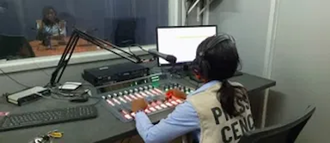
Radio studio of the Episcopal Conference of DR Congo, supported by ACN - Image © ACN
Source: Vatican Media
Today marks the 95th anniversary of Vatican Radio, a pioneering voice in global broadcasting and one of the Church's most historic media institutions.
Established on 12 February 1931 by Guglielmo Marconi, inventor of wireless telegraphy, at the request of Pope Pius XI, Vatican Radio began its mission with the first papal radio message. This event began a new era in the Church's use of modern communication to proclaim the Gospel.
Six years later, in 1937, the English Language Programme was launched, expanding the reach of the Pope's voice to English-speaking audiences. English-language broadcasts to Africa began in 1950, marking an important step in reaching listeners across the continent.
The timing of broadcasts to Africa was essential. The 1950s and early 1960s were a period of resurgence in Africa. This era was marked by the dismantling of colonial systems, the rise of new independent African nation-states, and a renewed appreciation of African cultural identity, including philosophies and aspirations such as Pan-Africanism.
The Catholic Church in Africa was equally experiencing significant growth and began to transition from a missionary-led Church to one driven by local, indigenous Bishops and communities.
Nevertheless, it was not until 1979 that the English Africa Service, as it is known today, was formally established. It emerged from the broader English-language section in response to changing social, political, and ecclesial realities across Africa.
In 1993, the Service introduced daily broadcasts of the Gospel readings in Ki-Swahili - a widely spoken Bantu language and a lingua franca of East Africa. A year later, with approval from the Directors of Vatican Radio, Ki-Swahili also became an established language programme under the English Africa Service.
Another significant milestone came in 2002 with the launch of daily broadcasts in Hausa, a Chadic language spoken by between 100 and 150 million people in West Africa. Although the initiative was short-lived, it reflected the radio's commitment to reaching wider audiences on the continent.
The current English-language half-hour daily broadcast format was adopted in 1995, one year after the First Special Assembly for Africa of the Synod of Bishops (First African Synod). Its structure reflects themes proposed in Pope Saint John Paul II's 1995 post-synodal apostolic exhortation, Ecclesia in Africa - "The Church in Africa."
Additional elements were later incorporated following the publication of Africae Munus - "The Commitment of Africa" - issued by Pope Benedict XVI in 2011, two years after the Second African Synod held in Rome in 2009.
Through these developments under the current Dicastery for Communication, the English Africa Service has continued to adapt, bringing the Pope's voice to the 23 African countries where English is the official language.
For decades, Vatican Radio was broadcast on shortwave radio (SW) transmitters in Rome to reach the continent. Today, the primary delivery method is through cooperation with partner Catholic diocesan radio stations in Africa, as well as the Radio Maria Africa network.
All in all, the English Africa Service of Vatican Radio has remained attentive to the pastoral joys and challenges of the local Churches, as well as the evolving realities of the African continent.
Radio stations in Africa are a lifeline for communities, especially rural communities. Despite the rapid technological advancements and the growth of mobile phones, the internet and social media, radio stations are found everywhere in Africa. The Catholic Church, in particular, has invested heavily in diocesan radio stations.
Radio remains a trusted and accessible source of information in rural Africa. Its continued importance stems from its ability to overcome challenges such as low literacy levels, limited access to electricity, and poor internet connectivity.
In his reflection on the anniversary, the Director of L'Osservatore Romano, Andrea Monda, writes: 'Among all Catholic media, radio stands out as the one most closely aligned with the Church's mission. It is, without a doubt, the most divine. Here is why.
God communicates, indeed, communicates Himself, through Scripture. The written word is essential, but writing comes after speaking. In the beginning, there is the Word. The Word is spoken before it is written. It is only later that it is transcribed.
'The Bible and the Gospels, the extraordinary texts in which the Christian faith is grounded, tell stories that first unfolded in real life and were first told aloud. One person speaks, another listens. It is no coincidence that Saint Paul says, "fides ex auditu," faith comes from hearing. Even earlier, the Old Testament emphasizes listening: "Hear, O Israel!"
'In short, God favours radio. He prefers hearing. This makes sense. Sight is powerful, the most effective of the five senses, and one might think it is better.
'Yet Saint John reminds us, "No one has ever seen God." Sight is so strong that it can overwhelm all the other senses. That is why God chooses hearing, perhaps the weakest of the senses. The God of the Bible is gentle. He does not use all His power but moderates it.
'What is at stake is human freedom, the gift God gives to every person and respects fully. If God appeared in all His power, what would happen to faith understood as freely accepting Him? Faith is a response to an invitation. God does not impose Himself. He presents Himself quietly, through our ears.
'Our ears are always open. It is impossible to close them, so we are naturally listeners. But what do we hear? Many things, perhaps too many. Everything comes in and touches our sensitive eardrums.
'What is required is choice, the ability to use our freedom to listen carefully. This is like tuning a radio, finding the right frequency, and catching God's message among the many voices of the world. It means becoming quiet, turning down the noise of the city, and even the noise of our own hearts.
'If God used television, it would be easy. When the TV is on, everyone watches, and life stops. Radio is different. A radio can play while life goes on. Music or news flows quietly in the background until something, an important note or a piece of news, catches our attention. Then we pause everything else and listen. That is how God can reach us.
'This is a discreet God who stands at the door and knocks, asking for our attention, a gift we are free to give or refuse. It is a subtle game, one that can shape our lives, a game for attentive ears. In short, even the ear has its role. And it may be the best one.'
 Facebook
 Twitter
 LinkedIn
 Print
Print Email
Email










 Facebook
 Twitter
 YouTube
 LinkedIn
 Pinterest